A commercial range cookline can cost from $1,200 for a basic two-burner unit to over $20,000 for a full six-burner configuration with convection oven and salamander. This guide breaks down the pricing factors and configuration options so you can spec a cookline that matches your volume, menu, and budget.
What makes up a cookline price
The cookline is the hottest, most expensive part of the kitchen to specify. A basic two-burner gas range starts around $1,200, but a six-burner range with convection oven, griddle, and salamander broiler can exceed $20,000 installed. The price drivers are burner count, BTU per burner, oven type, grate material, and stainless steel gauge. Buyers who treat the cookline as a commodity often overspec on burner count and underspec on durability: cast-iron grates and forged brass valves cost more upfront but survive heavy wok tossing and accidental impacts better than pressed-steel alternatives.
Burner configurations
Standard ranges use 18-inch or 24-inch widths with two, four, or six burners. A 24-inch four-burner range with one 12-inch griddle suits a 60- to 80-cover restaurant. A 48-inch six-burner range with two ovens suits a 150- to 200-cover operation. BTU per burner typically ranges from 18,000 to 40,000; Chinese and Southeast Asian menus with wok cooking need the upper end, while Western menus with simmer sauces can use standard-duty burners.
Salamander and overhead heat
A salamander broiler sits above the range and delivers finishing heat, cheese melt, or char. Units range from 2-burner infrared versions to 6-burner open-flame models. Price depends on heat output, infrared versus open flame, and whether the unit includes a dedicated flue. Salamanders are expensive for the footprint they occupy, but they eliminate the need for a separate finishing station and reduce plate travel.

Price ranges by configuration
Budget ranges use pressed-steel construction and standard burners; they suit low-volume institutions and temporary kitchens. Mid-tier ranges offer cast-iron grates, removable drip trays, and better oven insulation. Premium ranges add modular side shelves, back-shelf guards, and stainless steel construction throughout. The installed price should include the range, ventilation modifications, gas-pipe sizing, fire suppression, and commissioning. Retrofit projects often discover that existing hood capacity or gas-line size is inadequate, which adds $3,000 to $8,000 in mechanical work.
| Restaurant size | Typical range config | Equipment cost | Installed cost range |
|---|---|---|---|
| 40–60 covers | 2-burner + oven | $1,200 – $2,500 | $3,500 – $6,000 |
| 80–120 covers | 4-burner + griddle + oven | $2,800 – $5,000 | $7,000 – $12,000 |
| 150–200 covers | 6-burner + double oven + salamander | $6,500 – $12,000 | $14,000 – $22,000 |
| 250+ covers | Double range + island suite | $12,000 – $22,000 | $25,000 – $40,000 |
Key takeaway: Buy cookline capacity for your peak service, not your average load. Undersized ranges force chefs to batch orders, which slows ticket times and increases labor cost per cover.
Ventilation, gas, and safety compliance
Every range needs a properly sized Type 1 hood with fire suppression. The hood airflow should capture both convection heat and grease-laden vapors. Gas ranges add the requirement of an interlocked solenoid shutoff and a properly sized gas pipe. Many operators forget to include hood cleaning contracts in the first-year budget; grease buildup reduces capture efficiency and increases fire risk within six months of installation.
Griddles, charbroilers, and specialty tops
Griddles provide flat, consistent heat for burgers, eggs, and sandwiches. Charbroilers add radiant char for steak and vegetable plates. Both are modular options that bolt to the range front or sit on a separate stand. When mixing burner types, confirm that the ventilation designer has accounted for the combined thermal load. Specialty tops—induction, tilting skillet, or rice cookers—change both price and utility requirements; induction needs a heavy-duty electrical circuit, while tilting skillets need reinforced floor mounting.
Choosing the Best Commercial Ranges for Restaurants by Menu Type
The menu, not the headcount, should set the range configuration. A grill-heavy operation — steakhouses, charbroil bars — pairs a charbroiler with two open burners for sauce and sides. A sauté or pan-Asian kitchen needs four to six open burners at 25,000–40,000 BTU each plus a 12–24 inch griddle for noodles and fried rice. A breakfast-led menu is griddle-led: a 36–48 inch griddle with two burners covers eggs, pancakes, and grill items with little else. A pizza or pasta operation should choose a range with an oven base to hold sauces warm and finish bakes, trading burner count for that fixed cavity.
Burner count and BTU per burner are separate decisions: six 18,000 BTU burners suit simmer sauces, while four 35,000 BTU burners suit wok and sauté heat. An oven base adds height and recovery load but removes a separate appliance; skip it where a convection oven already sits nearby. For complex lines, a modular suite — range plus separate griddle and charbroiler on a common gas manifold — beats a single 60-inch range when you need parallel cooking zones and easier service access.
| Menu profile | Recommended configuration | Burner count / BTU | Notes |
|---|---|---|---|
| Grill-heavy | Charbroiler + 2 open burners | 2 × 25–30k BTU | Prioritise broiler output |
| Sauté / pan-Asian | 4–6 burners + griddle | 4–6 × 25–40k BTU | High BTU for wok heat |
| Breakfast-led | Griddle-led + 2 burners | 2 × 18–25k BTU | Large griddle surface |
| Pizza / pasta | Range with oven base | 4–6 × 20–30k BTU | Oven base for sauce finish |
Warranty, spare parts, and total cost
Range warranties usually cover burners, valves, and oven chambers for one to two years. Wear items such as grates, drip trays, and knobs are excluded. Spare-parts availability varies by brand: global brands stock parts in regional warehouses, while boutique manufacturers may ship from overseas with two to four week lead times. Over a ten-year life, a range with good parts support costs less to own than a cheaper model with long lead times for gaskets and burners. Include spare-parts pricing and delivery estimates in your vendor comparison, not just the initial quote.
Cooking Equipment
Ranges, burners, griddles and cookline accessories for commercial kitchens.
View cooking equipment →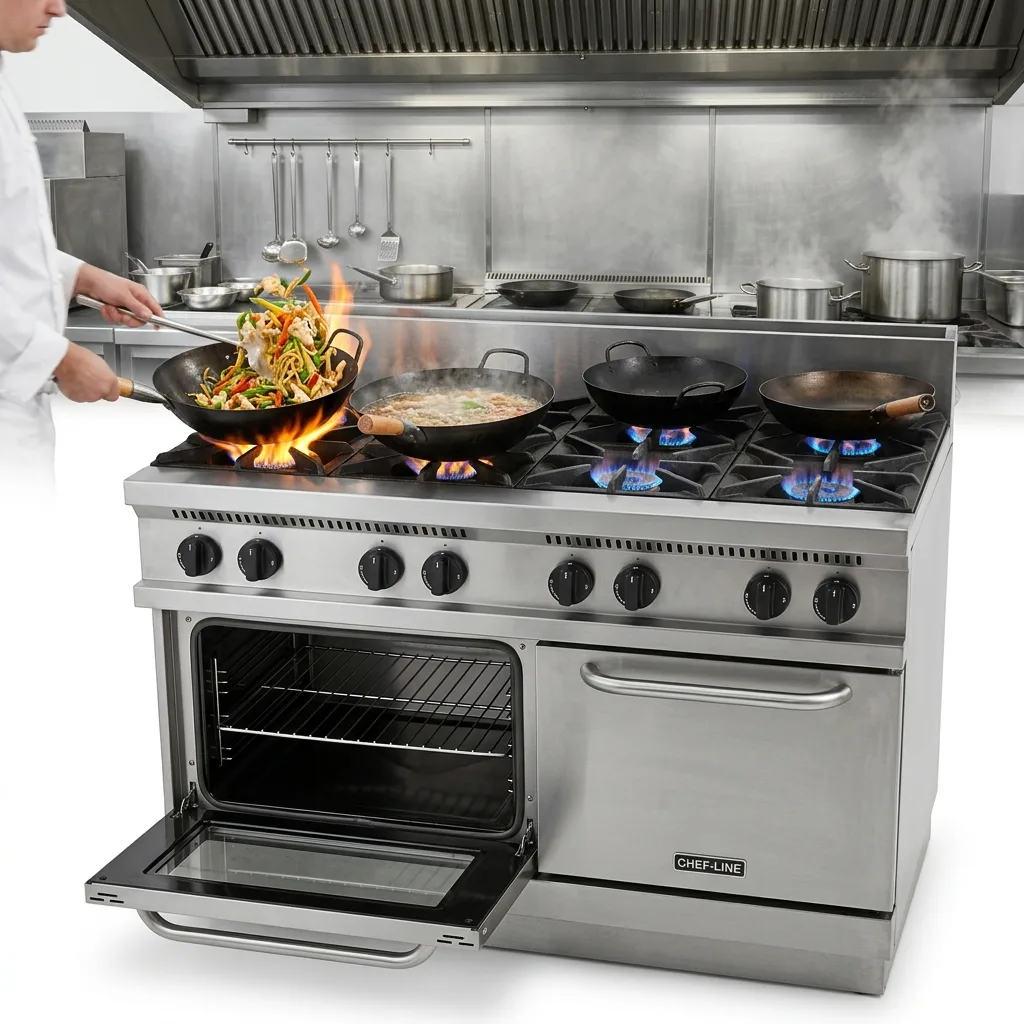
Browse the full cooking equipment range. For kitchen layout planning, see our central kitchen planning guide.
For projects with specific raw material requirements, target capacity needs, or custom factory drawing specifications, contact our team to discuss your working hours and operational requirements. We support full project planning from specification to installation.