Direct Answer / Key Takeaway: Compare air-bubble, hydraulic vortex, and brush-roller commercial vegetable washing machines. Review aqueous ozone log-reduction, water recirculation, and TCO.
When designing wet-preparation zones within our Commercial Kitchen Equipment Selection Hub, central commissary engineers and HACCP quality managers face two competing imperatives: stripping field silt, insect eggs, and agrochemical residues from raw produce while preventing mechanical leaf tearing and cross-batch pathogen transfer. Dumping cut romaine lettuce into an impeller-driven or brush-roller tank ruptures epidermal cell walls and triggers rapid brown-edge decay within 24 hours, whereas gentle air-bubble agitation alone cannot strip compacted clay from unpeeled potatoes or ginger rhizomes. This engineering guide benchmarks hydraulic vortex washers, air-bubble mesh-elevator lines, and 9-roller brush machines across our Commercial Vegetable Washers portfolio—detailing fluid dynamics, aqueous ozone ORP control, multi-stage filtration, and 5-year TCO.
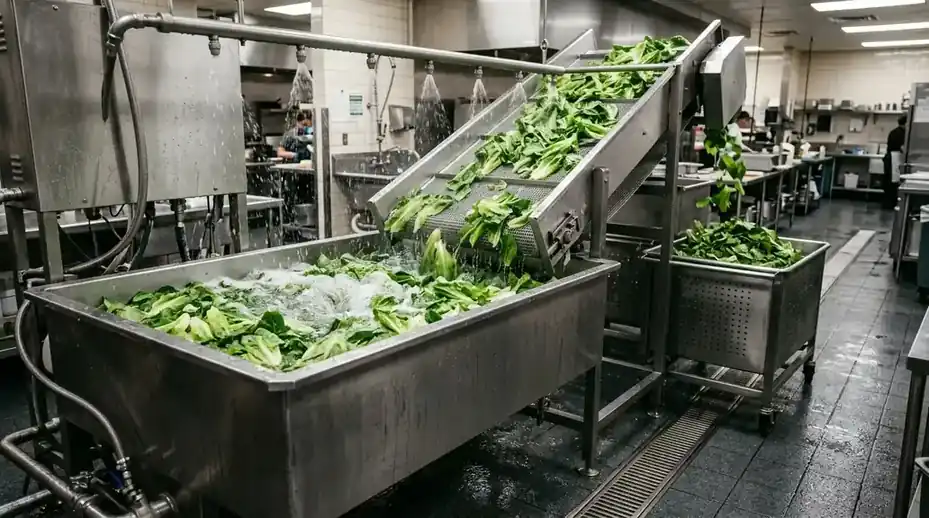
Key takeaway: Selecting between an air-bubble, hydraulic vortex, and rotary brush commercial vegetable washing machine depends on plant cellular fragility and soil adhesion: hydraulic vortex washers clean cut leafy greens at 150–300 kg/hr without mechanical bruising, surging air-bubble conveyors wash 1,000–3,500 kg/hr of mixed produce, and integrating 1.5–3.0 ppm dissolved aqueous ozone achieves a 2.5 to 3.5-log microbial reduction while cutting recirculated water usage by 60%.
Fluid Dynamics & Mechanical Cleaning Kinematics: Vortex vs. Air Bubble vs. Brush Roller
Different botanical structures—fragile cut salad leaves, buoyant hollow peppers, dense broccoli florets, and mud-caked root tubers—require distinct hydrodynamic shear forces and specific-gravity separation paths.
Hydraulic Vortex (360-Degree Helical Swirl) Architecture
A hydraulic vortex vegetable washer (such as the YL-VW-300) eliminates submerged mechanical paddles, chains, and conveyor belts inside the primary washing bowl. Instead, high-volume stainless steel centrifugal pumps inject pressurized water tangentially through directional side nozzles, creating a controlled 360-degree helical cyclonic flow across a 220-liter cylindrical or U-channel trough.
- Zero-Bruise Boundary Layer Shear: Cut leafy greens (spinach, baby kale, shredded iceberg lettuce, cilantro, and delicate herbs) remain fully suspended in the laminar-to-turbulent water column without rubbing against hard metal conveyor links.
- Centrifugal Density Stratification: As the produce swirls forward, heavy quartz sand and grit particles drop through a bottom perforated false floor into a quiescent sediment cone, while buoyant aphids, leaf fragments, and hollow stems float over an adjustable top skimming weir into a fine-mesh rotary drum strainer.
Surging Air-Bubble & Inclined Mesh Elevator Architecture
An air-bubble commercial vegetable washing machine (such as the YL-VW-1500 and dual-stage YL-VW-3000) utilizes a high-pressure regenerative ring blower (1.5 kW to 3.0 kW) piped to a perforated stainless steel aeration grid along the bottom of a 650L to 1,200L immersion tank.
- Acoustic & Cavitation Micro-Scrubbing: Thousands of rising air bubbles (3mm–8mm diameter) create intense vertical turbulence and localized surface shockwaves as they expand and burst against submerged produce. This tumbling agitation unfolds overlapping cabbage leaves, broccoli florets, strawberries, tomatoes, and diced root vegetables.
- Two-Stage Potable Rinse Separation: As an inclined AISI 304 stainless steel wire-mesh belt (or food-grade modular polypropylene belt) lifts the washed produce out of the main immersion tank at a 35-degree angle, an overhead fresh-water spray manifold operating at 0.25–0.35 MPa flushes away residual tank water before discharging the clean product into downstream food preparation equipment.
Horizontal 9-Roller Brush & High-Pressure Spray Architecture
For root tubers coated in sticky clay, soil nodules, or loose outer periderm (potatoes, carrots, lotus root, taro, sweet potatoes, and ginger), hydrodynamic water currents alone lack sufficient mechanical friction. The YL-VW-800B employs nine counter-rotating food-grade Nylon 612 brush rollers under a high-pressure spray header while an internal stainless auger advances the roots continuously at 500–1,000 kg/hr.
Engineering Specification Matrix: 150 kg/hr Batch Vortex to 3,500 kg/hr Dual-Stage Lines
To size wet-prep utilities accurately, the engineering matrix below compares our four flagship commercial vegetable washing configurations across hourly throughput, tank volume, pump/blower power, filtration architecture, and target produce categories.
| Engineering Parameter | Hydraulic Vortex Washer (YL-VW-300) | 9-Roller Brush Root Washer (YL-VW-800B) | Air-Bubble Elevator Washer (YL-VW-1500) | Dual-Stage Industrial Line (YL-VW-3000) |
|---|---|---|---|---|
| Primary Washing Mechanism | 360° Helical Vortex Flow + Tilting Basket | 9 Counter-Rotating Nylon Brushes + Auger | High-Pressure Air Bubble + Mesh Elevator | Stage 1 Bubble Soak + Stage 2 Vortex Wave |
| Target Botanical Scope | Cut leafy greens, baby spinach, herbs, berries | Potatoes, carrots, ginger, beets, sweet potatoes | Whole leafy heads, broccoli, tomatoes, peppers | High-volume fresh-cut salads & commissary mixes |
| Net Hourly Throughput | 150 – 300 kg/hr (330 – 660 lbs/hr) | 500 – 1,000 kg/hr (1,100 – 2,200 lbs/hr) | 1,000 – 1,800 kg/hr (2,200 – 3,960 lbs/hr) | 2,000 – 3,500 kg/hr (4,400 – 7,700 lbs/hr) |
| Water Tank Holding Volume | 220 L Single Recirculating Tank | Flow-Through Spray Manifold + Bottom Sump | 650 L Main Tank + 120 L Filter Side-Tank | 1,200 L Dual-Cascade Recirculating System |
| Total Connected Power | 1.5 kW (220V/1Ph or 380V/3Ph) | 2.2 kW (380V–415V/3Ph) | 3.7 kW (2.2 kW Blower + 1.1 kW Pump + 0.4 kW Drive) | 6.5 kW (Dual Blowers + Vortex Pump + VFD Drive) |
| Makeup Fresh Water Rate | 0.18 – 0.25 m3/hr (with recirculation) | 0.35 – 0.50 m3/hr (continuous spray) | 0.30 – 0.45 m3/hr (via top rinse bar) | 0.55 – 0.80 m3/hr (counter-current cascade) |
| Debris & Insect Filtration | Top Skimming Weir + 0.8mm Wedge-Wire Basket | Under-Chute Perforated Soil & Peel Tray | 3-Stage Side Filter Tank + Bottom Mud Drain Valve | Rotary Drum Micro-Screen (0.5mm) + Hydrocyclone |
| Aqueous Ozone Integration | 10 g/hr Corona Discharge + Venturi Injector | Optional Post-Wash Spray Dosing | 20 g/hr Ozone Generator + Venturi Loop | 40 g/hr PLC-Controlled Ozone + ORP Sensor |
Aqueous Ozone Sanitation, FDA 21 CFR 173.368 & Microbial Log-Reduction
Washing produce in plain untreated municipal water removes visible dirt but rapidly turns the recirculating tank into a vector for cross-batch pathogen contamination (Escherichia coli O157:H7, Salmonella enterica, and Listeria monocytogenes). Traditional sodium hypochlorite (chlorine bleach at 50–200 ppm) reacts with dissolved organic plant sap to form carcinogenic trihalomethanes (THMs) and requires massive volumes of potable rinse water to strip chemical off-flavors. Integrating an on-board corona-discharge aqueous ozone (O3) system resolves both chemical residue and microbial control:
- Regulatory Direct Food-Contact Approval (US FDA 21 CFR 173.368 & USDA Organic Compliance): Aqueous ozone is affirmed as Generally Recognized as Safe (GRAS) and approved by the FDA as a secondary direct food additive antimicrobial agent on raw agricultural commodities. Because ozone (O3) has a half-life of 20 to 30 minutes in cold water (
10°C–15°C) and decomposes spontaneously back into pure diatomic oxygen (O2), it leaves zero chemical residue on organic salads. - Oxidation-Reduction Potential (ORP) & Contact Kinetics: Rather than injecting ozone into the open air blower (which allows undissolved gas to escape into the kitchen breathing zone), HSYL washers utilize a pressurized side-stream Venturi cavitation injector that shears ozone gas into 20-micron micro-bubbles dissolved directly into the recirculating pump loop. Maintaining 1.5 to 2.5 ppm dissolved O3 (equivalent to an ORP reading of 650 to 750 mV) for a 90-to-120-second immersion residence time achieves a verified 2.5 to 3.5-log (99.7%–99.9%) reduction in surface vegetative bacteria while oxidizing organophosphate pesticide films.
- Ambient Off-Gas Safety Threshold (OSHA PEL 0.1 ppm TWA): To protect prep-room workers from respiratory irritation in accordance with OSHA 29 CFR 1910.1000 (Permissible Exposure Limit of 0.1 ppm 8-hour Time-Weighted Average), water temperatures must be kept below 18°C (64°F) to maximize ozone solubility, and industrial lines (YL-VW-3000) incorporate a hooded vapour collection port connected to the wet-area exhaust fan.
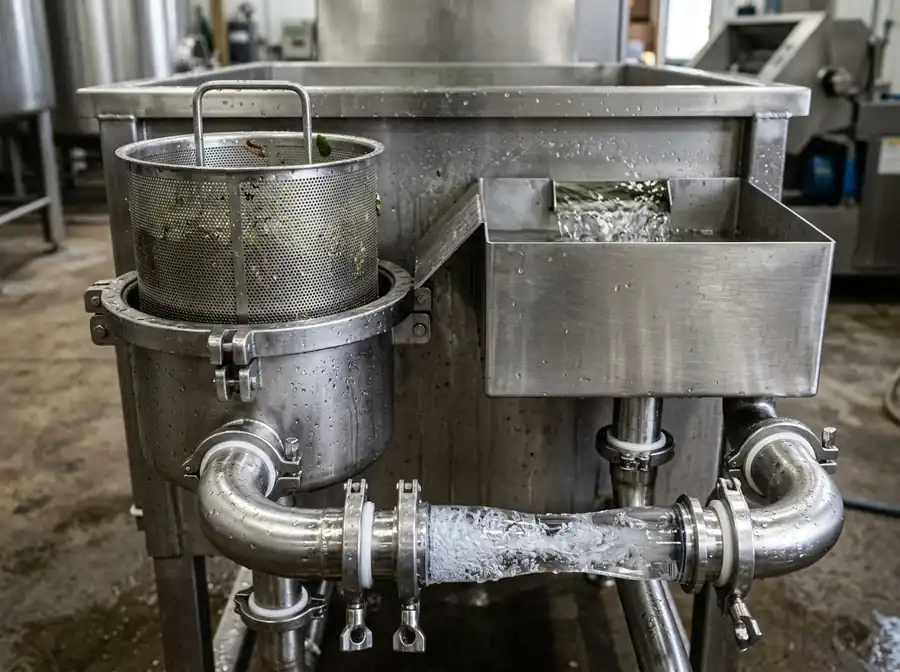
Counter-Current Water Recirculation, Wedge-Wire Filtration & Line Integration
A non-recirculating single-pass washing trough consumes up to 2.5 m3 (660 gallons) of fresh water per metric ton of vegetables. HSYL's recirculating filtration architecture cuts fresh water make-up to 0.25–0.45 m3 per ton (a 60%–75% reduction) through three mechanical design features:
- Counter-Current Cascade Principle: Clean potable make-up water enters exclusively through the overhead spray nozzles mounted near the top of the discharge elevator belt. This clean rinse water drains downward into the main tank, displacing dirty water backward toward the infeed zone where soil loads are highest, ensuring the cleanest water always contacts the cleanest produce last.
- Three-Stage Wedge-Wire Side Filtration: Water overflowing the surface skimming weir passes through a tool-free removable 1.5mm primary leaf screen and a 0.5mm–0.8mm stainless steel wedge-wire micro-strainer basket before entering the vortex pump suction header. This prevents floating insects, weed seeds, and broken leaf fibers from being pumped back into the spray nozzles.
- Sanitary Washdown & ATP Verification (NSF/ANSI Standard 2 & 8): Tanks are TIG-welded from 2.0mm AISI 304 stainless steel with a 5-degree sloped bottom leading to a 2-inch full-port sanitary butterfly drain valve for complete end-of-shift mud flushing. After washdown, quality teams verify biofilm removal on the mesh elevator links and weir corners using the protocols in our Commercial Kitchen Equipment Cleaning Verification & ATP Guide within the Hygiene & HACCP Engineering Hub.
Centrifugal Spin-Drying, Vibratory Dewatering & Cold-Room Ambient Control
Leaving free surface water on washed salad greens or diced roots accelerates microbial spoilage inside Modified Atmosphere Packaging (MAP) bags. When residual surface moisture exceeds 1.5% of net leaf weight, trapped water droplets foster Pseudomonas soft-rot bacteria and fog retail packaging film. To complete the wet-prep cycle, commercial vegetable washers must be paired with proper moisture-removal and thermal controls:
- Vibratory Dewatering Screens vs. Centrifugal Spin Dryers: After produce exits the YL-VW-1500 or YL-VW-3000 overhead rinse bar, a high-frequency eccentric vibratory shaker table removes 65%–75% of loose surface droplets from firm diced roots (carrots, potatoes, onions) before packaging. For cut leafy greens (romaine, iceberg, spinach, cabbage shreds), perforated basket batches are loaded into a variable-speed centrifugal spin dryer operating at 450 to 650 RPM for 90 to 120 seconds, pulling residual surface moisture below 0.8% without crushing leaf veins.
- Prep-Room Ambient & Chilled Water Management (10°C–14°C): Both plant cellular respiration rates and aqueous ozone decay double for every 8°C rise in water temperature. High-care vegetable washing rooms should be air-conditioned to 10°C–14°C (50°F–57°F), and central kitchens operating in tropical climates should feed the final stage of a dual-stage washing line (YL-VW-3000) with chilled potable water at 4°C–7°C via a plate heat exchanger. Cold hydro-cooling simultaneously locks in chlorophyll colour, maximizes dissolved ozone stability, and reduces the thermal load on downstream walk-in chillers.
End-to-End Automated Vegetable Processing Line Sequencing
In high-volume central kitchens (3,000 to 25,000 meals/day), the vegetable washer acts as the hygienic barrier separating "dirty raw receiving" from the "high-care clean prep room." The optimal continuous processing sequence links four stations: (1) upstream root skin stripping in our Commercial Abrasive Potato Peelers, (2) precision slicing, shredding, or dicing on our Commercial Dual-Inverter Vegetable Cutters, (3) turbulent air-bubble or vortex ozone washing in the YL-VW-1500/3000, and (4) centrifugal spin-drying or vibratory dewatering prior to cold-chain storage.
Five-Year Total Cost of Ownership (TCO): Manual Sink Washing vs. Automated Recirculating Lines
Below is a verified 5-year TCO comparison for a central catering commissary or school meal center washing 800 kg of mixed leafy greens and root vegetables per day (280,000 kg/year; 1,400 metric tons over 5 years), comparing manual 3-compartment sink washing (with chlorine tablets) against a single-stage YL-VW-1500 Air Bubble Washer and a hybrid YL-VW-300 Vortex + YL-VW-800B Brush Line (modeled at $16.50/hr labor, $3.20/m3 water/sewer, and $0.14/kWh electricity).
| 5-Year Cost Metric (800 kg Washed Produce/Day) | Manual 3-Sink Wash + Chlorine Dosing (Baseline) | Air-Bubble Elevator Washer (YL-VW-1500 + Ozone) | Dedicated Pair: YL-VW-300 Vortex + YL-VW-800B Brush |
|---|---|---|---|
| Initial Equipment CAPEX | $1,650 (Two 3-compartment stainless sinks + colanders) | $4,280 (Includes 20 g/hr ozone + filter side-tank) | $5,450 ($3,100 YL-VW-300 + $2,350 YL-VW-800B) |
| Daily Washing & Rinsing Labor Hours | 9.5 Man-Hours / Day (3 workers soaking/agitating/draining) | 1.2 Man-Hours / Day (Continuous conveyor feed) | 1.6 Man-Hours / Day (Parallel leafy + root lines) |
| 5-Year Cumulative Labor Cost ($16.50/hr) | $274,312 (16,625 labor hours) | $34,650 (2,100 labor hours) | $46,200 (2,800 labor hours) |
| 5-Year Water & Sewer Consumption ($3.20/m3) | $14,336 (4,480 m3 continuous dump & refill) | $5,040 (1,575 m3 recirculating filter loop) | $6,160 (1,925 m3 combined usage) |
| 5-Year Chemical Sanitizers, Power & Leaf Bruise Waste | $19,800 ($5,800 chlorine/test strips + 4% bruised leaf waste) | $4,950 ($1,450 power + 1.2% leaf loss; $0 chemicals) | $3,120 ($1,620 power + <0.4% vortex leaf loss) |
| 5-Year Total Cost of Ownership (TCO) | $310,098 | $48,920 (Saves $261,178) | $60,930 (Saves $249,168) |
Discuss Your Produce Washing & Ozone Sanitation Line with HSYL Engineers
Share your hourly leafy green and root vegetable throughput, target microbial log-reduction, and available floor footprint. HSYL engineering configures multi-stage vortex, air-bubble, and ozone recirculation lines with wedge-wire filtration.