How to Choose the Best Commercial Dishwasher for Your Operation
Skip brand rankings: six engineering criteria to select the best commercial dishwasher — racks/hour sizing, machine types, utilities, and 82-88C final rinse.
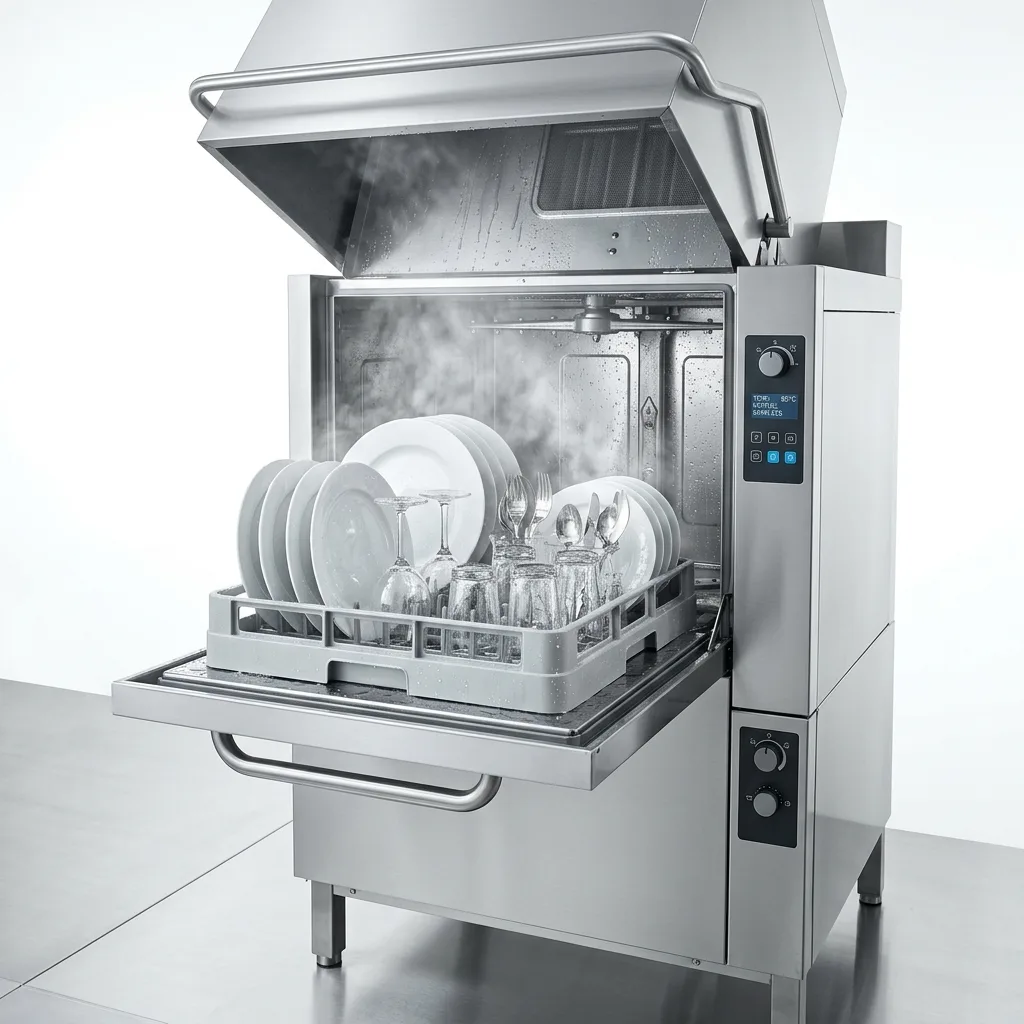
Search results for "best commercial dishwasher" are dominated by brand round-ups that rank machines without knowing a single fact about your kitchen. A unit that is ideal for a 60-seat bistro is a bottleneck in a 400-cover hotel banquet operation, and the most expensive conveyor on the market is wasted money in a café washing 30 racks a day. The useful question is not which brand wins, but which machine specification matches your dish traffic, your utilities, and your local hygiene code.
This guide replaces the brand ranking with a selection framework: six criteria, in the order a kitchen engineer would check them, that narrow the market down to a short list you can then price. Everything below applies whether you are specifying a single undercounter unit for a restaurant or a flight-type line for a canteen.
Key takeaway: The "best" commercial dishwasher is the smallest machine that clears your peak-hour rack volume with a compliant final rinse (82–88°C for high-temperature machines) on the utilities you actually have. Size by racks per hour first; compare brands last.
Criterion 1: Size by Racks per Hour, Not by Seats
Manufacturers rate capacity in racks per hour, and a standard 500 × 500 mm rack holds roughly 18 dinner plates, 25 glasses, or a mixed load of cutlery and side dishes. To size a machine, work from your busiest 60–90 minutes, not the daily average:
- Count covers at peak. A 100-seat restaurant turning tables 1.5 times at dinner serves about 150 covers in the rush.
- Convert covers to racks. Allow 1 rack per 2–3 covers for plate-and-glass service; banquets and canteens with compartment trays run closer to 1 rack per 3–4 covers.
- Add a 25–30% buffer. Machines rarely sustain their nameplate rate once loading, racking, and unloading pauses are included. If your peak demand calculates to 45 racks/hour, specify a machine rated around 60.
Worked example: 150 peak covers ÷ 2.5 covers per rack ≈ 60 racks at peak, plus buffer ≈ 75–80 racks/hour. That already rules out every undercounter machine on the market and points to a hood-type unit — before any brand is discussed. For deeper capacity math across the whole kitchen, see our capacity sizing resources.
The Three Machine Types at a Glance
Commercial dishwashers fall into three mechanical families. Each has a capacity ceiling, a footprint, and a labor pattern that suits a specific kind of operation.
Undercounter
Front-loading, 20–40 racks/hour, fits under a standard worktop. The default choice for cafés, bars, and restaurants up to roughly 60 seats.
View dishwashing equipment →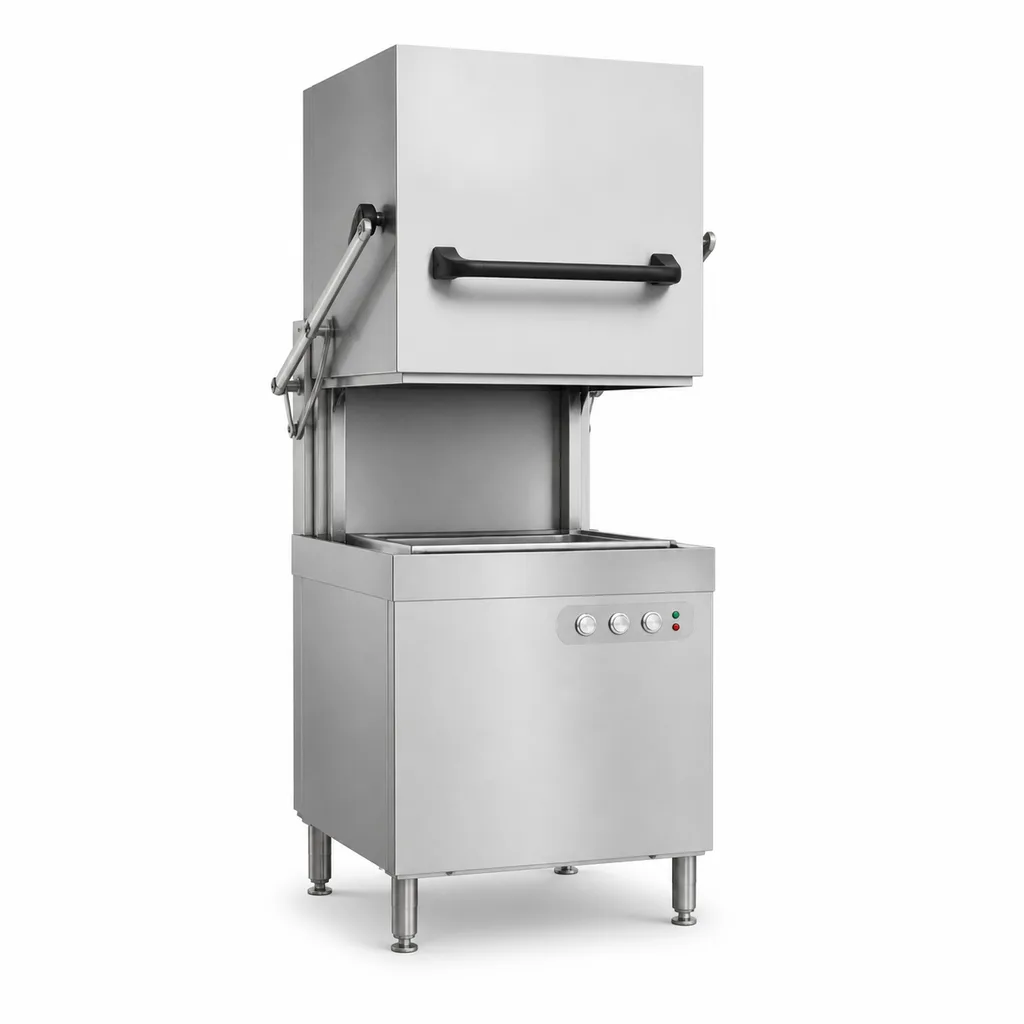
Hood / Door Type
Pass-through design, 40–60 racks/hour, with a hood that lifts for rack exchange. The workhorse of mid-size restaurants and hotel kitchens.
View dishwashing equipment →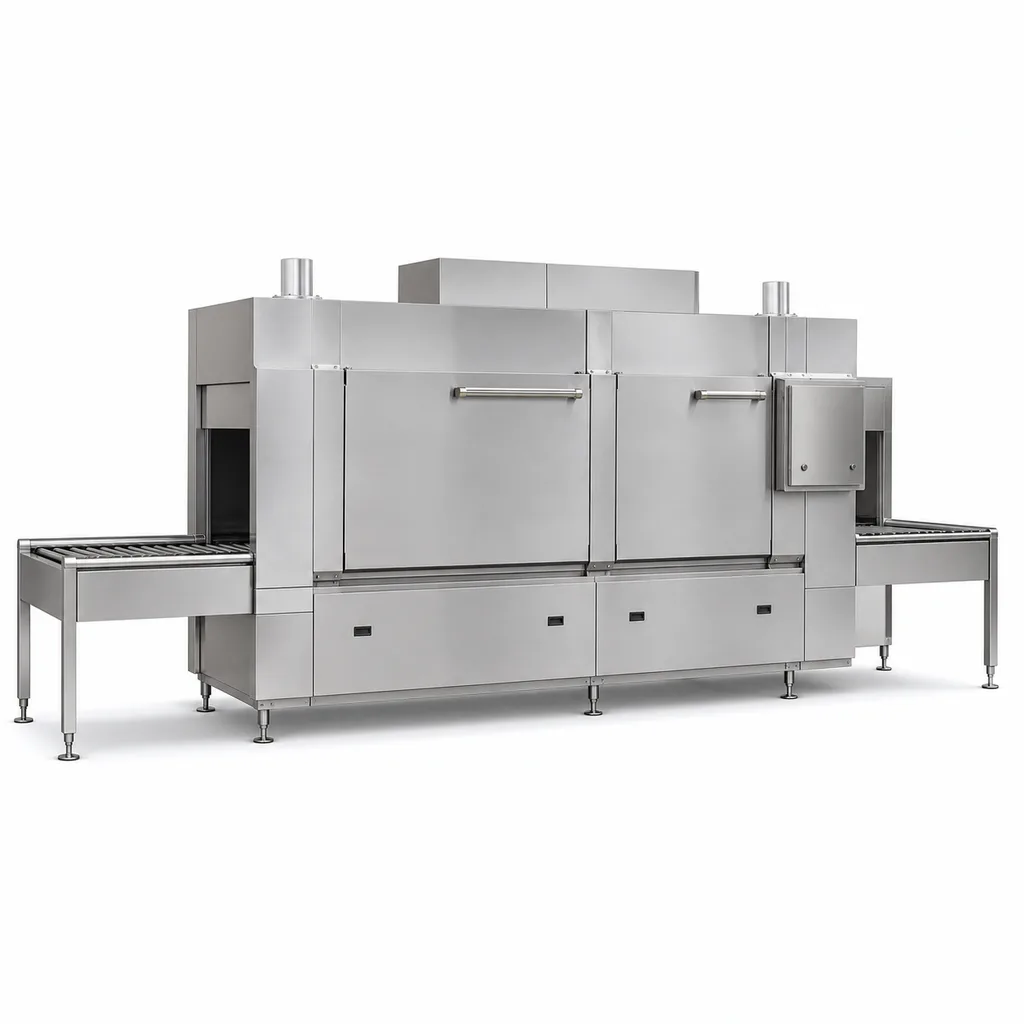
Rack Conveyor
Continuous throughput, 100–300+ racks/hour depending on tank count and drying zone. Built for canteens, hospitals, and central kitchens.
View dishwashing equipment →Criterion 2: Compare the Specification, Side by Side
Once the machine family is fixed, compare models on the parameters below rather than on brochure claims. Figures are typical market ranges, not quotes; actual pricing varies with configuration, voltage, optional heat recovery, and drying zones.
| Parameter | Undercounter | Hood Type | Rack Conveyor |
|---|---|---|---|
| Capacity | 20–40 racks/h | 40–60 racks/h | 100–300+ racks/h |
| Footprint | ≈0.4 m² | ≈0.8–1.2 m² + tables | 2–6 m linear |
| Power supply | 220–240 V, 1-phase | 380–415 V, 3-phase | 380–415 V, 3-phase |
| Connected load | 3–7 kW | 9–15 kW | 20–45 kW |
| Water per rack | 2.0–3.0 L | 2.0–3.5 L | 1.5–2.5 L |
| Indicative price | typically $3,000–$7,000 | typically $6,000–$15,000 | typically $20,000–$60,000+ |
Two comparisons deserve attention. First, water consumption per rack falls as machines get larger, because conveyor tanks recirculate more efficiently — a conveyor can cost less to run per rack than an undercounter despite its size. Second, a hood-type machine only reaches its rated 40–60 racks/hour when paired with inlet and outlet tables; without them, staff wait on the rack and real throughput drops by a third.
Criterion 3: Match the Machine to the Scenario
Undercounter suits operations where dish flow arrives in small, steady waves: cafés, bars washing mostly glassware, and restaurants under 60 seats. Its hard limit is surge capacity — one machine cannot absorb a post-banquet pile-up, and there is no room for a second unit in most bar layouts.
Hood type is the best commercial dishwasher for most restaurants between 60 and 250 seats. The pass-through layout creates a one-way dirty-to-clean flow, and a corner configuration fits dish rooms as small as 6–8 m².
Rack conveyor earns its floor space above roughly 400 covers per meal period — canteens, hospitals, and banquet halls — where wage cost of hand-feeding a hood machine for three hours exceeds the conveyor's higher purchase price within a few years.
Criteria 4–6: Utilities, Hygiene Temperature, and Operating Cost
4. Verify water, power, and drainage before you sign
Site conditions eliminate more candidate machines than any other factor:
- Water: most machines need 2–4 bar dynamic pressure and a flow of 8–15 L/min. Above roughly 6°dH hardness, budget for a water softener — scale on heating elements is the leading cause of premature failure and can void the warranty.
- Power: undercounter units run on single-phase 220–240 V; hood and conveyor machines almost universally require 380–415 V three-phase with a dedicated breaker. Confirm available capacity at the distribution board, not just the wall socket.
- Drainage and ventilation: a 50 mm trapped drain at floor level is standard; high-temperature machines exhaust 2,000–4,000 m³/h of humid air at the hood and need either a condensate hood or heat-recovery option.
5. Hold the final rinse to 82–88°C
High-temperature machines sanitize thermally: the final rinse must reach 82–88°C (typically cited as 180–190°F) at the plate surface for a few seconds, which achieves sanitization without chemicals and flash-dries wares as they exit. Low-temperature machines rinse at 49–60°C and rely on chemical sanitizer dosed into the rinse — cheaper to buy and to power, but slower to dry and dependent on a continuous chemical supply. Most health codes accept both routes; what inspectors check is the verified temperature or sanitizer concentration at the machine, so specify built-in thermometers and, for conveyors, an automatic low-temperature alarm. Related requirements are covered in our hygiene and HACCP topic section.
6. Cost the machine per rack, not per invoice
Purchase price is typically only 20–30% of the five-year cost of ownership. Water, energy, detergent, and a service contract make up the rest. A heat-recovery option that adds 10–15% to the price of a hood machine commonly cuts its 9–15 kW connected load by 3–5 kW in operation — worth pricing against your local electricity tariff before dismissing it.
Decision Checklist Before Requesting Quotes
Send suppliers the same one-page brief so quotes are comparable:
- Peak racks per hour (calculated, with buffer) and the rack count of your busiest single service
- Machine family selected — undercounter, hood, or conveyor — with available floor dimensions and a sketch of the dish-flow direction
- Confirmed site utilities: water pressure and hardness, electrical phases and spare capacity, drain position, ventilation route
- Required sanitizing method: high-temperature 82–88°C rinse, or low-temperature chemical, per your local code
- Options priced separately: water softener, heat recovery, drying zone, detergent dosing, and a commissioning visit
With those five lines fixed, any shortlist of brands becomes a like-for-like comparison on build quality, service network, and warranty terms — which is where brand differences genuinely matter. For the same framework applied across other equipment categories, see our equipment selection guides or browse the dishwashing equipment range.
Frequently Asked Questions
How do I calculate the racks-per-hour capacity my restaurant needs?
Count covers at your busiest 60–90 minutes, divide by 2–3 covers per rack for plate-and-glass service, then add a 25–30% buffer. For example, 150 peak covers works out to roughly 60 racks, so you should specify a machine rated around 75–80 racks/hour.
Is an undercounter dishwasher enough for a restaurant?
Undercounter machines handle 20–40 racks/hour and suit cafés, bars, and restaurants up to about 60 seats. A 100-seat restaurant turning tables 1.5 times at dinner already needs 75–80 racks/hour at peak, which only a hood-type (40–60 racks/hour, buffered) or conveyor machine can sustain.
What final rinse temperature should a commercial dishwasher reach?
High-temperature machines must deliver a final rinse of 82–88°C at the plate surface to sanitize thermally without chemicals. Low-temperature machines rinse at 49–60°C and rely on dosed chemical sanitizer; both are accepted by most health codes when verified at the machine.
What utilities does a hood-type or conveyor dishwasher require?
Hood and conveyor machines typically need 380–415 V three-phase power (9–15 kW for hood, 20–45 kW for conveyor), 2–4 bar dynamic water pressure at 8–15 L/min, a 50 mm trapped floor drain, and ventilation for 2,000–4,000 m³/h of humid exhaust air.
How much does a commercial dishwasher cost?
Indicative ranges: undercounter units typically $3,000–$7,000, hood-type $6,000–$15,000, and rack conveyor systems $20,000–$60,000+. Actual pricing varies with configuration, voltage, and options such as heat recovery or drying zones — and purchase price is only about 20–30% of the five-year cost of ownership.
Plan the Equipment Around Your Kitchen.
Share your menu, peak service demand, available space and site utilities. Tell us which equipment you are considering so we can review the requirements with you.