Commercial Kitchen Ventilation
Exhaustive engineering guide to commercial kitchen ventilation systems, exhaust canopy capture velocities, CFM airflow calculations, NFPA 96 fire compliance, and dedicated make-up air (MAU) balancing.
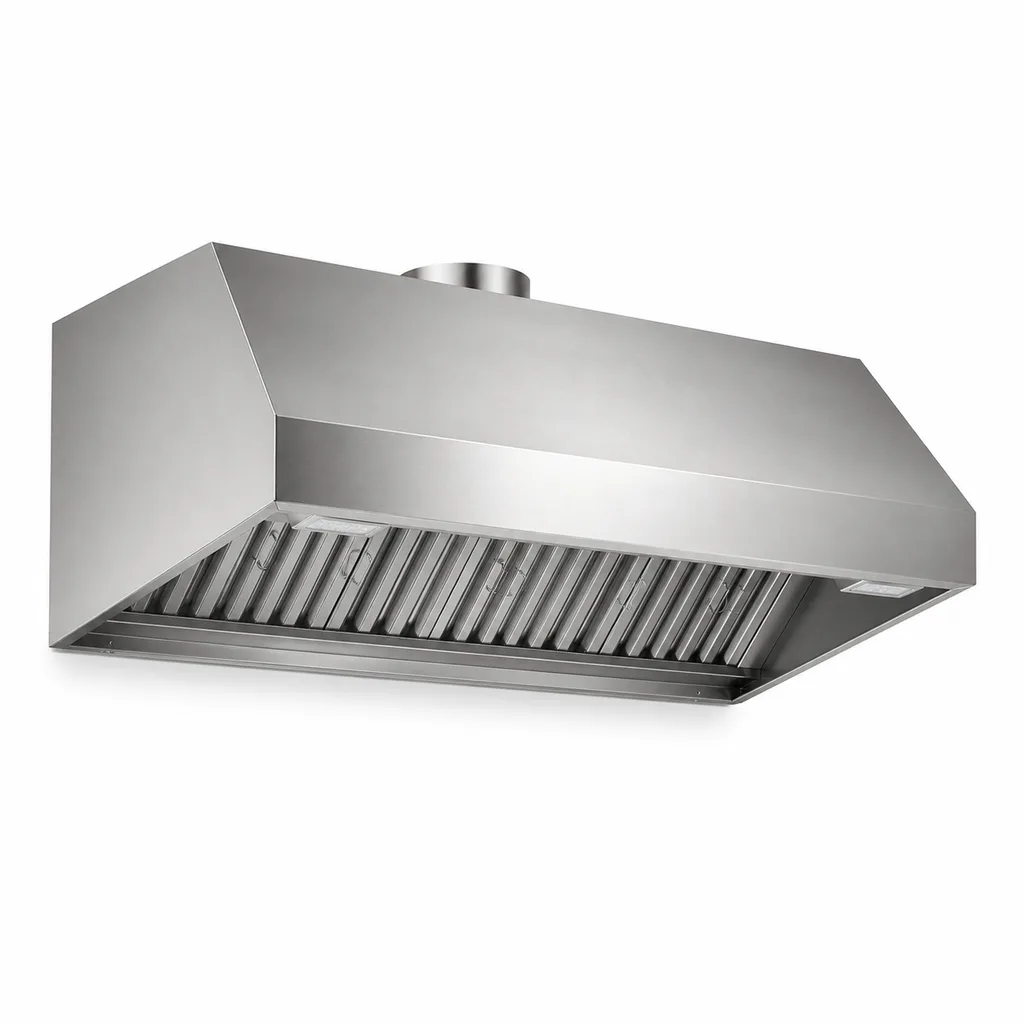
In high-density commercial and institutional kitchens, mechanical ventilation is the critical life-safety and environmental control infrastructure. Cooking processes generate massive thermal plumes carrying vaporized grease, acrid smoke, carbon monoxide, and latent moisture. An inadequately engineered exhaust system causes grease accumulation in ductwork, severe building negative pressure, staff heat exhaustion, and catastrophic kitchen fires. This engineering guide details exhaust canopy airflow dynamics, volumetric flow rate (CFM) calculations, dedicated make-up air unit (MAU) integration, and NFPA 96 / ASHRAE 154 fire safety compliance.
Figure 1: Heavy-duty 304-grade stainless steel exhaust hood canopy featuring aerodynamic baffle filters and integrated fire suppression nozzles.
1. Exhaust Canopy Classifications: Type I vs. Type II Hoods
Mechanical building codes establish strict distinctions between exhaust canopy designs based on the thermal and chemical effluent produced by the cooking battery:
| Canopy Classification | Primary Effluent Handled | Grease Extraction Filters | Fire Suppression System | Typical Equipment Applications |
|---|---|---|---|---|
| Type I Exhaust Canopy (Grease Hood) | Vaporized grease particulates, heavy smoke, open gas combustion products, volatile organic fats | Mandatory UL 1046 listed stainless steel baffle filters or continuous centrifugal extractors | Mandatory integrated UL 300 / NFPA 17A wet chemical fire suppression system | Commercial deep fryers, gas ranges, charbroilers, griddles, wok batteries, tilting braising pans |
| Type II Condensate Canopy (Heat & Vapor) | Sensible heat, latent steam moisture, ambient cooking odors (strictly zero grease vapor) | Optional moisture-deflection baffles or condensation gutters (no grease filters required) | Not required by international mechanical codes (IMC) | Commercial conveyor dishwashers, steam jacketed boiling pans, rice steamers, holding cabinets |
2. Exhaust Airflow Sizing & Volumetric CFM Calculations
Under-sizing exhaust flow causes grease spillage into the dining room; over-sizing wastes massive amounts of tempered air conditioning. Mechanical engineers calculate volumetric airflow (CFM - Cubic Feet per Minute) based on the thermal severity of the equipment lineup:
ASHRAE 154 / NFPA 96 Benchmark Ratings for Wall-Mounted Canopies:
• Light-Duty Equipment (Ovens, steam kettles, pasta boilers): 150 - 200 CFM / linear ft
• Medium-Duty Equipment (Open gas ranges, griddles, braising pans): 250 - 300 CFM / linear ft
• Heavy-Duty Equipment (Gas deep fryers, gas charbroilers): 350 - 450 CFM / linear ft
• Extra Heavy-Duty (Solid fuel wood-fired ovens, high-BTU wok stations): 550 - 700+ CFM / linear ft
Island Canopy Multiplier: Because single-island and double-island canopies lack rear wall containment, cross-drafts easily disrupt thermal plumes. Building codes mandate a minimum 30% to 40% increase in CFM volume for island canopies compared to wall-mounted configurations.
3. Canopy Capture Velocity & Overhang Tolerances
Thermal plumes rise at velocities between 0.5 m/s and 1.2 m/s depending on surface temperature. The exhaust hood must maintain sufficient perimeter capture velocity to draw plumes into the filter bank:
| Installation Parameter | Engineering Standard (Wall-Mounted) | Engineering Standard (Island Canopy) | Operational Risk if Non-Compliant |
|---|---|---|---|
| Front / Side Overhang | Minimum 150 mm (6 inches) beyond appliance front and ends | Minimum 300 mm (12 inches) perimeter overhang on all 4 open sides | Thermal plume spillage around canopy edges during peak cooking surges |
| Mounting Height | Lower edge positioned 2,000 mm to 2,100 mm (6'6" - 7'0") above finished floor | Lower edge positioned 2,000 mm above finished floor | Excessive height creates turbulence; lower heights create severe chef head strike hazards |
| Filter Face Velocity | 1.5 m/s to 2.5 m/s (300 - 500 FPM) across baffle face | 1.5 m/s to 2.5 m/s (300 - 500 FPM) across baffle face | < 1.5 m/s fails centrifugal grease separation; > 2.5 m/s pulls grease through into exhaust ductwork |
4. Dedicated Make-Up Air Unit (MAU) Balancing Dynamics
Evacuating 5,000 to 12,000 CFM of air through kitchen hoods creates intense negative building pressure if unreplenished. Negative pressure pulls sewer gases through dry floor drains, makes exterior doors impossible to open, and reverses drafts in gas water heaters:
Engineering Balancing Rule: The kitchen must remain under slight negative pressure (-0.02" to -0.05" W.C. relative to the dining room) so that cooking aromas never drift into guest areas, while dining room transfer air supplies the remaining 10% to 15%.
Make-Up Air Introduction Methods:
- Perforated Supply Plenums (PSP): Conditioned air discharges through micro-perforated stainless panels along the front face of the hood at low discharge velocity (< 0.25 m/s). This forms an air curtain that enhances plume capture without disturbing the cookline.
- Ceiling Diffusers (Four-Way Throw): Placed at least 3 meters away from the hood canopy to prevent high-velocity air streams from sweeping across the fryers and blowing plumes out from under the hood.
5. NFPA 96 Fire Safety, Ductwork Metallurgy & Wet Chemical Suppression
Commercial kitchen exhaust ducts operate at elevated temperatures and accumulate combustible grease deposits, demanding strict mechanical construction standards:
- Ductwork Metallurgy & Welding: Exhaust ducts must be constructed from minimum 16-gauge (1.52 mm) carbon steel or 18-gauge (1.21 mm) 304-grade stainless steel. All seams and joints must feature liquid-tight continuous external perimeter welds; screw fasteners or slip joints penetrating duct walls are strictly prohibited.
- UL 300 Wet Chemical Fire Suppression (Ansul R-102): Dedicated low-pH potassium acetate extinguishing agent nozzles must be positioned over every deep fryer, griddle, range burner, and inside the exhaust duct collar. The system must feature automatic thermal fusible link release (typically 182°C - 260°C / 360°F - 500°F) and a manual pull station.
- Fuel Shutoff Interlock: Actuation of the fire suppression system must automatically trip an electrical contactor and close a mechanical gas solenoid valve, cutting 100% of fuel and electrical power to all appliances positioned beneath the hood.
6. Troubleshooting Exhaust System Performance Deficiencies
When kitchen staff report smoke accumulation or excessive heat, facility directors must systematically diagnose mechanical faults:
Diagnostic Scenario: Smoke Spilling from Hood Perimeter During Peak Searing Rush
Step 1: Inspect Exhaust Fan V-Belt Tension: Loose or glazed rubber V-belts on rooftop centrifugal upblast exhaust fans cause slippage, dropping fan impeller RPM by 25% or more. Re-tension or replace belts.
Step 2: Measure Static Pressure Drop Across Baffle Filters: Accumulated grease blankets increase resistance across filter banks. Pressure drop exceeding 0.5" W.C. indicates clogged filters requiring immediate commercial dishwashing degreasing.
Step 3: Check Make-Up Air Supply Volume: If make-up air unit filters are clogged, the kitchen enters extreme negative pressure, choking the exhaust fan's ability to evacuate air.
7. Fan Affinity Laws & Rooftop Upblast Exhaust Engineering
Centrifugal upblast exhaust fans mounted on commercial kitchen rooftops must overcome total system static pressure (ductwork friction, grease baffle resistance, and cowl dampers):
• Airflow Volume: CFM_2 = CFM_1 × ( RPM_2 / RPM_1 )
• Static Pressure: SP_2 = SP_1 × ( RPM_2 / RPM_1 )^2
• Brake Horsepower: BHP_2 = BHP_1 × ( RPM_2 / RPM_1 )^3
Engineering Takeaway: Increasing fan speed by 20% to capture escaping smoke increases static pressure by 44% and increases electrical motor power consumption by 73%. Correct duct sizing is far more energy-efficient than over-spinning undersized fans.
8. NFPA 96 Grease Duct Fire Clearance & Insulation Standards
Commercial grease ducts reach temperatures exceeding 1,000°C (1,800°F) during internal duct fires. Mechanical building codes enforce strict clearance to combustible materials:
| Duct Construction / Insulation Method | Clearance to Combustible Construction | Clearance to Non-Combustible Structures | Mechanical Code Standard |
|---|---|---|---|
| Uninsulated Single-Wall 16-Ga Steel Duct | 450 mm (18 inches) continuous clearance | 150 mm (6 inches) | NFPA 96 / International Mechanical Code (IMC) |
| Single-Layer 25 mm Ceramic Fiber Wrap | 225 mm (9 inches) clearance | 50 mm (2 inches) | UL 2221 / ASTM E2336 1-Hour Rated Fire Barrier |
| Double-Layer 50 mm Ceramic Fiber Blanket | 0 mm (Zero Clearance to Combustibles) | 0 mm (Direct contact allowed) | UL 2221 / ASTM E2336 2-Hour Rated Fire Resistance Enclosure |
| Prefabricated Double-Wall Factory-Built Chimney | 25 mm to 50 mm (1 - 2 inches) | 25 mm (1 inch) | UL 103 / UL 1978 Listed grease duct assemblies |
9. Direct-Fired vs. Indirect-Fired Make-Up Air Unit (MAU) Engineering
Tempering incoming make-up air during winter conditions requires high-capacity heating burners to prevent kitchen freezing:
| MAU Heating Architecture | Combustion Efficiency (%) | Air Quality & Safety Interlocks | Capital Cost & Fuel Fit |
|---|---|---|---|
| Direct-Fired Gas Make-Up Air | 100% Thermal Efficiency (Flames burn directly in supply airstream) | Mandatory electronic airflow proving switches and dual flame sensors | Lowest Capex; optimal for large industrial kitchens requiring > 5,000 CFM |
| Indirect-Fired Sealed Heat Exchanger | 80% - 84% Efficiency (Combustion flue gases vented outdoors) | Zero risk of combustion byproducts entering kitchen supply air | Higher Capex; required in jurisdictions prohibiting direct-fired airstreams |
10. Exhaust Air Heat Recovery (Run-Around Coils & Heat Pipes)
Commercial kitchen ventilation exhausts enormous amounts of conditioned thermal energy outdoors. In cold climates or facilities operating 16+ hours daily, engineers install specialized sensible heat recovery exchangers:
| Heat Recovery Architecture | Sensible Effectiveness (%) | Grease Fouling & Cleaning Protocol | Freeze Protection Mechanism |
|---|---|---|---|
| Run-Around Hydronic Loop (Glycol Coils) | 45% - 55% Sensible Energy Recovery | Separate coils in exhaust and supply ducts; zero cross-contamination risk. Coils downstream of UV hood require semi-annual CIP washing. | Proportional 3-way modulating valve bypasses cold glycol to maintain exhaust temp > 2°C. |
| Heat Pipe Heat Exchangers (Thermosiphons) | 50% - 60% Sensible Recovery | Passive sealed refrigerant tubes transfer heat between adjacent airstreams without pump motors. Removable cassette for pressure washing. | Tilt-angle actuator reduces heat transfer rate when ambient drops below freezing point. |
| Rotary Energy Wheels (Desiccant Wheels) | Not Permitted on Grease Exhaust | NFPA 96 Prohibited: Direct air carryover spreads volatile organic compounds and aerosol grease into incoming fresh supply air. | Not applicable for Type I cooking hoods. |
Engineering Calculation: A 6,000 CFM kitchen running 14 hours/day with a winter ΔT of 25°F (from 25°F outdoor to 50°F pre-tempered) recovers over 120,000,000 BTU annually via run-around glycol loops, reducing MAU gas heating bills by $3,200 to $4,500 every winter.
Featured Commercial Equipment Models
Commercial Baffle Exhaust Canopies
Heavy-gauge 304 stainless steel wall-mounted exhaust canopies with removable centrifugal grease baffles.
View Exhaust Canopies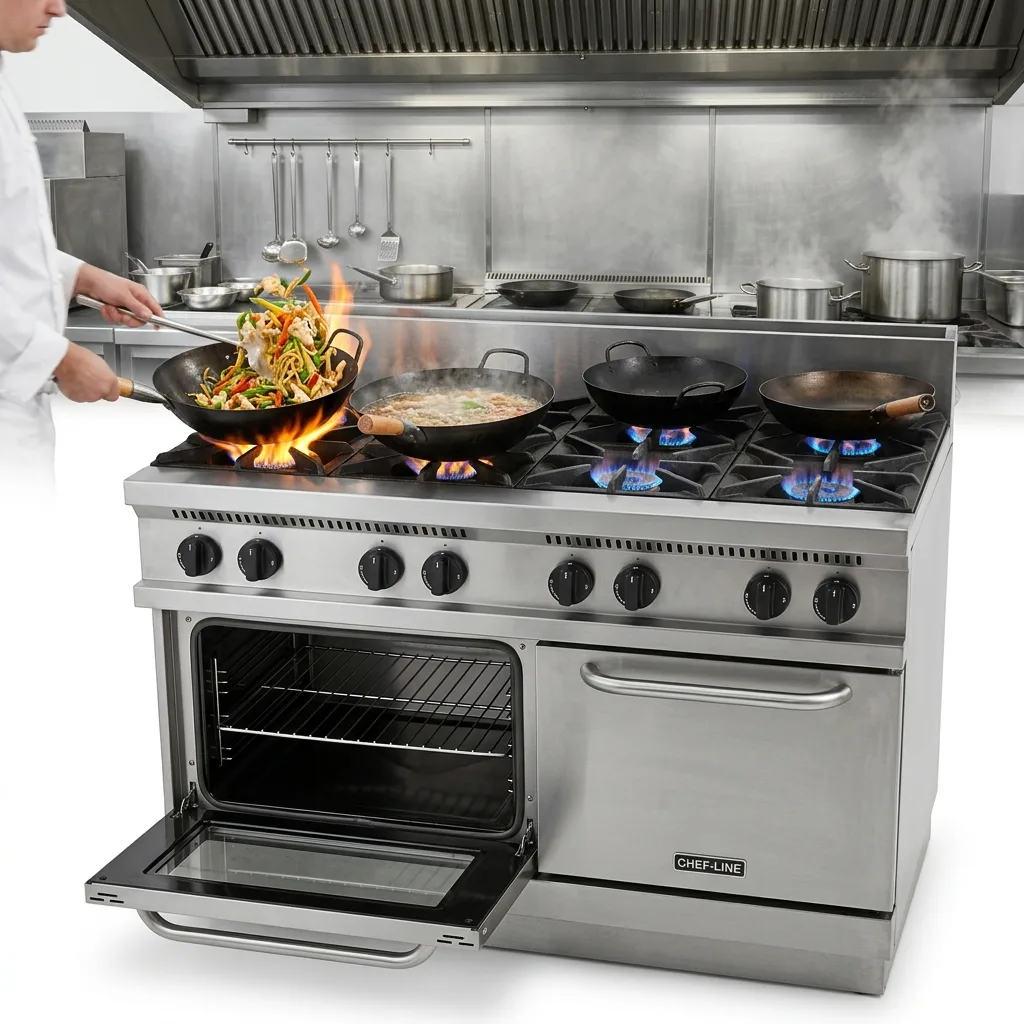
High-Output Thermal Cooklines
Heavy-duty commercial cooking suites engineered to align seamlessly beneath NFPA 96 canopy footprints.
View Cookline Equipment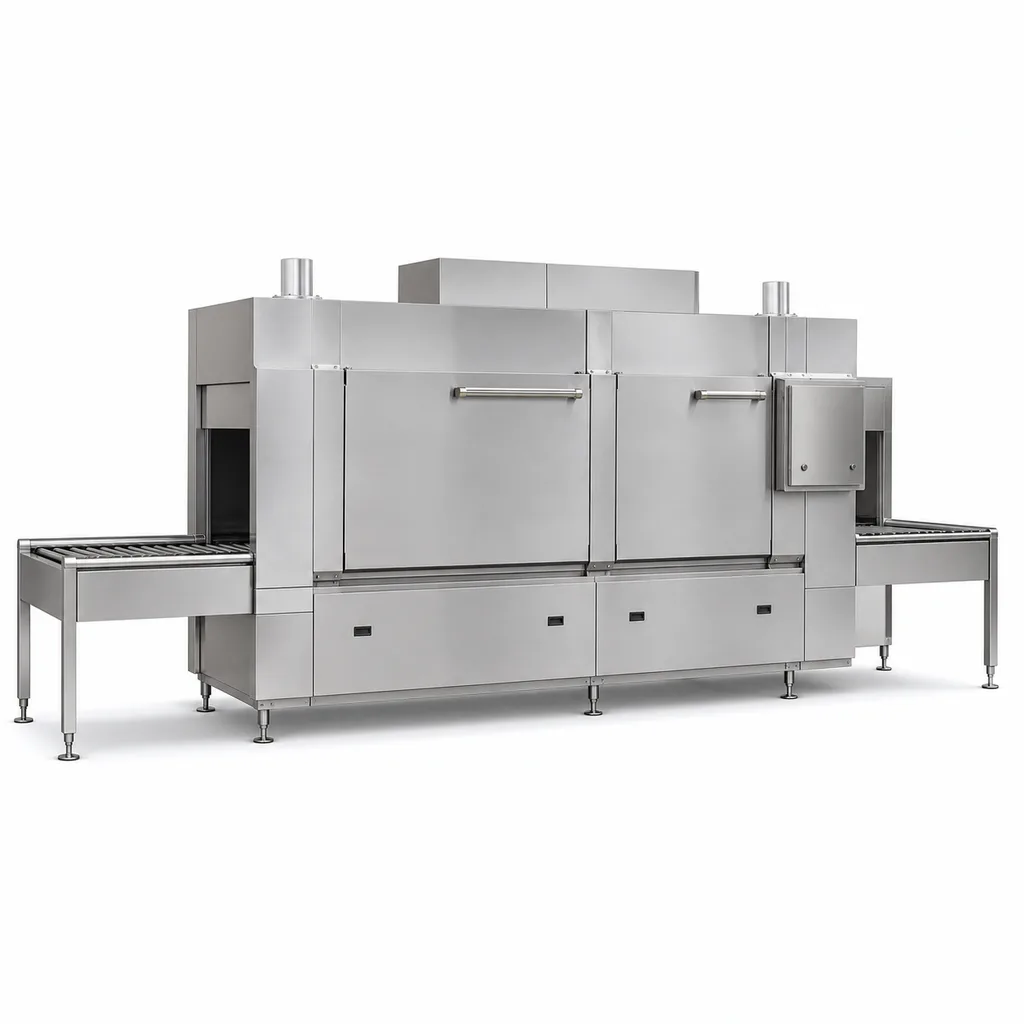
Type II Condensate Hoods
Stainless steel steam capture hoods designed specifically for pass-through and conveyor dishwashing stations.
View Dishwashing Hoods
Central Kitchen Ventilation Lines
Engineered large-scale ventilation plenums with integrated make-up air distribution for food processing.
View Industrial CanopiesTurnkey Engineering Solutions & Applications
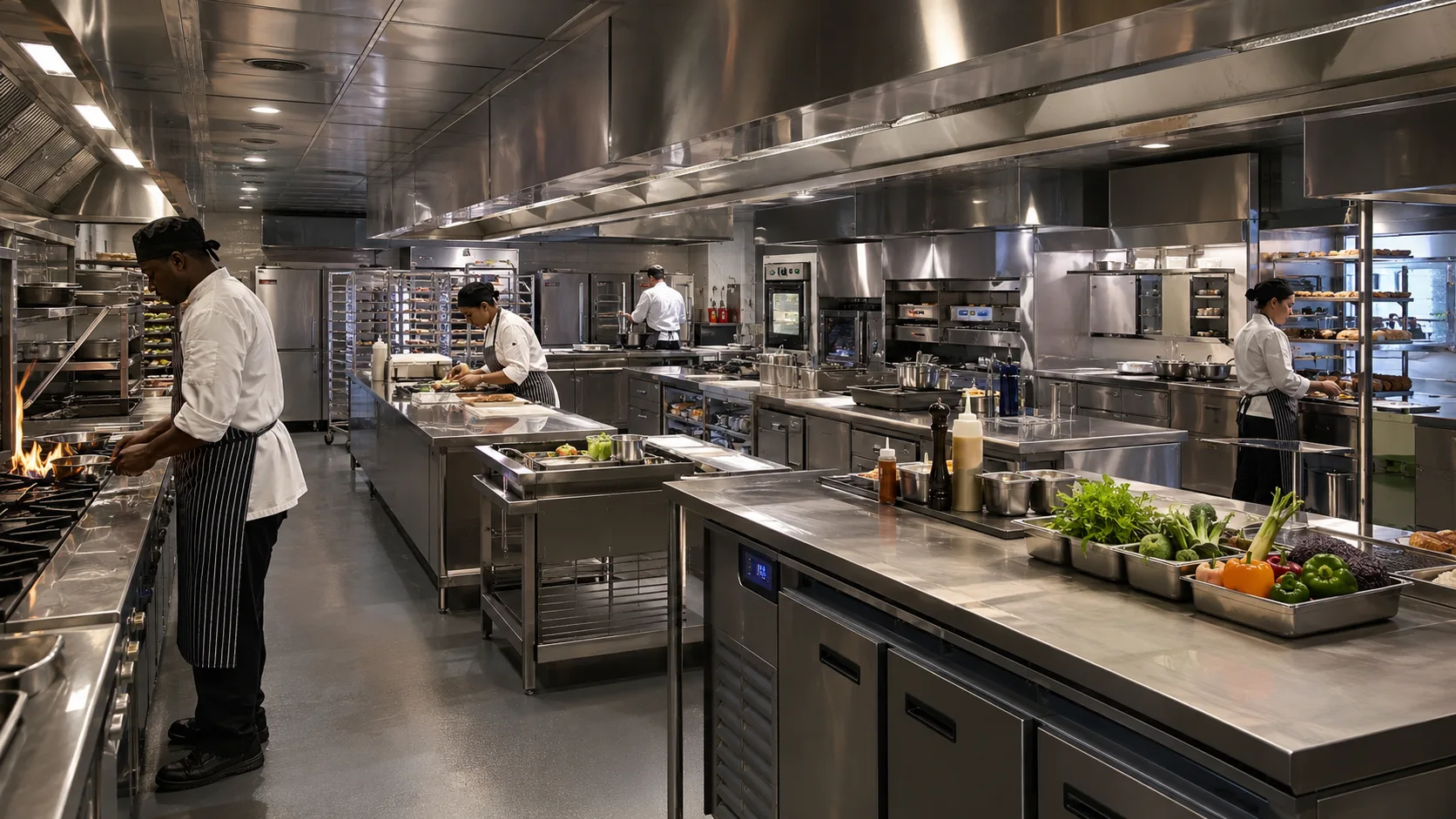
5-Star Hotel Banquet Exhaust
Multi-station island canopy ventilation engineering tailored for luxury hotel production kitchens.
Explore Hotel Solutions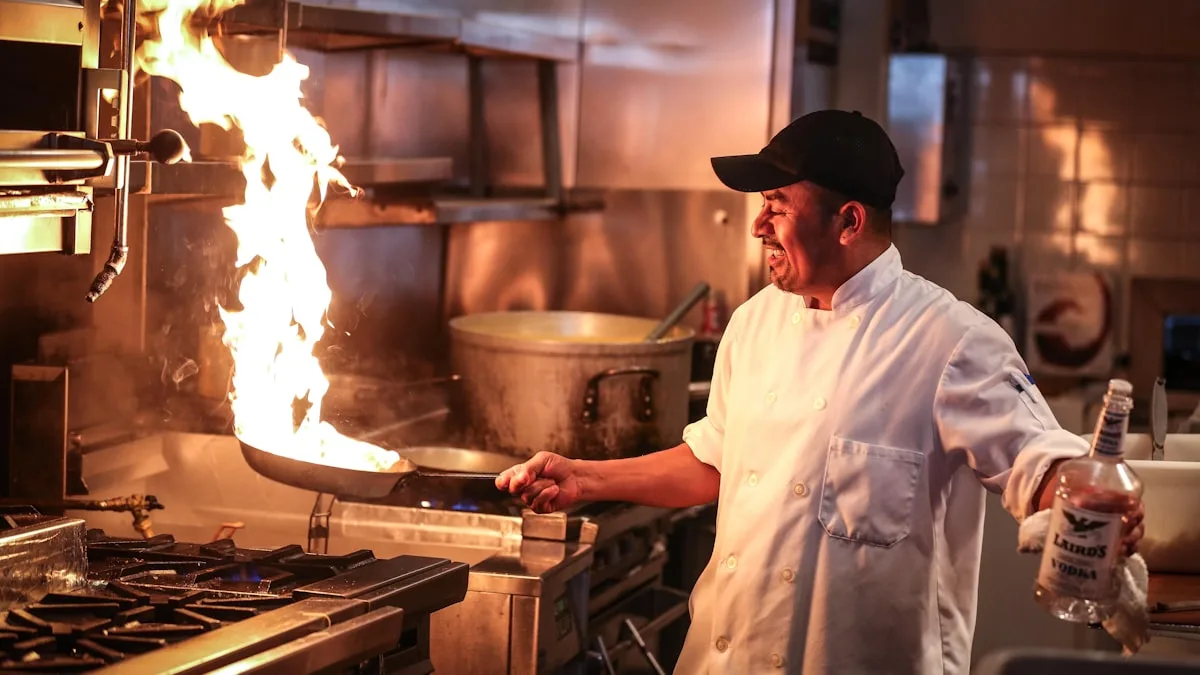
High-Density Restaurant Kitchens
Space-saving high-velocity extraction hoods engineered for compact urban commercial restaurant footprints.
Explore Restaurant SolutionsCentral Food Processing Plants
Industrial ventilation and make-up air systems engineered for large-scale commissary production halls.
Explore Central Kitchen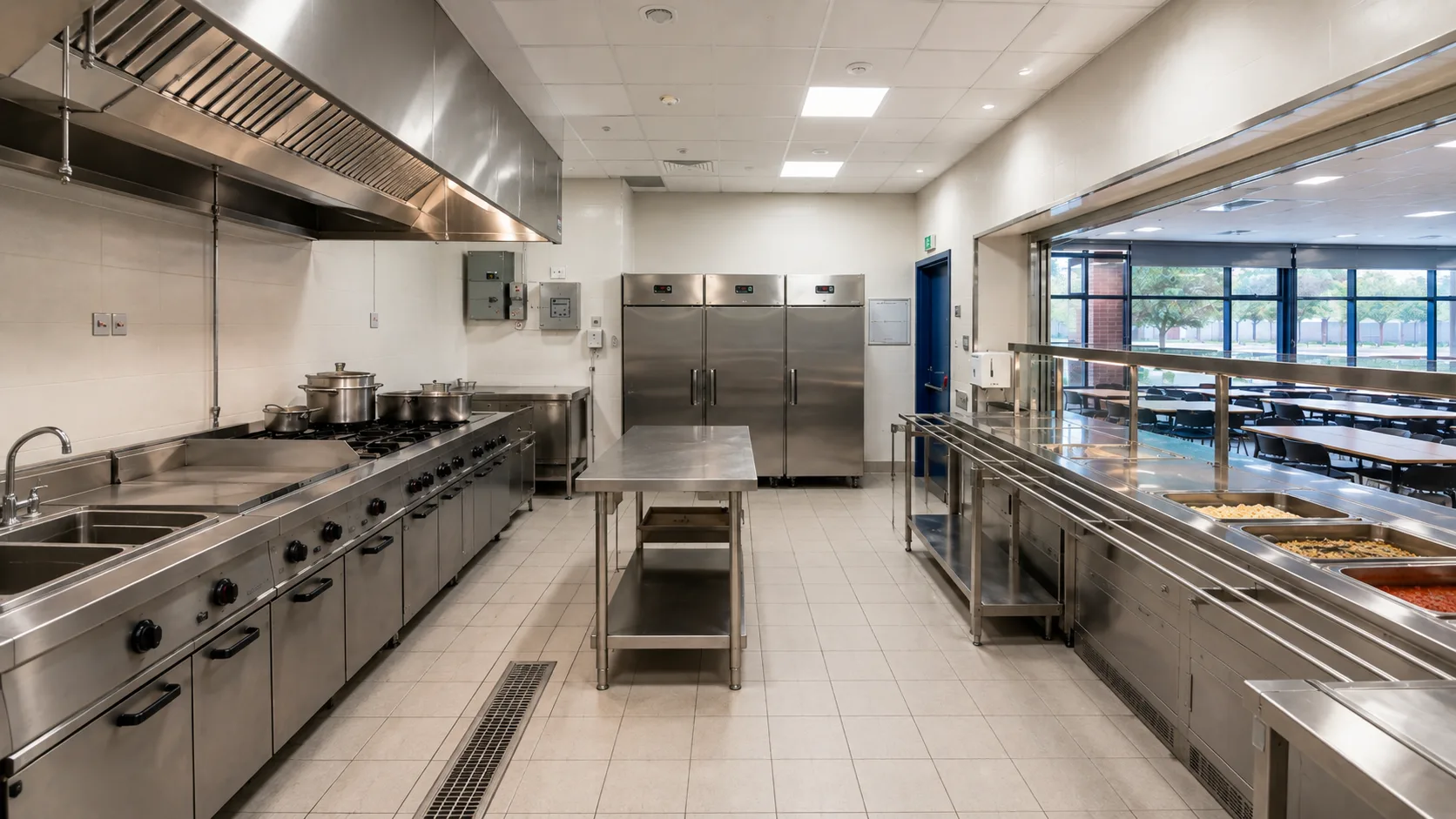
Institutional Dining Ventilation
Durable low-noise exhaust systems built for continuous volume feeding in school and corporate canteens.
Explore School SolutionsFrequently Asked Questions
What is the difference between a Type I and Type II kitchen exhaust hood?
Type I hoods are engineered for appliances producing grease and smoke (fryers, ranges, charbroilers) and require UL-listed baffle grease filters and wet chemical fire suppression. Type II hoods handle only heat, steam, and moisture (dishwashers, pasta boilers) and do not require grease filtration or fire suppression.
What percentage of exhaust air should be replaced by a make-up air unit (MAU)?
A dedicated make-up air unit should deliver 85% to 90% of the total exhaust volume in CFM. The remaining 10% to 15% should be pulled from the dining room as transfer air, keeping the kitchen under slight negative pressure so cooking smells do not enter customer dining spaces.
How often must commercial kitchen exhaust hoods and ducts be professionally cleaned?
Under NFPA 96 standards, systems serving solid fuel cooking equipment (wood/charcoal) must be cleaned monthly; high-volume kitchens (fast food, 24-hour operations) require quarterly cleaning; moderate-volume kitchens require semi-annual cleaning; and low-volume operations require annual certified degreasing.
Why are residential range hoods illegal in commercial kitchens?
Residential hoods lack certified 16-gauge liquid-tight welded construction, fail to deliver required capture velocities (typically delivering under 300 CFM versus 1,500-6,000+ CFM in commercial setups), lack UL 1046 baffle grease separation, and cannot integrate required UL 300 automatic fire suppression systems.
What causes negative building pressure in commercial restaurants?
Negative pressure occurs when exhaust hood fans evacuate large volumes of air without an adequately balanced make-up air unit (MAU) replenishing the space, causing drafty exterior doors, back-drafting of gas appliances, and sewer gas infiltration.
Plan the Equipment Around Your Kitchen.
Share your menu, peak service demand, available space and site utilities. Tell us which equipment you are considering so we can review the requirements with you.