Hotel Restaurant Kitchen Equipment
Hotel restaurant kitchen equipment must flex between banquet volume and fine-dining precision. We cover cooking, holding, and warewash equipment for hotel foodservice.
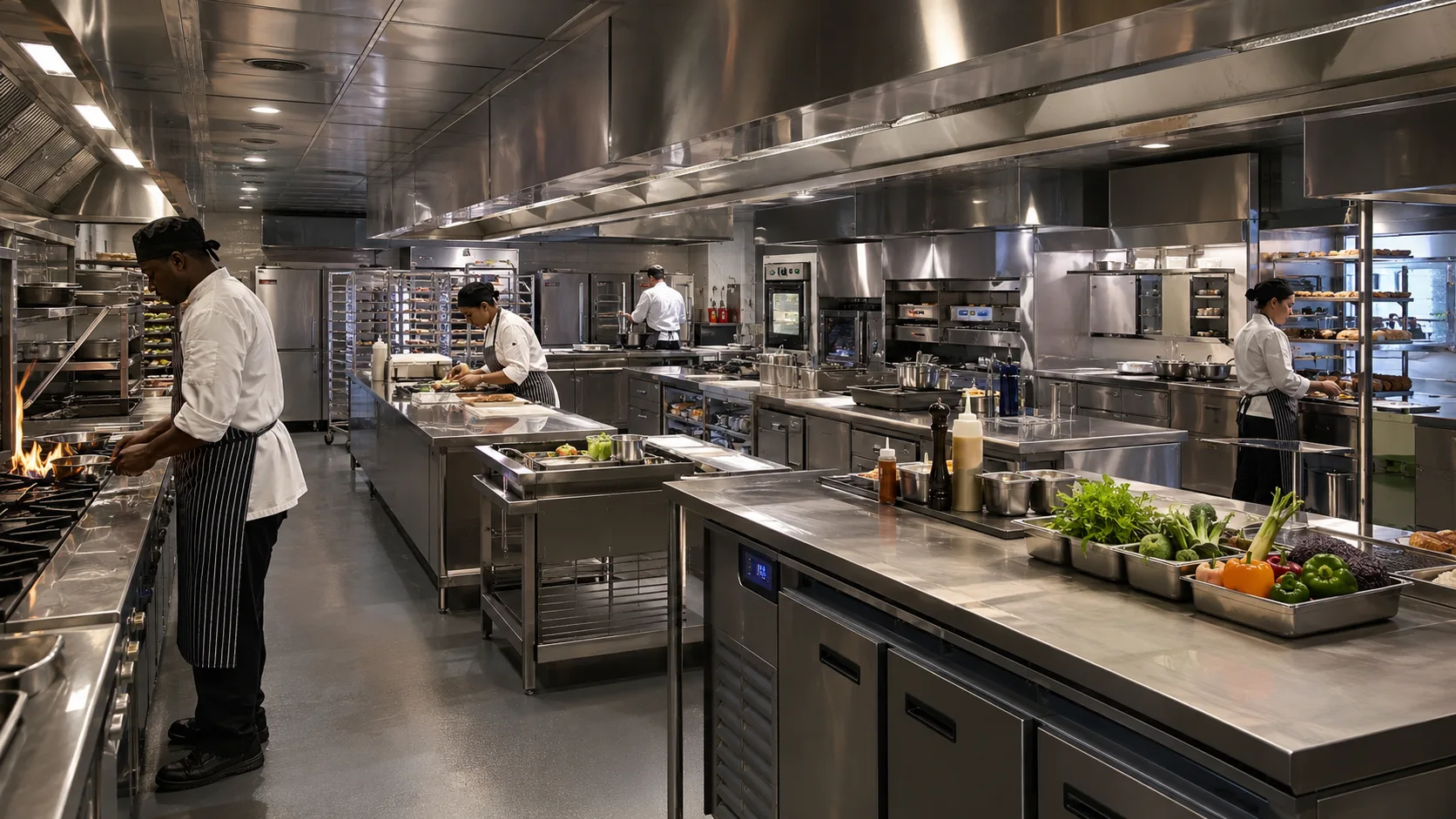
A hotel restaurant kitchen is not a scaled-down standalone restaurant. Banquet plating, in-room dining, and à la carte dinners often move through one space in the same window, so equipment must flex between batch cooking and precise plating without reconfiguring the line.
Key takeaway: Choose modular cooking and holding equipment that switches between banquet volume and fine-dining precision, and size the line against your busiest 60-minute window.
Solution Overview
This solution covers cooking, holding, dishwashing, and cold-storage equipment for a hotel kitchen serving several meal formats from one space. The line runs from receiving and prep to plated service, banquet holding, or in-room dispatch. Automation ranges from manual stations to programmable combi steamers and kitchen display systems, and the layout is customized to the property's dominant service profile.
Applicable Raw Materials and Final Products
The "raw materials" are the foodservice formats a property runs, and the "final products" are the meals delivered. This applies to hotels with banquet and conference catering, in-house fine-dining, all-day casual dining, and in-room dining, covering guest and staff meals. It excludes central bakeries, off-site commissaries, and packaged retail unless added during engineering.
Typical Workflow or Equipment Zones
The kitchen divides into receiving and dry storage, cold prep, the hot cooking line, banquet holding and transport, dishwashing, and waste handling. Raw and ready-to-eat flows stay separated, and the cooking line sits between prep and the pass.
- Receive and store dry, refrigerated, and frozen goods
- Prep raw proteins, vegetables, and mise en place in the cold zone
- Cook on the modular line: ranges, griddles, combi steamers, fryers
- Hold banquet and buffet items in heated cabinets and bain-marie
- Plate à la carte or assemble banquet trays and in-room orders
- Wash, sanitize, and store dishes, then route waste separately
Main Equipment
The table lists core equipment by stage; Standard items are required and Optional items are added where justified.
| Stage | Equipment | Function | Standard / Optional |
|---|---|---|---|
| Prep | Prep tables, cutters, mixers | Mise en place and batch prep | Standard |
| Cooking line | Range, griddle, salamander | Primary high-heat cooking | Standard |
| Cooking line | Combi steamer | Steam, bake, low-temperature cooking | Standard |
| Cooking line | Deep fryer | Fried items and garnish | Optional |
| Holding | Heated cabinets, bain-marie | Keep banquet and buffet food safe | Standard |
| Transport | Mobile heated trolleys | Move food to banquets and rooms | Optional |
| Cold storage | Reach-in and walk-in coolers, freezers | Store raw and ready-to-eat stock | Standard |
| Warewash | Rack conveyor or hood-type dishwasher | Sanitize dishes, trays, cookware | Standard |
Capacity and Automation
Capacity depends on peak covers per day [N], the banquet versus à la carte split, and daily meal periods. Size the cooking line and holding bank against the busiest 60-minute window, not the daily total. Automation options include programmable combi steamers, kitchen display systems for in-room orders, and conveyor dishwashing sized to [racks per hour]. Throughput stays a variable until volumes are defined.
Layout and Material Flow
Raw goods enter from the receiving dock and move inward to clean plating, while soiled dishes return on a separate path that never crosses clean service. Wet and dry zones are separated, and the cooking line sits between prep and the pass. Maintenance, cleaning access, drainage, and expansion are set against building dimensions before equipment is fixed.
Utility Requirements
Confirmed utility needs include electricity for cooking and refrigeration, gas or electric supply to the line, potable water, and ventilation with makeup air. Hood sizing follows cooking-line heat output, and drainage plus wastewater follow local code. Where values are undefined, they are calculated during layout engineering rather than assumed.
Food Safety and Hygienic Design
Food-contact surfaces use stainless steel suited to the zone, with welded seams and crevice-free construction. Temperature monitoring with alarms covers refrigeration and hot holding, and raw and ready-to-eat zones are physically separated. Equipment should carry the certifications required by the destination market, such as NSF, CE, or UL.
Labor and Operating Considerations
Banquet-first properties need cross-trained staff who move between setup, service, and cleanup, while fine-dining formats need specialists per station. Plan relief coverage so plating continues if a primary cook steps away during a banquet push.
Customization and Project Engineering
No two properties share the same banquet-to-à-la-carte ratio, room count, or local code. We confirm the service profile, then design the process, draft a preliminary equipment list, and calculate layout and utilities before manufacturing. Optional items such as mobile trolleys, blast chillers, and kitchen display systems are added only where justified.
Information Needed for a Technical Proposal
- Peak covers per day and the banquet versus à la carte split
- Number of meal periods and in-room dining volume
- Available floor area, building dimensions, and column positions
- Existing utility capacity: electricity, gas, water, ventilation
- Local certification and hygiene requirements
- Optional scopes: blast chilling, kitchen display systems, satellite kitchens
Discuss the Project
If you are planning a hotel restaurant kitchen, share your service profile, peak volumes, and floor plan. We can map the equipment list, utilities, and layout to your banquet and fine-dining mix and prepare a preliminary proposal. See our hotel kitchen solutions or browse food holding equipment for transport-ready models.
Related Content Keywords
Related Products and Solutions
combi oven,deep fryer,commercial oven,pizza oven,commercial fryer,kitchen equipment price,display freezer,commercial dishwasher,rack conveyor
- combi oven — combi steamers
- deep fryer — fried items
- commercial oven — oven selection
- pizza oven — pizza ovens
- commercial fryer — fryer selection
- kitchen equipment price — budget by zone
- display freezer — display freezers
- commercial dishwasher — warewash machines
- rack conveyor — conveyor dishwashing
Related Blogs
buying guide,equipment service,kitchen maintenance,catering service,maintenance contract,stainless steel,NSF certified,dishwasher maintenance,maintenance schedule
- buying guide — purchase checklist
- equipment service — service scope
- kitchen maintenance — maintenance planning
- catering service — catering SLA
- maintenance contract — contract terms
- stainless steel — material grade
- NSF certified — certifications
- dishwasher maintenance — service intervals
- maintenance schedule — task schedule
Keyword Field Configuration Notes
Node 1 and Node 2 are comma-separated keyword strings (English commas, no spaces) stored in the EyCms special-node keywords field, limited to 200 characters each. Matching is a substring fuzzy match against each published article's meta keywords, so each uses the shortest unique substring that identifies its target article; one substring represents one article, and related products of the same type share a single term.
Node 1 length: 141 (limit 200) -> PASS. Node 2 length: 162 (limit 200) -> PASS.
Frequently Asked Questions
Should I buy banquet or fine-dining equipment first?
Buy for your dominant service style. Banquet-first properties need holding capacity; fine-dining hotels need precision cookers.
Can one line handle both banquet and fine dining?
Yes, with modular burners, combi steamers, and mobile holding cabinets that reconfigure in under an hour.
How many holding cabinets per 100 banquet covers?
One full-size heated cabinet per 60–80 covers, plus one mobile trolley per room-service route.
Plan the Equipment Around Your Kitchen.
Share your menu, peak service demand, available space and site utilities. Tell us which equipment you are considering so we can review the requirements with you.