Direct Answer / Key Takeaway: Map commercial griddle temperature under a defined menu load. Record positions, instrument method, recovery and accepted product results before comparing.
Commercial griddle temperature mapping is useful when the kitchen defines what it is measuring. A thermostat setting, a surface observation and the temperature of cooked food are different results. A purchasing trial should relate the plate's behaviour under an identified load to the accepted menu outcome.
Begin with the exact offered plate, controls, utility version and permitted operating method. Agree the trial and measurement procedure with the supplier and competent test personnel before the plate is heated.
Make the test grid reproducible
Identify the usable cooking area and an agreed set of positions. Record each position relative to a fixed reference, such as the plate's front edge and control zones. Include positions important to the intended menu rather than selecting only a convenient central spot.
Keep the grid, instrument and reading sequence with the test record. If one run measures positions in a different order while the plate is recovering, the apparent spatial difference may include a time difference. Where readings are sequential, record their timestamps and interpret the sequence accordingly.
Choose a method suitable for the surface
Use the instrument manufacturer's guidance and a method approved for the actual food-contact surface. Check range, response, sensor contact where applicable and the measurement area. Do not modify a cooking surface with an unapproved coating merely to obtain an easier reading.
Fluke's infrared guidance explains that shiny surfaces and the instrument's measurement area can affect readings. A laser aiming spot does not establish the whole area being measured. Those limitations matter when comparing a reflective plate with a contact measurement.
Keep instrument identity and its relevant calibration or verification evidence. NIST distinguishes traceability from suitability for a particular measurement need. The trial should use an instrument and uncertainty appropriate to the agreed decision, rather than treating a certificate label as a universal guarantee.
Record unloaded and loaded conditions separately
Use the manufacturer's permitted stabilization and operating conditions. Record the control setting and observations before the agreed load, during the sequence where the approved method permits measurement, and through the defined recovery interval. Keep the product mass, initial state and arrangement identifiable.
An unloaded reading can support a baseline, but it does not establish the menu result during repeated loading. A test with a light demonstration product should not be presented as the expected behaviour of a heavier routine menu.
| Record | Details to preserve |
|---|---|
| Configuration | Plate, controls, utility version and approved method |
| Measurement | Grid position, timestamp, instrument and reading |
| Load | Recipe, quantity, starting state and placement |
| Recovery | Defined observation boundary and next permitted release |
| Product result | Agreed inspection of accepted and rejected items |
Connect the map to the food result
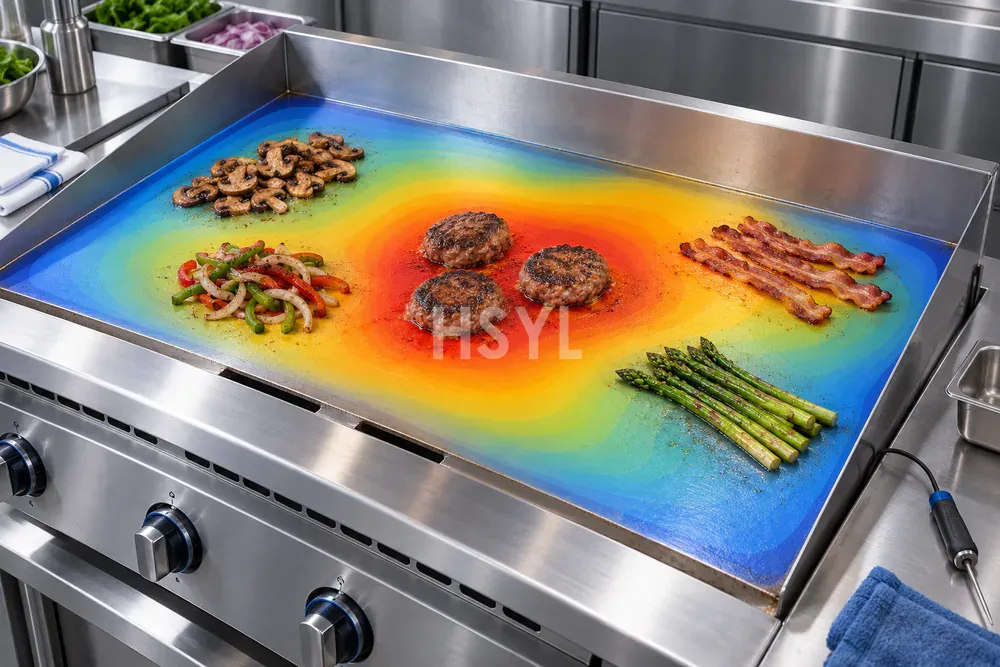
Identify which product occupied each relevant position and release. Apply the agreed quality and food-safety inspection separately from the plate reading. Surface colour on a diagram cannot establish that the finished food met its approved process.
Compare repeated observations before attributing a result to plate thickness or finish. Keep preparation and operating conditions consistent for an evidenced comparison. Where a difference is unresolved, record it and agree a controlled follow-up rather than changing several variables together.
Write a purchasing conclusion with a defined boundary
Report the conditions demonstrated, accepted product results, instrument method and limitations. If the site utilities differ from the trial, identify the additional confirmation needed at commissioning. Do not describe a qualitative illustration as a thermal survey or convert a single reading into guaranteed uniformity.
The existing griddle plate configuration guide helps organize the design comparison. A reproducible loaded test provides the evidence needed to decide which offered configuration meets the kitchen's actual duty.