Direct Answer / Key Takeaway: Choose fryer tank arrangements around simultaneous orders, separate oil duties, basket handling and cleaning; keep independent controls distinct from shared services.
A second fryer tank is useful when it gives a menu a workable separation or lets two different frying duties run together. It can also add oil, cleaning and connection costs without resolving the busy period. Compare tank arrangements using the orders that compete for the fryer.
Write down which products must run together
Map a representative order sequence: which baskets enter together, which products use different approved cooking conditions, and which must wait. Include basket draining and the staff member who portions the finished food. Two tanks do not help if both queues still depend on one blocked unloading position.
Where a kitchen needs dedicated oil for a menu policy, identify the required separation with the person responsible for that policy. Separate vats alone do not establish an allergen-free or dietary-compliant process. Baskets, utensils, storage, staff handling and the surrounding station also affect that assessment.
Compare actual tank sizes
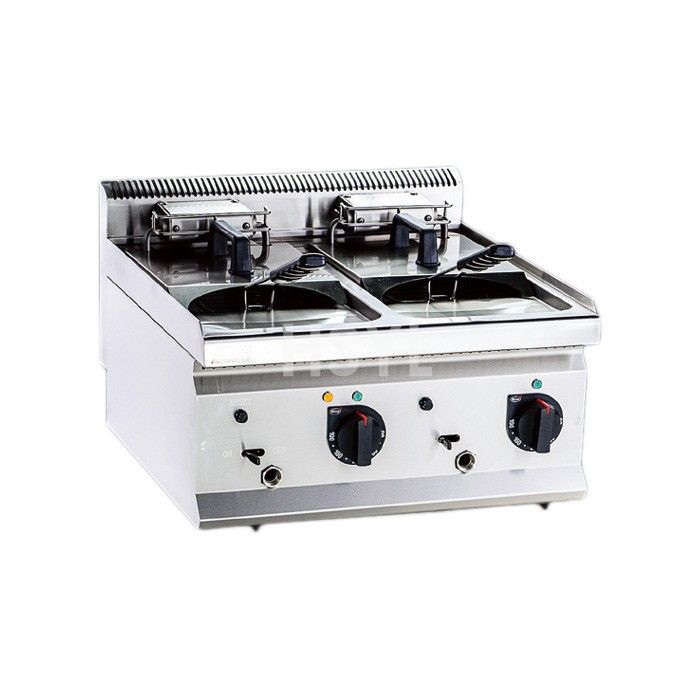
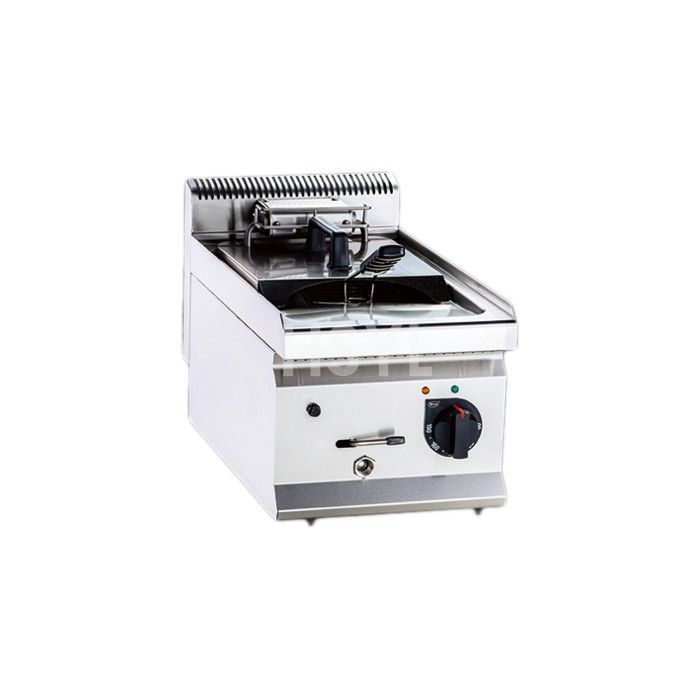
The catalog distinguishes HF9040-G, listed with one 28 L tank, from HF9080-G, listed with two 28 L tanks. It also lists smaller HDF8 and HDF8+8 countertop arrangements. A pair of small tanks should not be treated as equivalent to one larger tank just because their nominal volumes add to the same number.
Check each basket's usable dimensions against the product. A long item may fit a larger basket but not either small one. Compare how the food is placed, turned if required and removed. The frying duty assessment should retain these product-shape limits.
Ask what is actually independent
For a twin-tank offer, confirm the controls, heating arrangements and permitted operating combinations. Ask whether one tank may operate while the other is off and how routine oil handling is organized. Do not infer electrical isolation or service independence from the presence of two control knobs.
Have the supplier identify any shared components relevant to availability. If a kitchen plans to rely on one side during a fault or service intervention, that operating arrangement must be permitted for the delivered appliance. Count useful backup only after this question is resolved.
Price the repeated work
Compare oil fills, approved filtering or emptying equipment, cleaning access and the parts that staff handle for each tank. Include any separate basket set needed by the menu. Clarify which fryer accessories are supplied and which remain to be purchased.
Select the arrangement that resolves the named conflicts in the order sequence. If every product uses the same duty and the main restriction is basket area, a second small tank may be less useful than expected. If distinct duties must run together, document their allocation so that the separation survives the first busy service.