Direct Answer / Key Takeaway: Engineering guide to commercial meat slicer blade sizes (250mm–350mm), 45 gravity feed vs. 90 vertical feed, gear vs. belt drive for cheese slicing, NSF/ANSI 8 sanitation, and 5-year TCO.
Specifying a commercial meat slicer requires matching three mechanical parameters to your daily protein and cheese volume: rotary blade diameter (250 mm / 10 in. to 400 mm / 15.7 in.), product carriage feed geometry (45° Gravity Feed vs. 0° Vertical Feed), and transmission drivetrain architecture (Poly-V belt drive vs. oil-bath worm gear drive). Attempting to slice high-drag dairy blocks (cheddar, mozzarella) or tempered sub-zero meats (-4°C to 0°C / 25°F to 32°F) on an undersized belt-driven slicer causes severe belt slip, motor thermal overload, and tapered "wedge" slices that destroy portion cost control.
- Blade Diameter vs. Usable Cutting Envelope: Never equate blade diameter with maximum product width. Because the center hub and mounting bolts occupy the middle of the disc, the usable cross-sectional cutting capacity of a rotary slicer is strictly 0.62 × to 0.68 × the nominal blade diameter.
- 38°–45° Gravity Feed vs. 0° Vertical Feed: Gravity-feed carriages utilize the natural weight of the meat log to advance product against the gauge plate, making them the gold standard for general restaurant, deli, and hotel prep; vertical-feed (0°) carriages with dual-axis mechanical clamps eliminate gravity deformation for ultra-thin prosciutto, carpaccio, and precision charcuterie.
- Cheese & Tempered Meat Torque Duty: Slicing cheese for more than 30 minutes per shift or slicing tempered frozen beef/lamb rolls requires a minimum 0.37 kW to 0.55 kW (0.5 to 0.75 HP) gear-driven or dual-motor automatic drivetrain paired with a hollow-ground, hard-chromed 100Cr6 carbon steel blade or PTFE-coated anti-friction knife.
- NSF/ANSI Standard 8 Sanitation Compliance: High-volume commissaries must verify tool-free carriage removal, one-piece anodized aluminum or AISI 304 castings, and zero-clearance knife ring guards compliant with NSF/ANSI Standard 8 to prevent Listeria monocytogenes harborage during mandatory 4-hour washdowns.
Key takeaway: Specifying a commercial meat slicer requires matching three mechanical parameters to your daily protein and cheese volume: rotary blade diameter (250 mm / 10 in. to 400 mm / 15.7 in.), product carriage feed geometry (45° Gravity Feed vs. 0° Vertical Feed), and transmission drivetrain architecture (Poly-V belt drive vs. oil-bath worm gear drive). Attempting to slice high-drag dairy blocks (cheddar, mozzarella) or tempered sub-zero meats (-4°C to 0°C / 25°F to 32°F) on an undersized belt-driven slicer causes severe belt slip, motor thermal overload, and tapered "wedge" slices that destroy portion cost control.
Mechanical Kinematics of Rotary Slicing: Gravity Feed vs. Vertical Feed & Drivetrain Torque
A commercial meat slicer operates as a precision lathe for viscoelastic food logs. As the circular hollow-ground knife rotates at 280 to 350 rpm (producing a peripheral cutting edge linear velocity of 4.7 to 6.4 m/s), the operator or automatic carriage drives the product log horizontally across the Adjustable Gauge Plate (index plate). Slice thickness uniformity (0.2 mm tissue-thin prosciutto up to 18 mm steak cuts) is governed by the flexural rigidity of the gauge plate, the lateral stiffness of the knife shaft bearings, and how consistently the product face is pressed against the gauge plate throughout the cutting stroke.
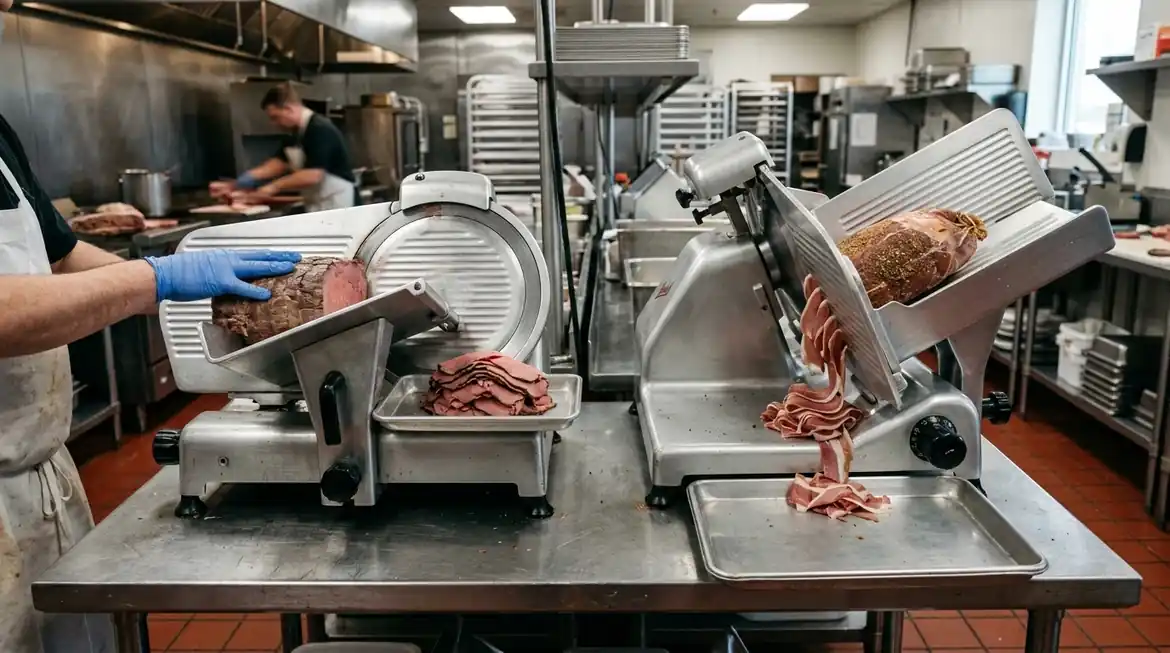
Inclined Gravity-Feed (38° to 45°) vs. Vertical-Feed (0°) Carriage Mechanics
Within our Equipment Selection engineering framework, the angle of the product table relative to the rotary knife plane dictates both operator ergonomics and slice geometry:
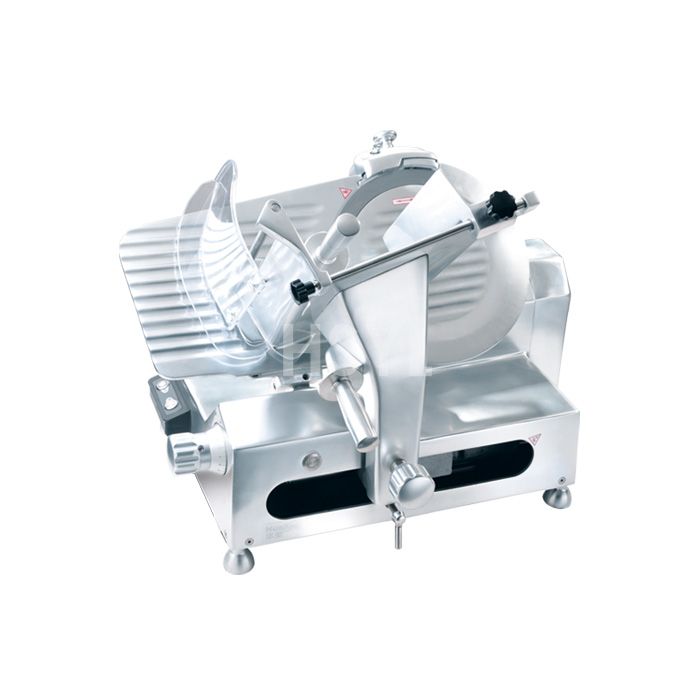
- Inclined Gravity-Feed Slicers (38° to 45° Chute Angle): The product table and gauge plate are tilted at an angle of 38° to 45° from vertical. Gravity resolves the mass (m · g) of the food log into a normal force vector (FN = m · g · sinθ) that continuously seats the cut face flat against the gauge plate without requiring the operator to manually adjust a spring clamp after every stroke. Paired with a pivoted toothed end-weight (pusher), gravity-feed slicers deliver the fastest loading and changeover speed for boneless meats, turkey breast, roast beef, bacon slabs, firm cheeses, and vegetables (tomatoes, onions, lettuce).
- Vertical-Feed Slicers (0° Perpendicular Table): The product carriage moves on a strictly horizontal plane perpendicular to a vertical blade (0° tilt). Because gravity pulls the log downward onto the carriage bed rather than forward into the gauge plate, vertical slicers avoid crushing soft or delicate bottom edges under the weight of a heavy upper log. Instead, a ratcheting mechanical pantograph arm clamps the product from above and advances it via a positive lead-screw increment. Vertical feed is preferred by artisanal charcuterie counters and prosciutto/biltong processors where visual slice presentation and zero bottom-edge compression are paramount.
Rotary Knife Tangential Velocity, Viscous Friction Torque & Throughput Equations:
- Peripheral Cutting Edge Velocity (vtip in m/s):
vtip = (π · Dblade · Nrpm) / (60,000) - Required Slicing Shaft Torque (τcut in N·m):
τcut = ( Fshear + μfriction · Acontact · Pnormal ) · (Deff) / (2) - Hourly Sliced Mass Throughput (Mslice in kg/h):
Mslice = (60 · Scpm · Alog · tslice · ρproduct · ηload) / (1,000,000) - Dblade = Nominal rotary knife diameter (250 mm to 400 mm)
- μfriction = Coefficient of sliding friction between food log and blade flank (0.18 to 0.25 for chilled meat; 0.55 to 0.82 for warm cheddar/mozzarella cheese)
- Scpm = Carriage reciprocation rate (35 to 60 strokes/min on automatic models)
- tslice = Dialed slice thickness (mm) and ρproduct = Product density (≈ 1,040 to 1,080 kg/m3)
Transmission Drivetrain Physics: Poly-V Belt Drive vs. Oil-Bath Worm Gear Drive
Why do entry-level slicers stall when slicing mozzarella or tempered sub-zero beef rolls? The answer lies in the coefficient of sliding friction (μfriction) and the drivetrain torque curve:
- Poly-V Ribbed Belt Drive: Transfers motor rotation to the knife hub via a multi-ribbed elastomeric belt. Poly-V belts run quietly (≤62 dBA), absorb shock loads, and are inexpensive to replace. However, when slicing high-moisture cheeses (whose casein-fat matrix smears against the steel blade cheek, tripling frictional drag) or semi-frozen meat rolls (-4°C), the resistive torque exceeds the static friction limit of the belt pulley. The belt slips, glazes, and loses up to 35% of blade RPM—causing ragged tearing instead of clean shearing.
- Helical / Worm Gear Drive (Oil-Bath Gearbox): Employs a hardened bronze worm wheel meshing directly with a precision-ground alloy steel motor worm shaft inside a sealed lubricating bath. Gear drives provide zero-slip positive mechanical engagement, maintaining full blade torque even at high axial gauge-plate pressures. For supermarkets, central commissaries, and pizzerias slicing cheese blocks or frozen hot-pot meat logs for 4 to 8 hours daily, a gear-driven or dual-motor automatic slicer is mandatory.
Engineering Specification & Blade Sizing Matrix: 10" vs. 12.6" (320 mm) vs. 14"–16" (350–400 mm)
Buyers browsing our Food Preparation Equipment catalog frequently ask whether a 10-inch (250 mm), 12.6-inch (320 mm), or 14-to-16-inch (350 to 400 mm) blade is required. The engineering rule is dictated by the maximum cross-sectional width of your food log and whether you require manual push operation or synchronized dual-motor automatic carriage reciprocation.
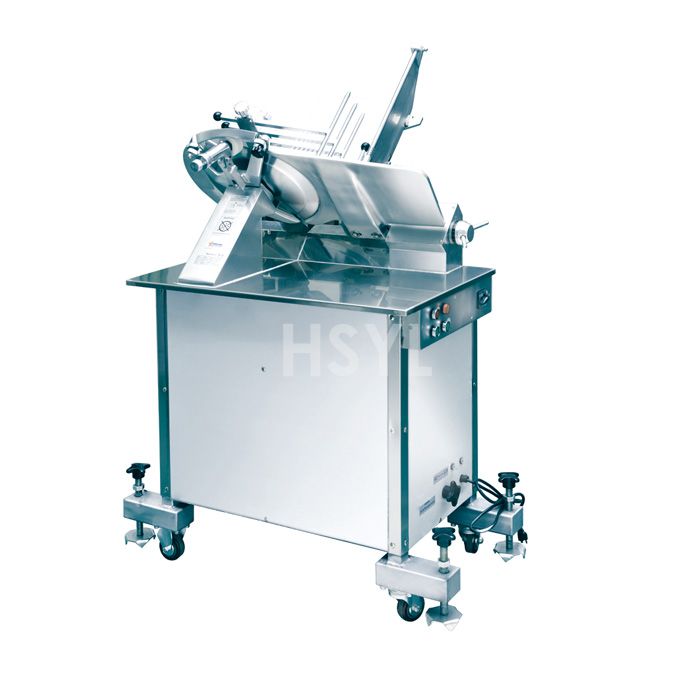
Below is the verified specification matrix comparing standard industry blade classes alongside HSYL's live production models—covered in detail on our Commercial Meat Slicers hub and individual SKU sheets for the Commercial Meat Slicer FP-HB-320, the Commercial Meat Slicer FP-HB-350400, and the high-output Commercial Meat Slicer FP-HCS500:
| Specification Parameter | Light-Duty 10" (250 mm) Reference | HSYL FP-HB-320 (12.6" / 320 mm) | HSYL FP-HB-350400 (14"–15.7" / 350–400 mm) | HSYL FP-HCS500 (High-Output Industrial) |
|---|---|---|---|---|
| Nominal Blade Diameter (Dblade) | Ø 250 mm (9.8 in.) | Ø 320 mm (12.6 in.) | Ø 350 mm / Ø 400 mm (13.8–15.7 in.) | Heavy-Duty High-Speed Industrial Cutter |
| Max Rectangular Cutting Envelope (W × H) | 180 × 135 mm (7.1 × 5.3 in.) | 220 × 175 mm (8.7 × 6.9 in.) | 260 × 200 mm (10.2 × 7.9 in.) | Continuous Chute / Multi-Log Industrial Feed |
| Max Circular Log Diameter | Ø 160 mm (6.3 in.) | Ø 210 mm (8.3 in.) | Ø 240–270 mm (9.4–10.6 in.) | Up to 500 mm Width Processing Class |
| Adjustable Slice Thickness Range | 0.5 to 12 mm | 0 to 18 mm (Stepless Index) | 0 to 18 mm (Heavy Gauge Plate) | Precision Portion Slicing Configuration |
| Carriage Feed Mode & Speed | Manual Push Only | Manual or Auto Reciprocation (40–45 cpm) | Dual-Motor Automatic + Manual Clutch (45 cpm) | Automated Continuous High-Speed Drive |
| Motor Power Rating (Blade + Carriage) | 0.18 to 0.25 kW (0.25–0.33 HP) | 0.37 kW Blade + 0.37 kW Carriage | 0.55 kW Blade + 0.37 kW Carriage | 0.55 kW (0.75 HP) Heavy Industrial Torque |
| Daily Continuous Operating Duty & Cheese Rating | ≤ 1 hr/day (No Cheese / No Frozen) | 2 to 4 hrs/day (Chilled Meat, Deli & Firm Cheese) | 4 to 8 hrs/day (Tempered -4°C Rolls & Cheese) | 6 to 10 hrs/day Central Kitchen Production |
| Overall Dimensions (L × W × H) & Net Weight | 480 × 390 × 380 mm (18 kg) | 650 × 600 × 750 mm (64 kg) | 720 × 660 × 820 mm (78–86 kg) | 860 × 480 × 810 mm (105 kg) |
Manual vs. Dual-Motor Automatic Carriage Reciprocation
On the FP-HB-320 and FP-HB-350400 series, an independent secondary drive motor reciprocates the gravity-feed carriage automatically at 40 to 45 strokes/min, while a mechanical clutch lever allows instant disengagement into manual push mode for small custom orders. During peak prep windows in hotel banquet kitchens, hot-pot chains, and school commissaries, automatic reciprocation frees the operator to shingle, weigh, and vacuum-tray sliced portions while the machine executes 2,400 to 2,700 uniform cuts per hour.
Regulatory, Sanitation & Operator Safety Compliance: NSF/ANSI 8, FDA 4-Hour Teardown & OSHA Guarding
Commercial meat slicers represent one of the highest-scrutiny equipment categories during both public health inspections and occupational safety audits. Across the United States and Europe, retail delis and central kitchens have faced strict regulatory enforcement over two critical hazards: microbiological biofilm colonization inside blind blade housings and laceration injuries during blade wiping.
- NSF/ANSI Standard 8 & FDA Food Code 4-Hour Sanitization Rule: Under NSF/ANSI Standard 8 and FDA 21 CFR Part 117 (alongside FDA Food Code Section 4-602.11), any meat slicer operating in a room at ambient temperature (≥4.4°C / 40°F) that contacts Time/Temperature Control for Safety (TCS) foods must be completely disassembled, washed, rinsed, and sanitized at least once every 4 hours. Recent epidemiological investigations have proven that worn rubber O-rings, cracked plastic knobs, and unsealed crevices behind the center blade hub trap warm meat exudate and fat, forming an insulated harbourage for Listeria monocytogenes. When specifying equipment, pair your slicer SOP with our engineering protocol on Cleaning Verification for Commercial Kitchen Equipment: From Visual Inspection to Evidence.
- Zero-Exposure Gauge Plate Interlock & Permanent Ring Guard (OSHA 29 CFR 1910.212): Per OSHA 29 CFR 1910.212, the rear perimeter of the rotary knife must be enclosed by a permanent metallic knife ring guard with radial clearance ≤ 1.5 mm from the bevel edge. In addition, modern heavy-duty slicers incorporate a gauge-plate carriage interlock: the product carriage cannot be tilted open or removed for cleaning unless the thickness dial is rotated fully below zero (
-1safety lock position), where the gauge plate physically overlaps and shields the forward cutting edge. - No-Volt Release (NVR) Magnetic Switch Protection: Industrial slicers (
FP-HB-320,FP-HB-350400,FP-HCS500) utilize latching magnetic contactors with a No-Volt Release circuit. If a facility power outage occurs or the thermal overload trips while the slicer is running, the machine will not spontaneously restart when electricity is restored until the operator physically presses the green start push-button.
Sanitary Disassembly Engineering: Tool-Free Carriage Release & Safe Blade Extraction
During a mandatory 4-hour HACCP sanitation cycle, operator compliance depends directly on mechanical teardown speed. If disassembling the product chute and knife cover requires hex wrenches or exposes the dishwasher staff to an unguarded razor edge, staff routinely take shortcuts—wiping only the visible front face of the blade with a damp towel while leaving emulsified fat and protein exudate trapped inside the rear ring-guard channel.
On HSYL commercial slicers, turning the micrometer dial past 0 into the safety lock position activates the carriage tilt-release knob, allowing the entire anodized aluminum chute assembly, slice deflector, and center blade cover tie-rod to be detached in under 45 seconds without tools. For deep nightly sanitation, a dedicated three-point acrylic or stainless blade removal tool (knife extractor) bolts over the exposed cutting edge and lifts the hollow-ground disc off the spindle hub without human fingers ever approaching the 60 HRC bevel—eliminating the single leading cause of commercial kitchen cut injuries even when ANSI Level A5 cut-resistant stainless mesh gloves are worn.
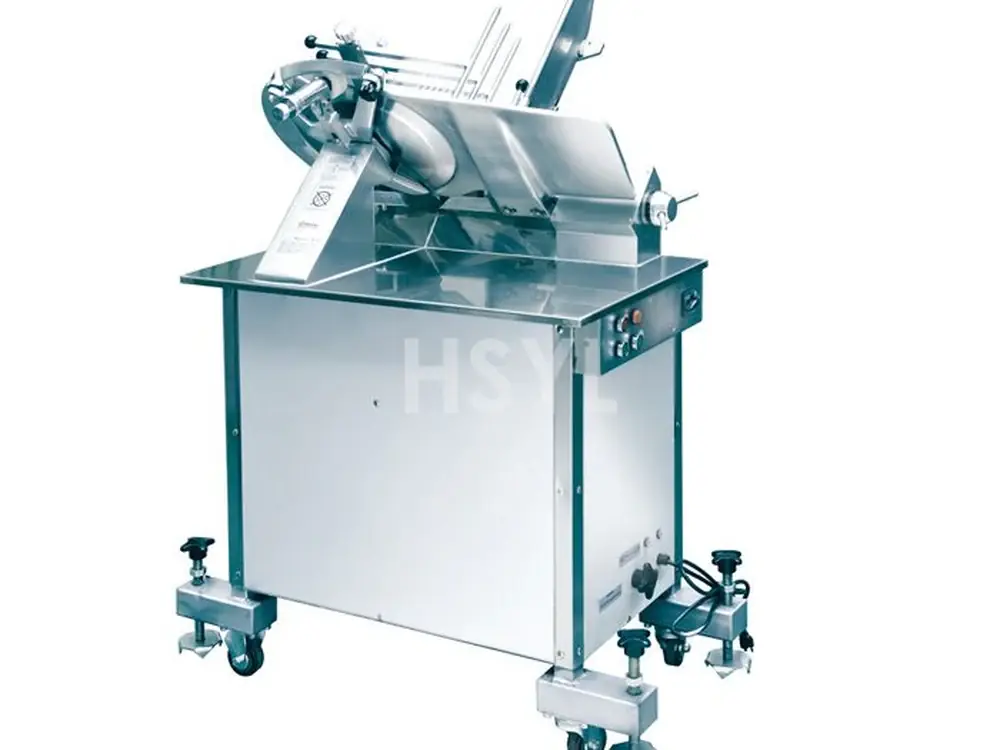
Blade Metallurgy & Thermal Tempering Physics: Hollow-Ground 100Cr6 vs. German 440C Stainless
Why Concave Hollow-Ground Blade Geometry Prevents Slice Tearing & Wedge Cuts
If you lay a straightedge across the front face of a commercial meat slicer blade (FP-HB-320 or FP-HB-350400), you will observe that the face is not flat—it is precision-machined into a concave spherical dish (hollow grind) between the outer cutting bevel and the inner mounting hub. If a flat disc blade were used to slice a 200 mm roast beef log or block of cheddar, the entire newly cut slice and the parent food log would rub against 80 cm2 of spinning steel surface area. That massive sliding contact creates frictional heat that melts fat, smears cheese, and pulls the slice downward, tearing the bottom edge and causing the blade to deflect outward into a tapered wedge cut.
With a concave hollow-ground blade, only the outer 2.5 mm to 4.0 mm primary cutting bevel physically contacts the food log. Immediately after the bevel shears through the muscle fibers, the concave relief zone drops away by 1.8 mm to 3.2 mm, reducing sliding contact area by more than 88%. For high-volume cheese slicing (mozzarella, Swiss, provolone), specify a blade with radial relief grooves or a baked-on fluoropolymer (PTFE / Teflon) low-friction coating, which breaks the vacuum suction seal between wet dairy proteins and the knife cheek.
Blade Alloy Metallurgy: Hard-Chromed 100Cr6 Carbon Steel vs. 440C Martensitic Stainless
- Forged 100Cr6 (SAE 52100) High-Carbon Bearing Steel with Hard Chrome Plating: The premier choice for precision charcuterie, prosciutto, and high-volume meat slicing. Heat-treated to 58 to 62 HRC (Rockwell C) and electroplated with a 12 to 18 μm industrial hard-chrome layer (65 to 68 HRC surface hardness), 100Cr6 takes a significantly finer carbide grain edge (18° to 22° bevel angle) and retains sharpness 1.8 × longer than standard stainless steel.
- Martensitic Stainless Tool Steel (9Cr18Mo / AISI 440C): Hardened to 56 to 58 HRC throughout the entire thickness of the disc. Because corrosion resistance is alloyed throughout the homogeneous steel matrix (17% Cr) rather than relying on an outer chrome plating that is ground away at the bevel during sharpening, 440C stainless blades resist rusting along the sharpened edge in high-acid vegetable, pickle, and wet-brine deli stations.
The Physics of Tempering Frozen Meat (-4°C to 0°C) Before Slicing
A frequent cause of shattered blades, stripped carriage gears, and burned-out motors is attempting to slice rock-hard frozen meat blocks straight from a -18°C (0°F) freezer on a standard rotary blade slicer. At -18°C, intracellular water inside skeletal muscle is 92% crystallized into high-compressive-strength ice. Forcing a thin hollow-ground rotary bevel into -18°C ice induces lateral blade flutter, chips the microscopic carbide edge, and stalls the carriage drive.
To achieve paper-thin 1.0 mm to 2.0 mm hot-pot rolls, shabu-shabu beef, or gyros slices without tearing, frozen meat logs must be tempered (slackened) in a controlled tempering cabinet to an internal core temperature of -4°C to -2°C (24.8°F to 28.4°F). Within this sub-zero cryo-tempering window, roughly 55% to 65% of the water remains in semi-crystalline ice needles that provide structural rigidity to the cylinder so it does not squash under the end-weight, while the remaining unfrozen bound water lubricates the hollow-ground bevel for effortless shearing on the FP-HB-320 or FP-HB-350400.
5-Year Total Cost of Ownership (TCO), Butt-End Yield Loss & Labor Payback Analysis
In a commercial kitchen or supermarket deli slicing 45 kg/day (100 lbs/day) of cooked roast beef, turkey breast, ham, and provolone cheese (_ESCDOLLAR_11.50/kg blended protein cost, 350 days/year), the largest hidden financial drain is not electricity—it is portion weight over-slicing (from gauge plate flex on light-duty machines) and unsellable butt-end waste. Evaluate the 5-year TCO comparison below:
| Cost Component (5-Year Cumulative) | Entry-Level 10" (250 mm) Manual Belt Slicer | HSYL FP-HB-320 (320 mm Auto/Manual Dual Drive) | HSYL FP-HB-350400 (350/400 mm Heavy Auto Slicer) |
|---|---|---|---|
| Initial Equipment Acquisition CAPEX | $650 (Replaced 2.5 × in 5 Years = $1,625) | $1,850 (Single 7+ Year Industrial Unit) | $2,480 (Single 10+ Year Industrial Unit) |
| Gauge-Plate Deflection & Portion Over-Weight Loss (On 78,750 kg Total 5-Year Protein Volume) | $38,030 (4.2% Wedge-Cut & Thickness Drift) | $7,245 (0.8% Precision Micrometer Hold) | $4,528 (0.5% Ultra-Rigid Gauge Plate) |
| Butt-End Remnant Waste (End-Weight Grip Clearance at Log Termination) | $19,920 (2.2% Remnant Loss + Pre-Trimming) | $8,150 (0.9% Articulated Gripper Teeth) | $6,340 (0.7% Full-Width Log Acceptance) |
| 5-Year Direct Slicing & Prep Labor (Calculated at _ESCDOLLAR_18.00/hr Loaded Kitchen Wage) | $78,750 (2.5 hrs/day Manual Arm Pushing) | $31,500 (1.0 hr/day Auto Carriage Shingling) | $25,200 (0.8 hr/day High-Stroke Auto Feed) |
| 5-Year Replacement Blades, Stones & Belts | $1,480 (Frequent Belt Burnout & Cheap Knives) | $620 (2 Hollow-Ground Blades + Honing Stones) | $740 (2 Hollow-Ground Blades + Honing Stones) |
| Total 5-Year Lifecycle Cost (TCO) | $139,805 (Severe Yield & Labor Penalty) | $49,365 (Saves $90,440 over 5 Years) | $39,288 (Saves $100,517 over 5 Years) |
Engineering ROI Conclusion: Upgrading from a light-duty manual 10-inch slicer to an automatic 320 mm (FP-HB-320) or 350/400 mm (FP-HB-350400) heavy-duty gravity slicer pays for its entire acquisition price in under 36 days strictly by eliminating wedge-slice portion giveaway and cutting daily prep labor by 60%.
Discuss Your Deli & Commissary Slicing Specifications with HSYL Engineers
Tell HSYL your daily protein and cheese slicing volume, log cross-section dimensions, and target slice thickness range. We help you select between manual gravity-feed and automatic reciprocating carriage slicers. Contact HSYL for Meat Slicer Configuration & Quote Support.