Direct Answer / Key Takeaway: Compare abrasive carborundum, knife-blade, and brush-roller commercial potato peelers across peel loss %, kg/hr batch sizing, starch interceptors, and TCO.
Within our Commercial Kitchen Equipment Selection Hub, root-vegetable pre-processing is frequently miscalculated because project planners equate nominal machine drum volume with net hourly edible yield. Over-timing a batch of thin-skinned new potatoes by just 45 seconds in a coarse abrasive drum increases flesh waste from 9% to 22%, while discharging unstrained potato starch slurry directly into a building floor drain solidifies inside horizontal plumbing traps within weeks. This engineering specification guide evaluates centrifugal carborundum drum peelers, stamped knife-blade peelers, and continuous brush-roller machines across our Commercial Potato Peelers lineup—covering batch sizing formulas, starch interceptor plumbing, and 5-year Total Cost of Ownership (TCO).
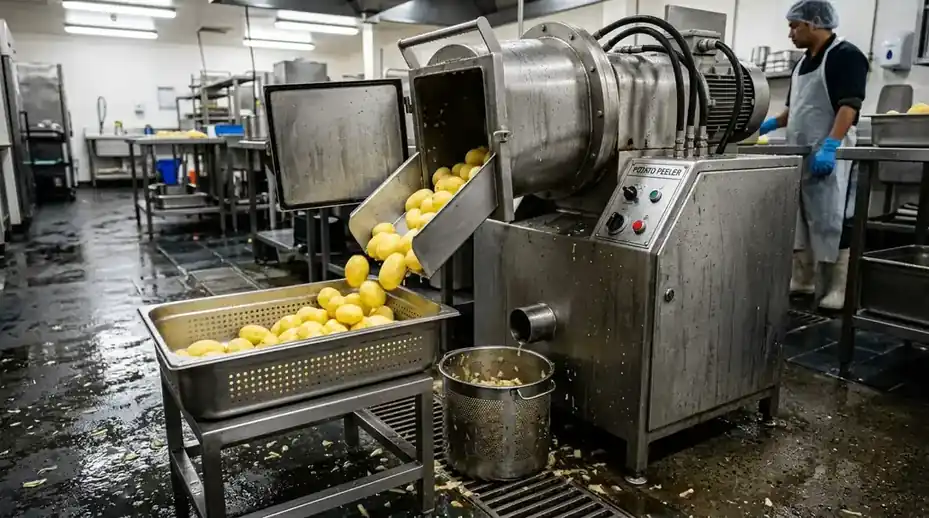
Key takeaway: Selecting a commercial potato peeler machine is governed by acceptable flesh yield loss, tuber skin morphology, and hourly mass throughput: centrifugal silicon-carbide (carborundum) abrasive peelers process 10 kg to 30 kg batches in 60–90 seconds (150–800 kg/hr) with 8%–12% peel loss, knife-blade disc peelers preserve a smooth hand-peeled surface finish with 5%–7% waste, and horizontal 9-roller brush machines handle 800–1,500 kg/hr continuously.
Mechanical Peeling Kinematics: Abrasive Carborundum vs. Knife-Blade vs. Brush Rollers
Root crops (potatoes, carrots, taro, beets, celeriac, and ginger) exhibit widely varying periderm (skin) thickness and geometry. Commercial peeling machinery utilizes three distinct mechanical friction or shear principles to strip the outer periderm without cooking the subsurface starch layer.
Centrifugal Abrasive (Silicon Carbide / Carborundum) Drum Architecture
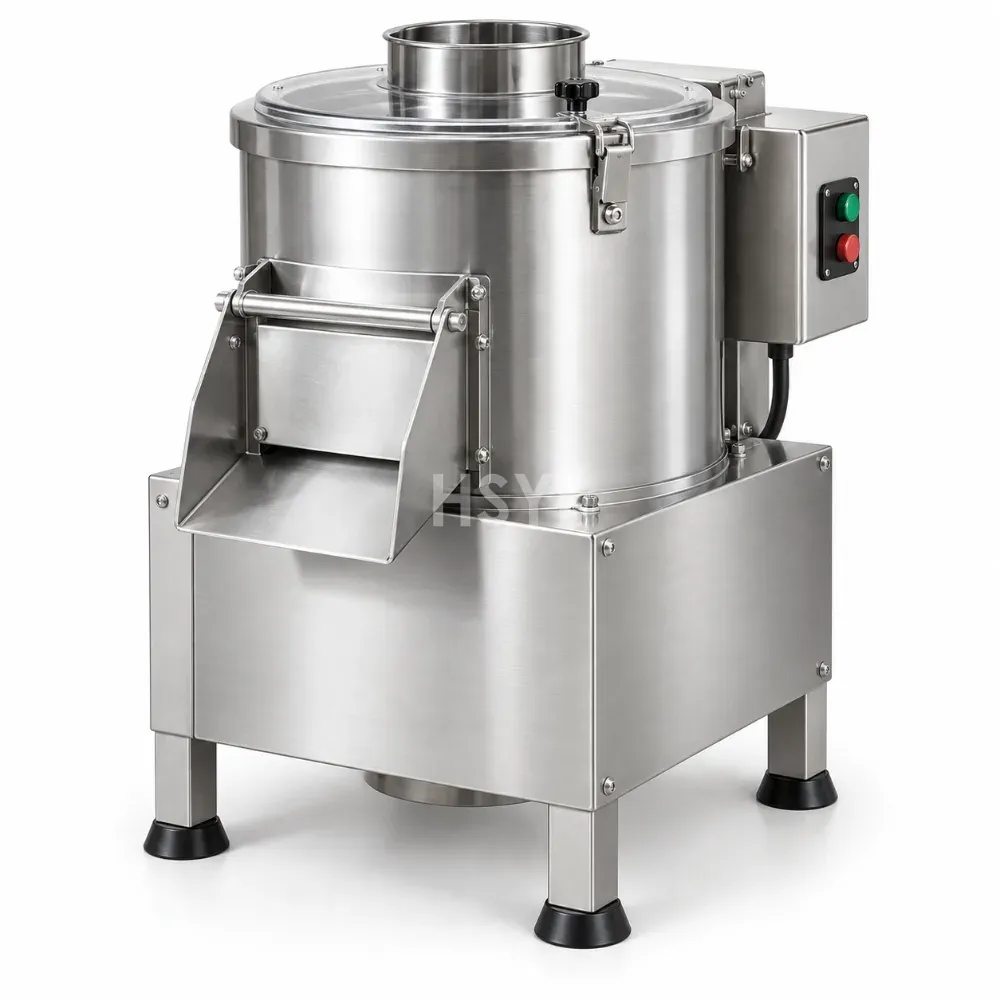
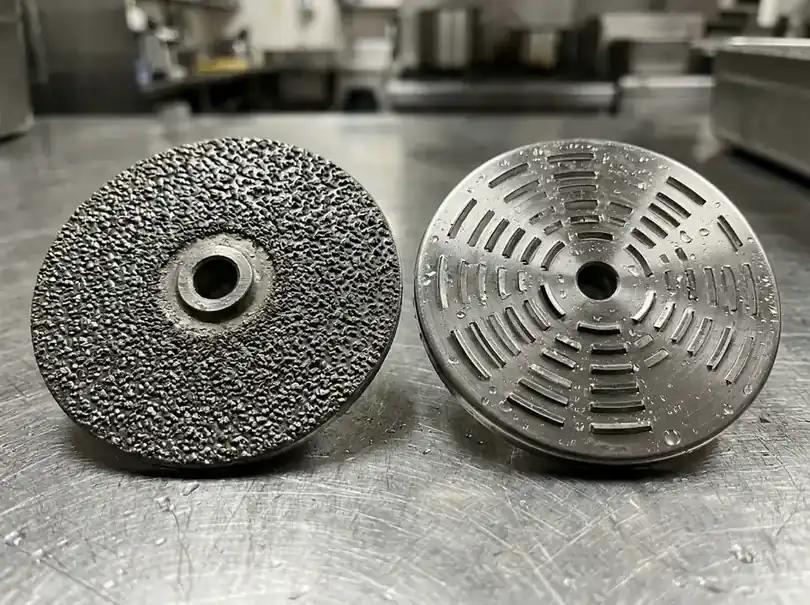
In a standard vertical batch peeler (such as the YL-PP-10, YL-PP-15, and YL-PP-30), unpeeled tubers are loaded through a top hopper onto a horizontally rotating cast-aluminum or stainless steel bottom disc spinning at 280 to 360 RPM. Both the rotating base plate and the stationary vertical cylinder wall are bonded with fused 30-to-46-grit silicon carbide (SiC / carborundum) aggregate.
- Baffle-Induced Tumbling Kinetics: An integral eccentric wave-baffle molded into the rotating disc or cylinder wall flips the tubers radially inward as centrifugal force pushes them outward. This three-dimensional tumbling ensures uniform skin abrasion across oval and round potatoes within 60 to 90 seconds.
- Continuous Water-Flushing Manifold: A 1/2-inch solenoid-controlled cold water spray ring at the top of the drum flushes abraded periderm particles and free starch granules downward through perimeter clearance slots into the drain base, preventing wet skin paste from glazing over the sharp silicon-carbide grit.
- Surface Micro-Texture: Abrasive peeling leaves a slightly matte, micro-roughened surface texture. For French fries, roast potatoes, and battered wedges, this micro-roughness increases oil-contact surface area and produces a crispier fried crust; however, if held exposed to air without water immersion, the ruptured surface cells oxidize faster than knife-peeled tubers.
Centrifugal Knife-Blade (Slotted Shaving Disc) Architecture
Knife-blade disc peelers utilize the same vertical cylindrical footprint as abrasive batch units but replace the silicon-carbide grit plate with a precision-stamped, hardened AISI 420 martensitic stainless steel knife disc containing radial arrays of raised 1.2mm micro-slotted shaving edges.
- Pure Mechanical Shear (Hand-Peeled Finish): Instead of grinding the skin into microscopic slurry, the raised radial blades shave off thin ribbons of periderm. Because plant parenchyma cells beneath the cut plane remain uncompressed, enzymatic browning is delayed and the potato retains a glossy, translucent "hand-peeled" appearance required for boiled hotel banquet potatoes and vacuum-packed fresh tubers.
- Superior Edible Yield: Knife-blade discs reduce average peel loss to 5%–7% by weight (compared to 8%–12% on carborundum abrasive drums), saving 30 to 50 kg of edible flesh per metric ton of raw potatoes processed.
Horizontal Continuous 9-Roller Brush Architecture
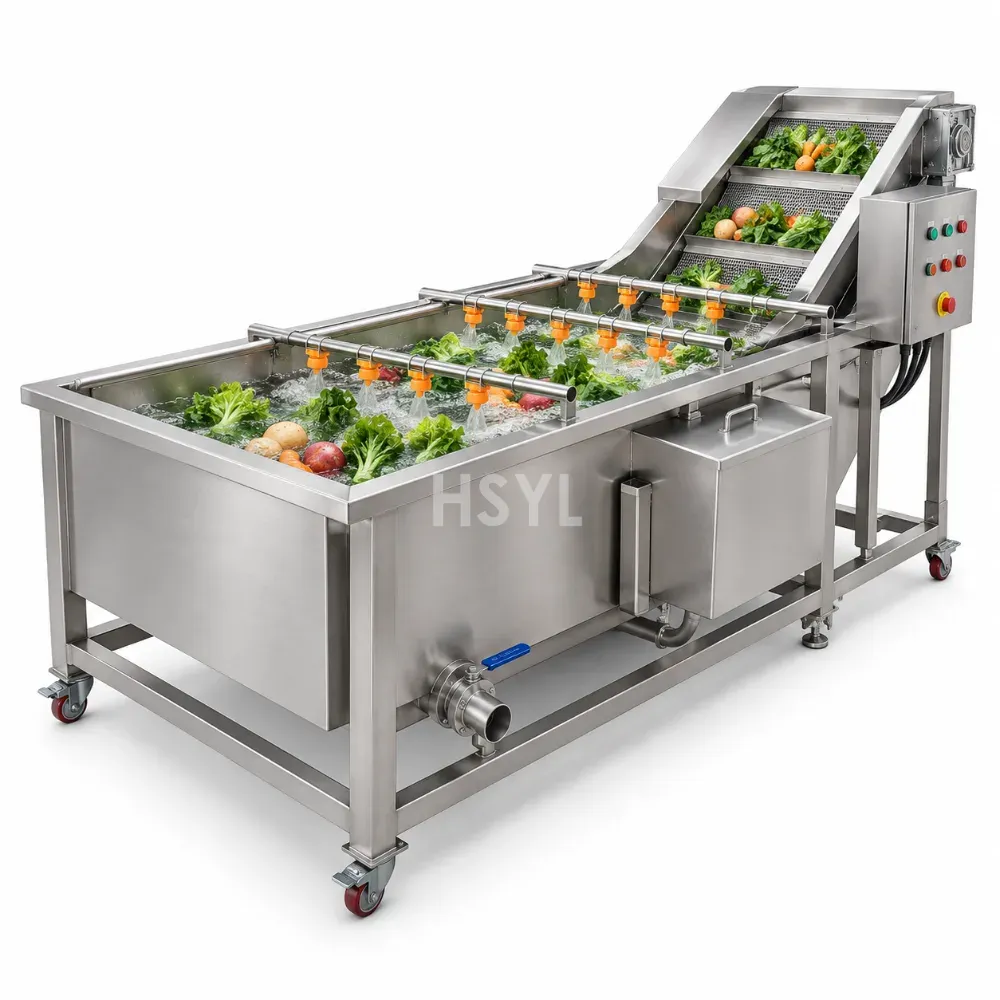
For industrial central commissaries and ready-meal factories processing over 800 kg/hr, intermittent batch loading becomes a labor bottleneck. The YL-PP-1000B (and its companion YL-VW-800B Brush Roller Washer) employs nine parallel, counter-rotating horizontal rollers bristled with high-tensile DuPont Nylon 612 filaments (0.6mm–0.8mm diameter, optionally impregnated with silicon carbide grit) combined with a variable-speed internal auger screw.
- Concave Pocket Scrubbing: Unlike rigid abrasive discs that bridge over recessed potato eyes and concave root crevices, flexible nylon bristles reach into irregular indentations on ginger rhizomes, sweet potatoes, carrots, and ungraded field potatoes.
- Continuous First-In-First-Out (FIFO) Flow: The internal stainless auger advances tubers axially from the infeed end to the discharge chute under a high-pressure overhead spray manifold, enabling direct conveyor coupling to downstream Commercial Vegetable Cutters & Dicers.
Engineering Specification & Sizing Matrix: 10 kg Batch to 1,500 kg/hr Continuous
A frequent sizing mistake in institutional tenders is multiplying a peeler's batch load by 60 minutes without accounting for the 45 to 60 seconds required between cycles to open the discharge chute, empty the drum, close the latch, and dump the next crate of raw tubers. Real-world operational duty equals 15 to 18 batches per hour (not 30–40 theoretical batches). The matrix below provides realistic net throughput ratings across our core model lineup:
| Engineering Parameter | Compact Batch Peeler (YL-PP-10) | Standard Canteen Peeler (YL-PP-15) | Heavy-Duty Commissary Peeler (YL-PP-30) | Continuous 9-Roller Peeler (YL-PP-1000B) |
|---|---|---|---|---|
| Peeling Mechanism | Centrifugal Carborundum Disc (Knife Disc Optional) | Abrasive Base Disc + Replaceable SiC Drum Liner | Reinforced SiC Disc + Full-Height Abrasive Drum | 9 Rotary Abrasive/Nylon Brush Rollers + Auger |
| Rated Batch Load Capacity | 10 kg (22 lbs) per cycle | 15 kg (33 lbs) per cycle | 30 kg (66 lbs) per cycle | Continuous Auger Flow (120 kg chamber hold) |
| Active Peeling Cycle Time | 60 – 90 Seconds | 60 – 90 Seconds | 75 – 110 Seconds | Continuous VFD Residence (90–150 Seconds) |
| Net Hourly Output (Realistic vs Peak) | 150 – 250 kg/hr (330 – 550 lbs/hr) | 250 – 400 kg/hr (550 – 880 lbs/hr) | 500 – 800 kg/hr (1,100 – 1,760 lbs/hr) | 800 – 1,500 kg/hr (1,760 – 3,300 lbs/hr) |
| Motor Power & Electrical Supply | 0.55 kW (0.75 HP) | 220V/1Ph | 0.75 kW (1.0 HP) | 220V/1Ph or 380V/3Ph | 1.5 kW (2.0 HP) | 380V/3Ph (220V Opt) | 2.2 kW (3.0 HP) | 380V–415V/3Ph |
| Fresh Water Consumption Rate | 3.5 – 5.0 L/min (1/2" BSP Inlet) | 5.0 – 7.5 L/min (1/2" BSP Inlet) | 8.0 – 12.0 L/min (3/4" BSP Inlet) | 15.0 – 22.0 L/min (High-Pressure Spray Header) |
| Starch & Peel Interceptor | External Drain Hose + Fine Mesh Filter Bag | Perforated AISI 304 Under-Drain Strainer Basket | Enclosed Multi-Baffle Starch Settling Tank | Full-Length Bottom Sump + Wedge-Wire Screen |
| Recommended Dining Facility Scale | 100 – 350 Meals/Shift (Bistros, Cafés) | 350 – 1,200 Meals/Shift (Hotels, Schools) | 1,200 – 4,000 Meals/Shift (Hospitals, Canteens) | 4,000 – 20,000+ Meals/Day (Central Kitchens) |
Regulatory Compliance, Safety Interlocks & Plumbing Starch Interception
Commercial potato peelers operate in wet, high-starch floor environments and combine high-inertia rotating discs with side-opening discharge chutes. Specifying engineers must enforce three regulatory and MEP standards:
- Sanitation & Tool-Free Disc Removal (NSF/ANSI Standard 8): Under NSF/ANSI 8 guidelines for commercial powered food preparation equipment, the rotating peeling disc must lift vertically off the central drive spline without wrenches so operators can flush out trapped potato eyes and starch paste beneath the disc hub at the end of every shift. All splash-zone surfaces must be fabricated from corrosion-resistant AISI 304 stainless steel or food-grade anodized aluminum.
- Dual-Point Interlock Guarding (UL 763 & EN 13288 Food Processing Machinery Safety): A severe amputation and abrasion hazard exists if an operator reaches into the discharge chute to clear a wedged tuber while the carborundum plate is spinning. Compliant peelers integrate waterproof IP65 magnetic proximity switches on both the top loading hopper cover and the side discharge chute latch, wired to cut motor contactor power within 0.5 seconds if either access point is unlatched.
- Municipal Plumbing Code Solids & Starch Interception (IPC Chapter 10 Traps, Interceptors and Separators): Potato peelings and raw amylose/amylopectin starch granules have a specific gravity of 1.50 g/cm3. When discharged into standard building drains, raw starch settles rapidly in horizontal pipe runs and forms a concrete-hard plug that bypasses standard grease traps. Every commercial potato peeler must discharge through a dedicated perforated stainless steel solids basket (1.5mm–2.0mm mesh aperture) and a baffled starch sedimentation trap before entering the floor trench drain, as planned in our Utilities & Ventilation Engineering Hub.
Operational Yield Optimization: Controlling Peel Waste & Re-Gritting Schedules
In a central commissary peeling 1,000 kg of potatoes daily (350,000 kg/year), a 6% difference in peel waste represents 21,000 kg of lost raw produce annually. Controlling mechanical peel loss requires four engineering adjustments:
- Pre-Sorting Tuber Caliber (45–65mm vs. 70–95mm): When jumbo 90mm baking potatoes and small 45mm new potatoes are loaded into the same batch, the heavier jumbo tubers force the smaller potatoes against the abrasive wall with excessive normal force, grinding away 25% of the small tubers before the large tubers are clean. Grading raw potatoes into two size bands prior to loading cuts average batch waste by 3.5% to 4.8%.
- Digital Auto-Stop Countdown Timers: Never allow kitchen staff to run a centrifugal peeler manually "by ear." Over-running a 75-second cycle by just 30 seconds strips 4mm of pure edible cortex flesh after the skin is already gone. Specify digital relay timers (standard on the YL-PP-30) that shut off both the drive motor and the water solenoid valve automatically at 70–85 seconds.
- 80%–85% Drum Loading Factor: Under-loading a 30 kg peeler with only 8 kg of potatoes causes the tubers to bounce violently across the base disc rather than rolling smoothly against the side liner, bruising subsurface starch cells and causing black-spot discoloration during cooking. Maintain batch loads between 75% and 90% of rated drum capacity.
- Carborundum Re-Gritting & Liner Replacement Interval: Silicon carbide grit dulls after processing 45,000 to 60,000 kg of unwashed root crops (approximately 18 to 24 months in a standard canteen). When cycle times stretch beyond 130 seconds, replace the modular bolt-in stainless abrasive wall liner and re-bond or swap the base disc rather than extending cycle times.
Five-Year Total Cost of Ownership (TCO) & Labor Payback Model
To quantify the financial return of automated root peeling, the table below models a 5-year operational lifecycle for an institutional kitchen requiring 250 kg of peeled potatoes per day (87,500 kg/year; 437,500 kg over 5 years), comparing manual paring-knife labor against our YL-PP-15 (abrasive disc), YL-PP-15-K (knife-blade disc option), and YL-PP-30 heavy-duty peeler (modeled at $16.50/hr kitchen labor, $0.95/kg raw potato cost, $0.14/kWh electricity, and $3.20/m3 water/sewer).
| 5-Year Cost Metric (250 kg Net Peeled/Day) | Manual Knife Peeling (Baseline) | Abrasive Peeler (YL-PP-15, 15 kg Batch) | Knife-Blade Peeler (YL-PP-15-K, 15 kg Batch) | Heavy-Duty Peeler (YL-PP-30, 30 kg Batch) |
|---|---|---|---|---|
| Initial Equipment & Starch Trap CAPEX | $180 (Paring peelers & sinks) | $1,120 (Includes S/S strainer basket) | $1,340 (Includes AISI 420 knife disc) | $1,890 (Includes enclosed filter tank) |
| Daily Active Operator Time (incl. Eyeing) | 8.3 Man-Hours / Day (30 kg/hr manual) | 1.1 Man-Hours / Day (18 batches + eye trim) | 1.25 Man-Hours / Day (20 batches + eye trim) | 0.65 Man-Hours / Day (9 batches + eye trim) |
| 5-Year Cumulative Labor Cost ($16.50/hr) | $239,662 (14,525 labor hours) | $31,762 (1,925 labor hours) | $36,093 (2,187.5 labor hours) | $18,768 (1,137.5 labor hours) |
| Average Peel Flesh Loss % & 5-Year Raw Tuber Cost | 14.0% Loss ($483,285 raw potatoes) | 10.0% Loss ($461,805 raw potatoes) | 6.2% Loss ($443,102 raw potatoes) | 9.5% Loss ($459,254 raw potatoes) |
| 5-Year Water, Power & Replacement Discs | $1,450 (Running sink tap water) | $1,680 (2 replacement SiC discs/liners) | $1,920 (3 replacement knife discs) | $1,840 (2 replacement SiC discs/liners) |
| 5-Year Total Cost of Ownership (incl. Raw Potatoes) | $724,577 | $496,367 (Saves $228,210) | $482,455 (Saves $242,122) | $481,752 (Saves $242,825) |
Downstream Cooking & Steaming Integration
Once peeled and inspected, root tubers should be transferred immediately into water-filled holding totes or loaded directly onto perforated GN 1/1 pans for thermal processing. To size the downstream steamer cabinets required to cook bulk peeled potatoes without batch queuing, refer to our Commercial Steamer Cabinet Capacity & Pans-Per-Meal Sizing Guide within the Capacity & Sizing Engineering Hub.
Discuss Your Root Vegetable Peeling & Starch Interceptor Layout with HSYL Engineers
Provide your daily tuber and root crop tonnage, acceptable peel loss threshold, and floor drainage layout. HSYL engineers configure batch abrasive peelers or continuous 9-roller brush washing lines matched to your downstream cutters. Contact HSYL for Root Peeling Line Sizing & Quotations.