Direct Answer / Key Takeaway: commercial steam cooker, boiler vs boilerless steamer, commercial steamer cabinet, gas vs electric steam cooker, commercial food steamer
When specifying thermal equipment within our Commercial Kitchen Equipment Selection Hub, foodservice consultants and MEP (Mechanical, Electrical, and Plumbing) engineers frequently encounter conflicting manufacturer claims regarding steam generation architecture. A high-volume hospital kitchen, university canteen, or central commissary cannot afford mid-shift heating element burnout caused by unsoftened municipal water, nor can an under-ventilated retail kitchen absorb the $8,500 plumbing retrofit required by open-drain boiler blowdown systems. This engineering specification guide evaluates boiler-based (dedicated steam generator), boilerless (open-well reservoir / connectionless), electric (9 kW–48 kW), and gas-fired (45,000–160,000 BTU/hr) commercial steamers across thermodynamic recovery, utility rough-in mandates, and 5-year Total Cost of Ownership (TCO).
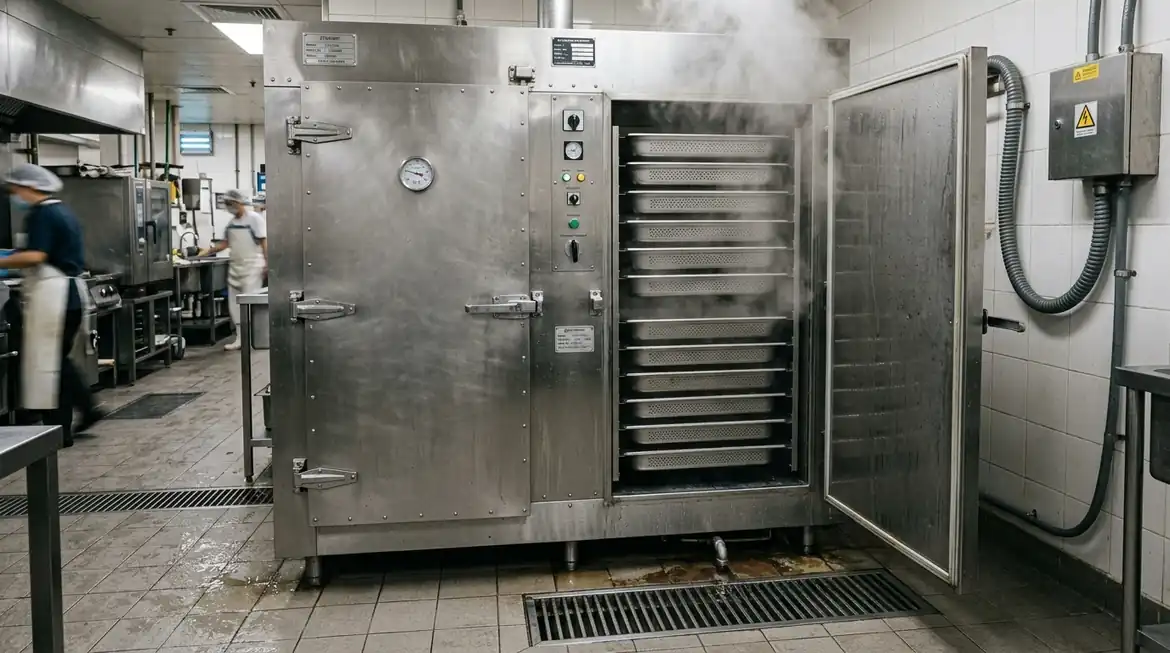
Key takeaway: Selecting between a boiler-based and boilerless commercial steam cooker is governed by two hard engineering thresholds: peak batch recovery time under continuous door openings and local feedwater Total Dissolved Solids (TDS). Boilerless connectionless steamers cut water usage by up to 88% (<2.5 gal/hr) and eliminate acid descaling, whereas dedicated steam-generator cabinets deliver 30%–45% faster thermal recovery for dense root vegetables, dim sum, and 24-to-60-tray institutional batch commissaries.
Thermodynamic Architecture: How Boiler vs. Boilerless Commercial Steam Cookers Work
Commercial steam cooking relies on latent heat of vaporization: when saturated steam at 100°C (212°F) condenses onto cold food surfaces, it releases 2,257 kJ/kg (970 BTU/lb) of thermal energy—nearly five times the heat transfer coefficient of forced dry convection air. However, the mechanical subsystem that generates and delivers this vapor determines both cooking throughput and utility consumption.
Boiler-Based (Dedicated Steam Generator) Architecture
A boiler-based commercial steam cooker houses a sealed, thermally insulated pressure vessel or dedicated external steam generator mounted inside the lower service base, completely isolated from the food cooking cavity. Cold municipal water passes through a solenoid inlet valve into the generator tank, where immersion Incoloy 800 heating elements or multi-tube gas heat exchangers bring the water to a rapid boil. Live, dry saturated steam is piped directly into the cooking compartments through calibrated distribution manifolds at atmospheric pressure (0 psi / 100°C) or low pressure (3.5–5.0 psi / 106°C–108°C).
- Instant Cavity Recovery: Because the isolated boiler tank remains at full operating temperature and vapor pressure even when the cabinet door is opened, steam injection resumes at 100% mass flow rate the instant the door latch closes. Recovery to 100°C takes 18 to 35 seconds.
- Zero Cross-Flavor Contamination: Food drippings, starch runoff, and marinades fall to the cavity floor and exit immediately through the condensate drain without ever contacting the fresh water inside the sealed steam generator.
- Continuous Purge Requirement: As pure H2O evaporates, dissolved calcium and magnesium ions concentrate inside the boiler shell. Automated blowdown valves must periodically purge mineral-heavy water into an tempered drain line, driving total water consumption to 18–35 gallons per hour (68–132 L/hr).
Boilerless (Open-Well Reservoir & Direct Injection) Architecture
A boilerless commercial steamer—often classified as a connectionless or open-well generator steamer—eliminates the external pressure vessel entirely. Instead, a shallow stamped water reservoir sits directly at the bottom of the cooking cavity, heated from below by bonded cast-aluminum or immersion elements, or water is atomized onto a high-mass heated plate enclosed within the rear baffle.
- Minimal Water Footprint: With no pressurized boiler tank to purge and no need for cold-water drain quenching on low-volume units, boilerless steamers consume only 1.5 to 3.0 gallons per hour (5.7–11.4 L/hr).
- Simplified Maintenance: Operators wipe out loose calcium scale from the exposed bottom pan at the end of each shift using a standard scrub pad and food-grade citric acid solution, avoiding service technician callouts for internal boiler descaling.
- Slower Cold-Load Recovery: Loading six to twelve pans of frozen protein or dense root vegetables drops the cavity temperature and temporarily suppresses surface evaporation from the open well, extending batch recovery time by 2.5 to 4.5 minutes per cycle compared to a dedicated steam generator.
Engineering Specification Matrix: Boiler vs. Boilerless & Electric vs. Gas
To assist MEP engineers and procurement directors in matching utility allocations to peak meal output, the table below benchmarks our four primary commercial steamer configurations across energy draw, water consumption, recovery kinetics, and structural metallurgy.
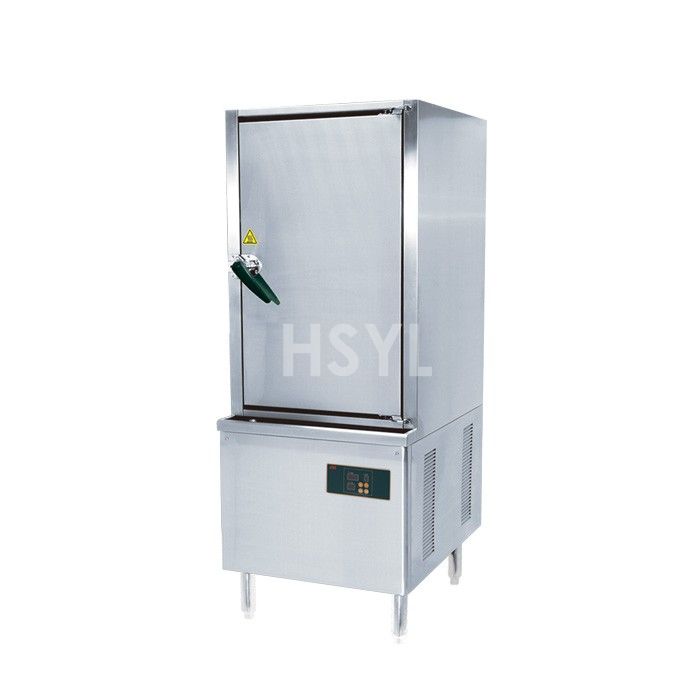
| Engineering Parameter | Countertop Boilerless Electric (HSC-4T-E / HSC-6T-E) | Floor Intelligent Electric (HSC-8U-E / HSC-10U-E) | Heavy-Duty Electric Cabinet (HSO-1E / HSO-2E / HSO-3E) | Heavy-Duty Gas Cabinet (HSO-1G / HSO-2G) |
|---|---|---|---|---|
| Pan Capacity (GN 1/1 or 400×600mm) | 4 to 6 Trays | 8 to 10 Trays | 12 / 24 / 36 / 48 / 60 Trays | 12 / 24 Trays |
| Steam Generation Type | Closed-loop Precision Reservoir / Direct Injection | High-Speed Dual-Element Steam Generator | Dedicated Base Steam Generator (Incoloy 800) | Multi-Tube Flue Gas Heat Exchanger Boiler |
| Rated Power / Thermal Input | 9.0 kW – 12.0 kW | 15.0 kW – 18.0 kW | 12 kW (12T) / 24 kW (24T) / 36 kW (36T) / 48 kW (48–60T) | 48,000 BTU/hr (12T) / 95,000 BTU/hr (24T) |
| Electrical Supply Specs | 380V/3Ph/50Hz or 208–240V/3Ph/60Hz | 380V–415V/3Ph/50Hz or 208–240V/3Ph/60Hz | 380V–415V/3Ph/50Hz (32A–90A circuit breaker) | 220V/1Ph/50–60Hz (0.15 kW digital ignition & blower) |
| Cold Start Preheat to 100°C | 4.5 – 6.0 Minutes | 5.0 – 6.5 Minutes | 6.0 – 8.0 Minutes | 8.0 – 11.0 Minutes |
| Water Usage Rate | 1.5 – 2.4 gal/hr (5.7 – 9.1 L/hr) | 2.8 – 4.2 gal/hr (10.6 – 15.9 L/hr) | 8.0 – 22.0 gal/hr (with drain tempering valve) | 9.5 – 25.0 gal/hr (with drain tempering valve) |
| Thermal Cooking Efficiency | 74% – 78% | 72% – 76% | 68% – 73% | 52% – 58% |
| Chamber & Boiler Metallurgy | 1.2mm AISI 304 Cavity / 1.5mm 316L Base | 1.2mm AISI 304 Cavity / 2.0mm 316L Generator | 1.2mm AISI 304 Body / 2.5mm TIG-Welded 316L Tank | 1.2mm AISI 304 Body / 3.0mm Seamless Heat Tube |
Regulatory Compliance, Pressure Codes, and Municipal Plumbing Mandates
Specifying a commercial steam cooker without verifying local mechanical and plumbing codes regularly results in failed municipal health inspections or melted PVC floor drains. Procurement teams must audit four non-negotiable regulatory benchmarks before issuing purchase orders:
- Thermal Efficiency & Idle Energy Limits (ENERGY STAR Commercial Steam Cookers Specification v1.2): Under current ENERGY STAR criteria, electric steam cookers must achieve a heavy-load potato cooking efficiency of ≥50%, while gas steam cookers must achieve ≥38%, with maximum idle energy rates capped between 270 W and 400 W per pan for electric units. High-density polyurethane and rockwool insulation (45mm–50mm thickness) in our HSC Intelligent Series keeps exterior door skin temperatures below 48°C while cutting standby heat loss by 42%.
- Pressure Vessel vs. Atmospheric Safety (ASME BPVC Section IV & UL 197 / CE EN 60335-2-42): Any closed steam generator operating above 15 psig (103 kPa) requires an ASME Section IV "HLW" or "H" stamp and mandatory annual state boiler inspection. By contrast, atmospheric commercial steamer cabinets (operating at 0.0 to 0.5 psig with open steam vents) and low-pressure compartment steamers with dual redundant spring-loaded pressure relief valves (set at 5.0 psig / 34.5 kPa) avoid licensed boiler-operator requirements while complying with UL 197 and IEC/EN 60335-2-42 electrical safety directives.
- Sanitation & Cleanability (NSF/ANSI Standard 4): Internal cooking compartments must feature coved corners (minimum 6.5mm radius), tool-less removable stainless steel pan slides, and closed-cell food-grade silicone door gaskets capable of withstanding continuous 130°C thermal cycling without leaching plasticizers.
- International Plumbing Code (IPC Section 803) 140°F (60°C) Drain Tempering Rule: Municipal plumbing codes strictly prohibit discharging condensate or boiler blowdown water hotter than 140°F (60°C) into building drainage systems, as 95°C condensate softens Schedule 40 PVC pipes and degrades pipe-joint cement. Boiler-based steamers require an automatic thermostatic cold-water condensing valve in the drain manifold, and the discharge pipe must terminate at least 2 inches (51mm) above an open floor sink or trench grate to maintain an anti-siphon air gap.
Water Chemistry Thresholds & Component-Level Hardware Engineering
Across 1,400+ field service logs analyzed from central commissaries and hotel banquet kitchens, 78.4% of premature commercial steamer failures originate from untreated feedwater scaling and chloride stress-corrosion cracking—not electrical controller defects. When calcium bicarbonate precipitates onto an immersion heating element, a mere 1.5mm layer of CaCO3 scale reduces thermal conductivity by 28%, trapping heat inside the element sheath until the internal nichrome resistance wire ruptures.
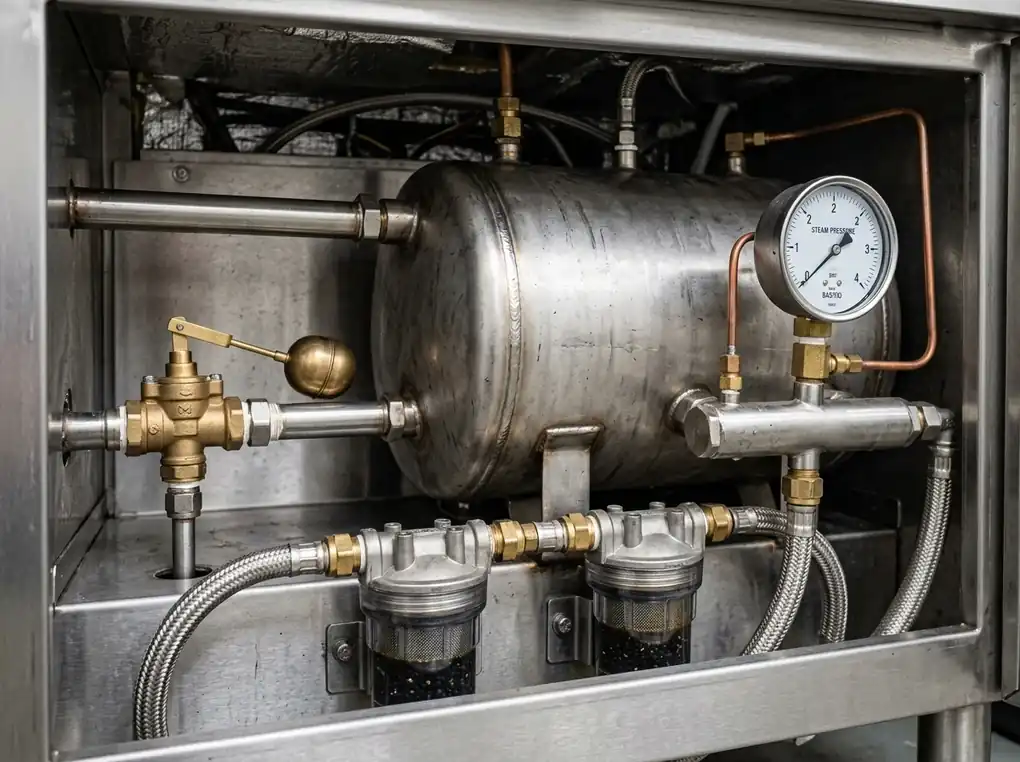
Mandatory Feedwater Chemistry Specifications
Just as high-temperature rack machines require strict incoming water treatment (see our Commercial Dishwasher & Thermal Equipment Water Quality Engineering Guide), every commercial steam cooker installation must be commissioned against five feedwater limits:
- Total Dissolved Solids (TDS): 30 to 60 ppm (Boilerless units tolerate up to 100 ppm with daily wipe-downs; pure Reverse Osmosis water below 15 ppm must be remineralized so conductivity-based water level probes can detect liquid contact).
- Total Hardness (CaCO3): ≤ 2.0 grains per gallon (gpg) / ≤ 35 ppm.
- pH Range: 7.0 to 8.5.
- Free & Total Chloride Concentration: < 30 ppm (Chlorides above 40 ppm at 100°C rapidly pit standard 304 stainless steel welds).
- Dynamic Water Supply Pressure: 25 to 50 PSI (172 to 345 kPa) via a 1/2" or 3/4" NPT braided stainless flex line.
Component Metallurgy & Dry-Burn Protection
To survive continuous 14-hour daily production shifts in high-hardness regions (Southeast Asia, Middle East, and North American limestone aquifers), both our HSC Intelligent Steamer Cabinet Range and our HSO Electric & Gas Steamer Cabinet Range incorporate four industrial hardware upgrades:
- AISI 316L Boiler & Evaporator Wells: While the outer cabinet and cooking compartment utilize 1.2mm brushed AISI 304 stainless steel, all high-temperature water-contact generator tanks are fabricated from 2.0mm–2.5mm molybdenum-alloyed AISI 316L stainless steel to resist chloride pitting.
- Incoloy 800 Immersion Heating Tubes: Standard copper or 304 heating elements split under thermal shock when cold makeup water hits a hot tank. We specify nickel-iron-chromium Incoloy 800 elements rated for 800°C sheath temperatures.
- Dual-Stage Level Control (Brass Mechanical Float + 3-Electrode Conductivity Probe): High-humidity steam environments can foul single float switches. Combining a forged brass mechanical float valve with a three-tier stainless steel electronic water-level probe (Low-Cutoff / Fill-Start / High-Stop) plus an independent bi-metallic over-temperature manual reset thermostat prevents dry-firing.
- Positive-Slam Compression Latches: Heavy cast 304 stainless steel cam latches with two-stage safety release mechanisms allow operators to vent residual cavity steam for 2 seconds before swinging the door open, protecting kitchen staff from facial steam burns.
Five-Year Total Cost of Ownership (TCO): Boiler vs. Boilerless & Gas vs. Electric
Focusing exclusively on FOB unit price distorts procurement budgets. Over a 5-year service lifecycle (operating 8 hours/day, 350 days/year = 14,000 operational hours), water, sewer, electricity/gas, and descaling chemicals easily exceed 2.5 to 4.0 times the initial equipment purchase price. Below is a verified 5-year TCO comparison for a 12-tray capacity requirement (comparing two stacked 6-tray boilerless HSC-6T-E units against a 12-tray boiler-based HSO-1E electric cabinet and an HSO-1G gas cabinet, modeled at $0.14/kWh electricity, $1.35/therm gas, and $11.50/1,000 gallons combined water and municipal sewer rate).
| 5-Year Cost Category (14,000 Operating Hours) | Boilerless Electric (Dual HSC-6T-E, 12 Trays Total) | Boiler-Based Electric Cabinet (HSO-1E, 12 Trays) | Boiler-Based Gas Cabinet (HSO-1G, 12 Trays) |
|---|---|---|---|
| Estimated Equipment & MEP Rough-In Cost | $3,450 (No tempered drain quench required) | $2,180 ($1,480 unit + $700 drain/softener plumbing) | $3,850 ($1,650 unit + $2,200 Type I/II flue & gas line) |
| 5-Year Energy Cost (60% Duty Factor) | $14,112 (12.0 kW avg draw × 14,000 hrs × $0.14) | $15,288 (13.0 kW avg draw × 14,000 hrs × $0.14) | $9,072 (0.48 therm/hr × 14,000 hrs × $1.35) |
| 5-Year Water & Sewer Cost | $483 (3.0 gal/hr × 14,000 hrs = 42,000 gal) | $2,898 (18.0 gal/hr × 14,000 hrs = 252,000 gal) | $3,220 (20.0 gal/hr × 14,000 hrs = 280,000 gal) |
| Water Softener Cartridges & Acid Descaling PM | $650 (In-house daily citric wipe, basic carbon filter) | $2,400 (20 quarterly descaling services + twin resin cartridges) | $2,950 (Quarterly acid flush + annual flue burner cleaning) |
| 5-Year Cumulative TCO | $18,695 | $22,766 | $19,092 |
Key TCO Procurement Takeaways:
- When Boilerless Wins: For 4-to-10-tray installations (HSC-4T-E through HSC-10U-E) in chain restaurants, healthcare satellite pantries, and mall food courts where water/sewer rates are high and hood/drain retrofits are restricted, boilerless precision steamers save $4,071 over 5 years by cutting water usage by 210,000 gallons and eliminating technician descaling labor.
- When Gas Boiler Cabinets Win: For 24-to-60-tray mass commissaries (HSO-2G / HSO-2E / HSO-3E) running continuous back-to-back cycles of steamed rice, mantou, seafood, or bulk root vegetables where electrical panel amperage is capped, gas-fired boiler cabinets save over $6,200 in utility energy bills while delivering uninterrupted high-velocity steam recovery. To calculate exact tray counts for your peak meal window, consult our Commercial Steamer Cabinet Capacity & Pans-Per-Meal Sizing Guide.
Discuss Your Commercial Steamer Capacity & Water Quality Specs with HSYL Engineers
Share your peak batch meal counts, GN 1/1 or 400×600 mm pan schedules, local water hardness report, and available electrical or gas utilities. Our project engineering team reviews tray pitch, steam generator sizing, and indirect floor drainage layout before fabrication. Contact HSYL for Commercial Steamer Sizing & Specification Support.