Affordable Restaurant Equipment: How to Buy Cheap Without Buying Twice
How to buy affordable restaurant equipment safely: pre-purchase checklist, where to save vs. splurge, new vs. refurbished trade-offs, and supplier vetting.

A $900 "commercial" range that dies after 14 months costs more than a $1,800 unit that runs for ten years — once you add the emergency replacement, the lost service nights, and the second installation fee. That arithmetic is why experienced buyers treat "affordable restaurant equipment" as an engineering problem, not a price-tag hunt. The goal is not the lowest invoice; it is the lowest cost per year of reliable service.
This guide gives you a working method: a pre-purchase checklist you can apply to any quote, an honest map of which equipment categories tolerate budget cuts and which do not, a framework for choosing between new, discounted, and refurbished stock, and a supplier-vetting routine built around factory audits and sample orders.
Key takeaway: You can safely economize on passive stainless steel items (work tables, sinks, shelving) where there is no motor or compressor to fail. You should never economize on refrigeration compressors, cooking-line burners, or dishwashing pumps — the failure cost of these components routinely exceeds the entire purchase saving.
A Pre-Purchase Checklist for Any Discount Quote
Before comparing prices, run every candidate unit through the same verification checklist. If a supplier cannot answer these points in writing, the discount is hiding something.
| Check | What to Verify | Pass Standard | Red Flag |
|---|---|---|---|
| Steel grade & gauge | Material certificate for food-contact surfaces | 304 stainless, 1.0–1.2 mm on work surfaces | 201 steel sold as "stainless," or no certificate |
| Welds & finish | Photos or video of corners, joints, undersides | Continuous welds, no sharp burrs or gaps | Spot welds, visible grinding marks, rust at seams |
| Core components | Brand of compressor, burner valve, or pump | Named brand with global spare-parts network | "Equivalent to" unnamed components, no model number |
| Certifications | Certificate number verifiable with the issuing body | CE, ETL, or NSF matching the exact model | Certificate for a different model or expired report |
| Spare parts | Parts list, price list, and supply commitment | Wear parts available for 5+ years | "Contact us when needed" with no written commitment |
| Warranty | Coverage scope, labor vs. parts, claim process | 12–24 months parts, named service channel | Warranty void if installed by third party, vague terms |
| Load test | Factory test video or third-party inspection report | Unit run at rated load before shipment | Only cosmetic photos offered |
Where You Can Save — and Where You Cannot
Equipment divides into two risk classes. Passive equipment — work tables, sinks, shelving, exhaust hoods — has no moving parts. Quality differences show up as wobble, thin steel, and rough welds, all of which you can inspect and all of which degrade slowly. Active equipment — refrigeration, cooking lines, dishwashers — contains compressors, valves, and pumps whose failure stops your kitchen entirely.
The budget logic follows directly: save aggressively on the passive class, protect the active class.
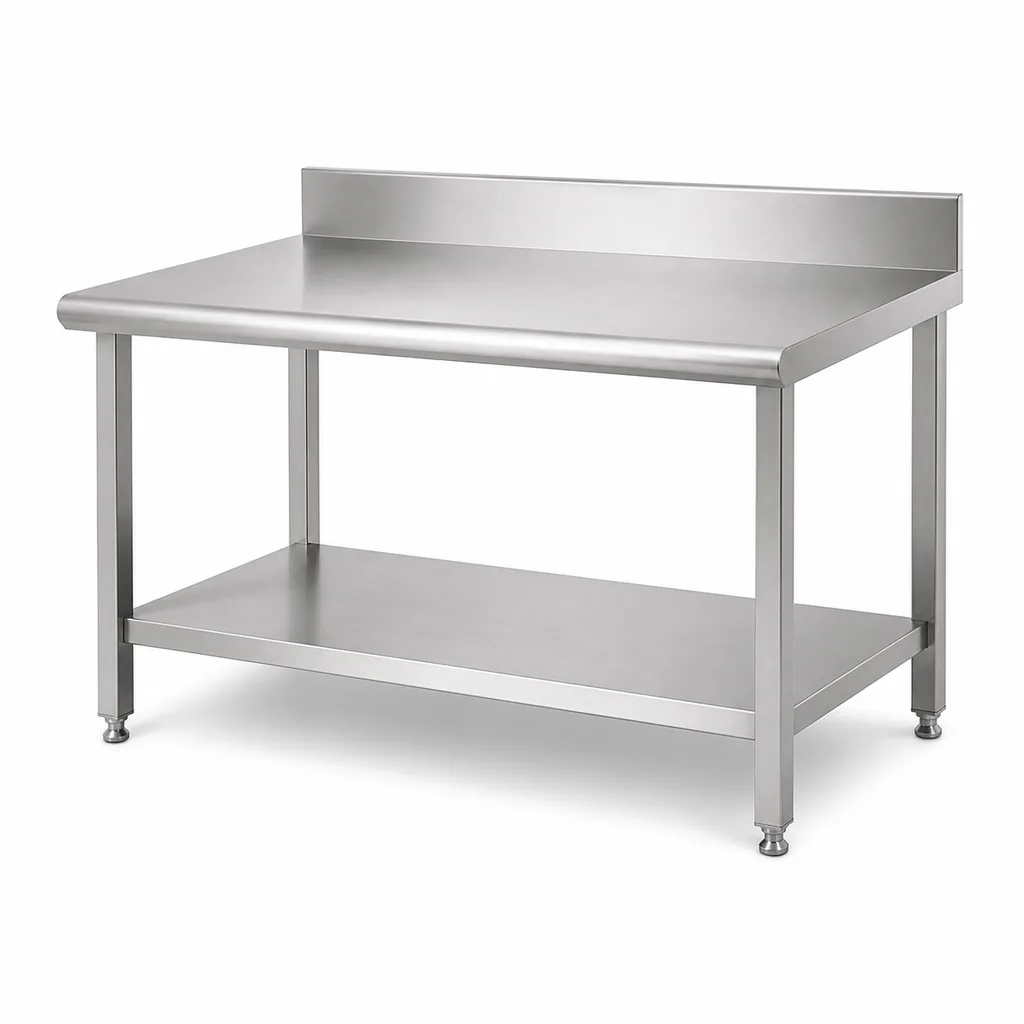
Categories where budget buying is usually safe
Work tables, wall shelves, sinks, and dish tables from a competent fabricator typically run $150–$600 per unit depending on size and steel thickness, versus two or three times that from premium Western brands — with little practical difference in daily service, provided you verify 304-grade steel and weld quality per the checklist above. The same applies to exhaust hoods and most stainless steel fabrication. A simple bain-marie or plate warmer, where the heating element is the only active part, also tolerates discount sourcing reasonably well.
Categories where cheap becomes expensive
Refrigeration is the classic trap. A budget upright chiller at $800 against a quality unit at $1,500–$5,000 depending on capacity looks like a saving, until the no-name compressor fails in month 18 with no parts available — and with $2,000 of stock spoiling overnight. Compressor brand, not cabinet price, should drive the decision when you buy refrigeration equipment. The same logic applies to dishwasher pumps and wash-arm assemblies, and to burner valves and thermostats on the cooking line: these are the components that decide whether the machine works, and they are exactly where ultra-cheap manufacturers cut cost first.
New, Discounted, or Refurbished: Making the Call
New budget equipment
Factory-direct new equipment from manufacturing regions offers the best price-to-lifespan ratio for most buyers, because you get full component life and a warranty clock that starts at installation. The risk sits in unverified factories, which is why the audit and sample-order process below matters more than the quote itself.
Discounted and clearance stock
Genuine discounts exist: discontinued models, overstock, and display units can sell at 20–40% off. Verify why the price is low. A discontinued model is fine if spare parts remain committed for 5+ years; it is a problem if the product line is being abandoned entirely. Display units should be discounted for their hours of use, not just their appearance.
Refurbished equipment
Refurbished units make sense for passive categories and for simple, robust machines — planetary mixers, slicers, work tables — where a competent overhaul restores near-new function at 40–60% of new price. They make little sense for refrigeration unless the compressor has been replaced (not just "tested"), and little sense for anything with complex electronics, where a $200 control board can erase the saving in the first breakdown. Always ask for the refurbishment record: what was replaced, what was tested, and what warranty applies.
Vetting Low-Cost Suppliers: Audits and Sample Orders
Price risk concentrates in the supplier, not the product category. A disciplined vetting routine removes most of it.
- Screen by documentation. Request business license, export records, material certificates, and test reports for the exact models quoted. Suppliers who hesitate here filter themselves out.
- Audit the factory. A third-party inspection (typically $200–$500 per visit depending on location and scope) verifies whether the "factory" is a real production line or a trading office. Check welding stations, material stock (is that 304 or 201 steel on the rack?), and the testing area where units should be run before packing.
- Order a sample first. One unit at sample price, shipped to your site and run under real load for 2–4 weeks, tells you more than any catalog. Test temperature recovery on refrigeration, actual versus rated output on cooking equipment, and noise and vibration on anything with a motor.
- Write the checklist into the contract. Steel grade, component brands, certification numbers, spare-parts commitment, and pre-shipment load testing should appear in the purchase contract, not just in emails.
Working directly with a manufacturer that publishes its production and quality process — you can review how HSYL structures its fabrication and inspection on the company page and browse the full range in the product catalog — removes the opacity that makes discount buying risky in the first place. For buyers equipping a full venue, the restaurant kitchen solution page shows how budget allocation typically splits across equipment classes.
Further Resources
- Equipment Selection Guides
Category-by-category selection criteria, including the component specs worth paying for.
- Technical Guides
Engineering references on materials, utilities, and performance standards for commercial kitchens.
- Capacity Sizing
Size equipment to real demand first — an oversized unit is wasted budget regardless of price.
- Spare Parts & Support FAQ
How spare-parts supply works after purchase, and what to confirm before signing.
Affordable equipment is not a contradiction — it is the outcome of checking materials, protecting the components that can stop your kitchen, picking the right mix of new and refurbished, and making the supplier prove quality before you pay for volume. Run the checklist, order the sample, and let the arithmetic work for you instead of against you.
Frequently Asked Questions
Which restaurant equipment categories are safe to buy cheap?
Passive stainless steel items — work tables, sinks, shelving, exhaust hoods — are safe at the low end ($150–$600 per unit depending on size and steel thickness) because they have no motor or compressor to fail. Just verify 304-grade steel at 1.0–1.2 mm thickness and continuous welds before buying.
Where should you never cut costs on kitchen equipment?
Refrigeration compressors, cooking-line burner valves and thermostats, and dishwashing pumps. A budget chiller at $800 versus a quality unit at $1,500–$5,000 looks like a saving until the no-name compressor fails in month 18 with no parts available — and spoils around $2,000 of stock overnight.
Is refurbished restaurant equipment worth buying?
Yes for passive items and simple robust machines like planetary mixers and slicers, where an overhaul restores near-new function at 40–60% of new price. Avoid refurbished refrigeration unless the compressor was actually replaced (not just "tested"), and be cautious with anything containing complex electronics — a $200 control board can erase the saving in the first breakdown.
How much does a third-party factory audit cost when vetting suppliers?
Typically $200–$500 per visit depending on location and scope. The audit verifies whether the "factory" is a real production line, checks the steel grade in stock (304 vs. 201), and confirms that units are load-tested before packing.
Why is some discount restaurant equipment so much cheaper?
Genuine discounts of 20–40% come from discontinued models, overstock, and display units. A discontinued model is fine if spare parts remain committed for 5+ years; it becomes a problem when the entire product line is being abandoned, so always ask why the price is low and get the answer in writing.
Plan the Equipment Around Your Kitchen.
Share your menu, peak service demand, available space and site utilities. Tell us which equipment you are considering so we can review the requirements with you.