Commercial Deep Fryer Price Guide: What You Should Budget
Commercial deep fryer price guide: countertop vs floor models, single vs twin tanks, gas vs electric, oil capacity, filtration ROI and safety certifications.
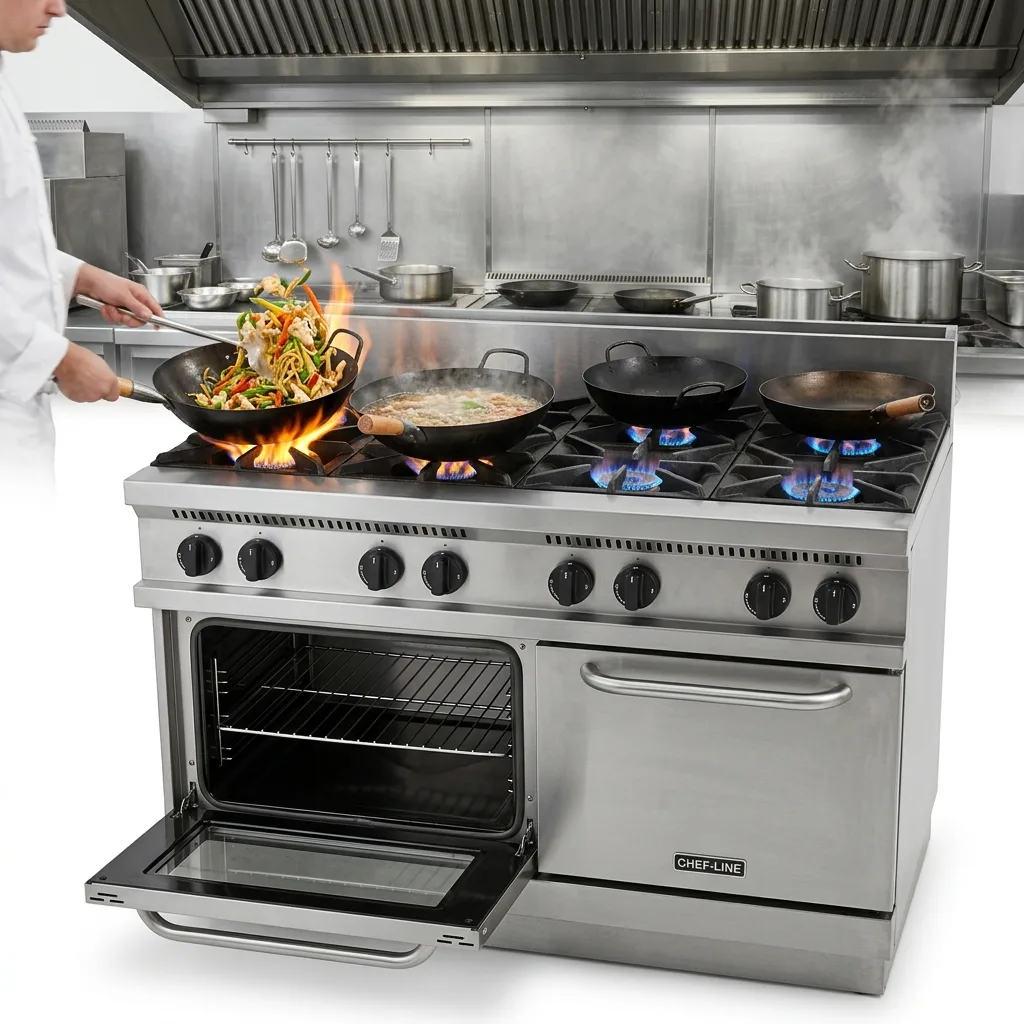
Ask three suppliers for a commercial deep fryer price and you will get three numbers that are not comparable: one quotes a countertop electric unit, another a 50 lb floor model on gas, the third a high-efficiency fryer with built-in filtration. The spread between them can be 20x — from around $200 to well over $5,000 — and every one of those quotes can be the right answer for a different kitchen.
This guide breaks the price question into the five decisions that actually move the number: form factor, tank configuration, fuel type, oil capacity and filtration. Figures are typical market ranges and shift with brand, build grade and order volume — treat them as budgeting anchors, not quotations.
Key takeaway: Budget $200–$600 for a countertop fryer, $1,000–$3,000 for a standard floor model, and $4,000–$12,000 for high-efficiency units with built-in filtration. Size the fryer by oil capacity against your peak-hour fried output — not by menu count — and never buy one without a certified high-limit thermostat, because fryers are a leading source of commercial kitchen fires.
What Drives the Price of a Commercial Deep Fryer
Fryer pricing looks chaotic until you map it to five variables. Once you fix these, quotes from different suppliers become comparable:
- Form factor: countertop units are light-duty appliances; floor-standing units are plumbed, hard-wired or gas-connected production equipment with heavier tanks and burners
- Tank configuration: a twin-tank fryer is nearly two machines in one cabinet — two thermostats, two drain valves, double the basket sets
- Fuel type: gas fryers cost more upfront but usually less to run; electric fryers are cheaper to buy and install where gas is unavailable
- Oil capacity: a 40 lb and a 90 lb fryer differ in steel, burner power and recovery system, and price scales accordingly
- Filtration: a built-in filter system adds roughly $1,000–$2,500 per fryer but pays back through oil savings, covered below
On top of these, certification (NSF, ETL/UL, CE), steel grade and controls explain most of the remaining gap between an economy and a premium unit of the same size.
Commercial Deep Fryer Price Ranges by Type
The table below gives typical purchase ranges for new equipment in the export and North American markets. Prices vary with configuration, brand tier and order quantity — a container order from a manufacturer prices very differently from a single unit through a local dealer.
| Fryer type | Oil capacity | Typical price range | Best fit |
|---|---|---|---|
| Countertop electric, single tank | 10–15 lb | $200–$600 | Cafés, food trucks, backup frying |
| Countertop electric, twin tank | 2 × 10–15 lb | $400–$1,200 | Small restaurants, bar snacks |
| Floor gas, single tank | 40–50 lb | $1,000–$3,000 | Full-service restaurants, QSR |
| Floor electric, single tank | 40–50 lb | $1,500–$4,000 | Kitchens without gas service |
| Floor gas, twin tank | 2 × 40–50 lb | $2,500–$6,000 | High-volume frying, mixed menu |
| High-efficiency with built-in filtration | 50–90 lb | $4,000–$12,000+ | Chains, central kitchens, 8+ hr/day frying |
Two notes on this table. First, a floor fryer almost always sits under a Type I hood, and hood plus fire-suppression costs ($3,000–$10,000 installed) belong in the same budget line. Second, the jump from a $1,500 economy floor fryer to a $5,000 mid-tier unit buys thicker tank steel and faster recovery — what matters at hour six of a dinner rush.
Oil Capacity and Output: Matching Fryer Size to Volume
A fryer's working output tracks its oil capacity, not its footprint. A field-tested rule of thumb: a fryer in continuous service turns out roughly 1.5–2 times its oil capacity in finished product per hour. A 50 lb fryer delivers about 75–100 lb of fries per hour; undersize it and recovery stretches, oil temperature sags, and product comes out greasy.
Light duty: 10–15 lb oil
Output around 15–30 lb per hour. Handles appetizer volumes or a side fryer for wings and snacks. Countertop footprint, standard 220V supply.
Medium duty: 40–50 lb oil
Output around 60–100 lb per hour. The standard restaurant fryer; one unit covers most à la carte frying for a 100–150 seat dining room.
Heavy duty: 75–90 lb oil or battery
Output 120–180 lb per hour per vat. QSR, central kitchens and banquet operations usually run a battery of two to four vats under one hood.
Size against your peak 60-minute fried volume with a 20–25% margin. If the peak menu load is 80 lb of fries per hour, a 50 lb fryer is at its limit; a 65 lb unit or a twin-tank configuration buys you recovery headroom. For a structured sizing method across the whole cooking line, see the capacity planning section.
Filtration Systems: Where the Real Money Is
The purchase price is a one-time line. Oil is a weekly one. A 50 lb fryer takes roughly 6 gallons (about $55–$70 at typical bulk oil prices) per fill, and unfiltered oil in a busy fryer degrades to discard quality in 3–4 days — 90–120 fills a year, or $5,000–$8,000 in oil annually, more than the fryer itself.
Filtering daily extends oil life to 6–8 days, cutting oil spend by roughly 40–50%. A built-in filtration system adds $1,000–$2,500 to the fryer price; at $2,500–$4,000 in annual oil savings, payback is typically under 12 months. It also removes the most dangerous job in the kitchen — manually draining 175°C oil into a stockpot. For fryers under 30 lb, a portable filter machine ($300–$800) is the practical alternative.
Gas vs Electric: Upfront Price vs Operating Cost
Electric fryers are cheaper to buy at countertop sizes and cheaper to install anywhere — no gas line, no combustion air requirements. They also recover slightly faster because the element transfers heat directly into the oil.
Gas wins on running cost in most markets. A 40–50 lb fryer frying 6 hours a day costs roughly 30–50% less to run on natural gas than on electricity — several hundred dollars a year per vat. Over a 10-year service life that usually outweighs the $500–$1,000 gas premium and the connection cost.
The deciding factors in order: utilities already in the kitchen, local energy tariffs, and daily frying hours. A café frying 90 minutes a day should buy electric; a QSR frying 10 hours a day should run the gas math first.

Safety Certifications: The Non-Negotiable Line Item
Fryers carry a fire risk no other cooking appliance matches: open tanks of oil at 175–190°C, next to open gas burners, in a busy line. Frying equipment is consistently among the top ignition sources in restaurant fire statistics. Do not trade away the following to save on price:
- High-limit thermostat: a second, independent thermostat that cuts gas or power if oil exceeds about 230°C (450°F). This is the single most important safety component on the fryer — verify it is a separate device, not a software limit on the main control
- ETL/UL listing (North America) or CE (Europe): confirms the unit passed electrical and combustion safety testing; required for insurance and code approval in most jurisdictions
- NSF certification: hygiene design — cleanable tank corners, drain valve access, splash containment
- Fire-suppression compatibility: the fryer must sit under a suppression system compliant with NFPA 96 or local equivalent, with fuel shut-off interlocked to the suppression trigger
A fryer quote that is $300 cheaper because it lacks a listing mark is not cheaper — it is a code violation and an insurance exclusion waiting to be discovered. The broader certification framework for imported equipment is covered in our compliance standards section.
Budgeting Checklist Before You Request Quotes
Send every supplier the same specification and the quotes become comparable. Work through this list first:
- Peak fried volume: pounds per hour in the busiest 60 minutes, plus 20–25% margin — this fixes oil capacity
- Tank count: twin tanks if you fry allergens (fish, gluten items) separately or run two temperature programs; otherwise one larger tank is cheaper per pound of output
- Fuel: gas if a line exists and daily frying exceeds 4–5 hours; electric otherwise
- Filtration: built-in for 40 lb and above at high volume; portable filter for smaller units
- Certifications: state NSF, ETL/UL or CE explicitly in the RFQ, and ask for the certificate number
- Total budget line: fryer + hood/suppression share + oil + filtration consumables, not fryer alone
Browse the full cooking equipment range to see fryers alongside the ranges and ovens they will share a line with, or check the equipment selection guides for matching fryers to specific kitchen formats.
Frequently Asked Questions
How much does a commercial deep fryer cost?
It depends on configuration: countertop electric single-tank units run $200–$600, standard 40–50 lb floor gas fryers $1,000–$3,000, twin-tank floor models $2,500–$6,000, and high-efficiency fryers with built-in filtration $4,000–$12,000+. All ranges shift with brand, build grade, certifications and order volume.
Is a twin-tank fryer worth the higher price?
A twin-tank floor fryer costs $2,500–$6,000 versus $1,000–$3,000 for a single tank. It pays off when you need to separate allergens (fish, gluten items) or run two temperature programs. If neither applies, one larger tank gives more output per dollar.
How does a built-in filtration system affect fryer price and payback?
Built-in filtration adds roughly $1,000–$2,500 to the fryer price. Daily filtering extends oil life from 3–4 days to 6–8 days, cutting annual oil spend by 40–50% — for a 50 lb fryer that is $2,500–$4,000 saved per year, so payback is typically under 12 months.
Is a gas or electric fryer cheaper to run?
At typical commercial energy prices, a 40–50 lb fryer running 6 hours a day costs about 30–50% less to operate on natural gas than electricity. Gas units cost $500–$1,000 more upfront plus the connection, but the operating saving usually outweighs that within the fryer's 10-year service life if you fry more than 4–5 hours daily.
What safety certifications should a commercial fryer have?
Insist on a certified high-limit thermostat that cuts fuel or power at about 230°C (450°F), plus ETL/UL listing (North America) or CE (Europe) and NSF certification. The fryer must also sit under an NFPA 96-compliant fire suppression system. A unit without listing marks risks code violations and voided insurance.
Plan the Equipment Around Your Kitchen.
Share your menu, peak service demand, available space and site utilities. Tell us which equipment you are considering so we can review the requirements with you.