Commercial Dishwasher Descaling
Comprehensive engineering guide to commercial dishwasher descaling chemicals, limescale dissolution thermodynamics, water softener regeneration, and heating element protection.
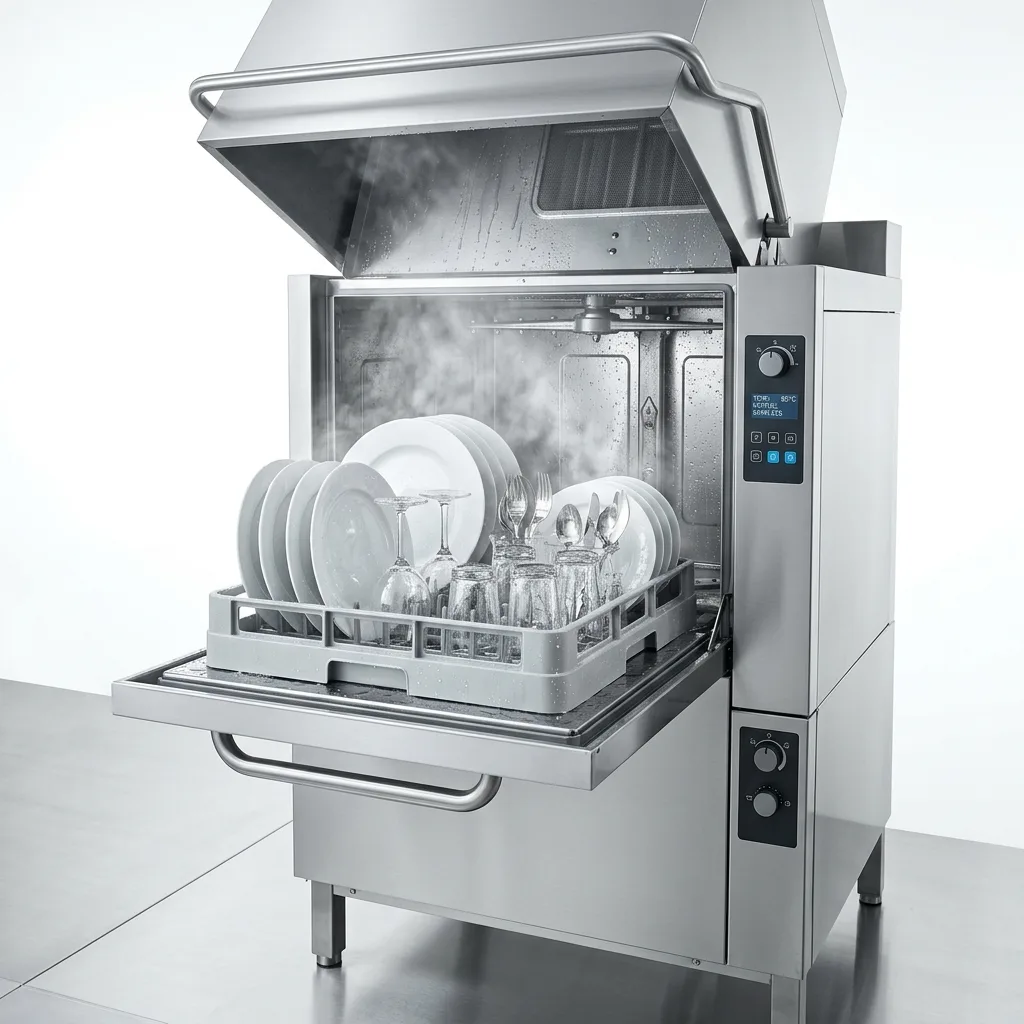
In high-throughput hospitality, healthcare, and institutional warewashing operations, mineral scale accumulation is the leading root cause of heating element burnout, booster failure, cloudy glassware, and failed health inspections. Hard municipal water containing calcium and magnesium carbonates (CaCO3 and MgCO3) continuously precipitates out of solution when heated above 60°C (140°F), encrusting wash manifolds, rinse nozzles, and internal booster heating elements. A professionally engineered commercial dishwasher descaling and preventative maintenance program restores thermal efficiency, eliminates bacterial harboring biofilms, and extends equipment service life by up to 10 years.
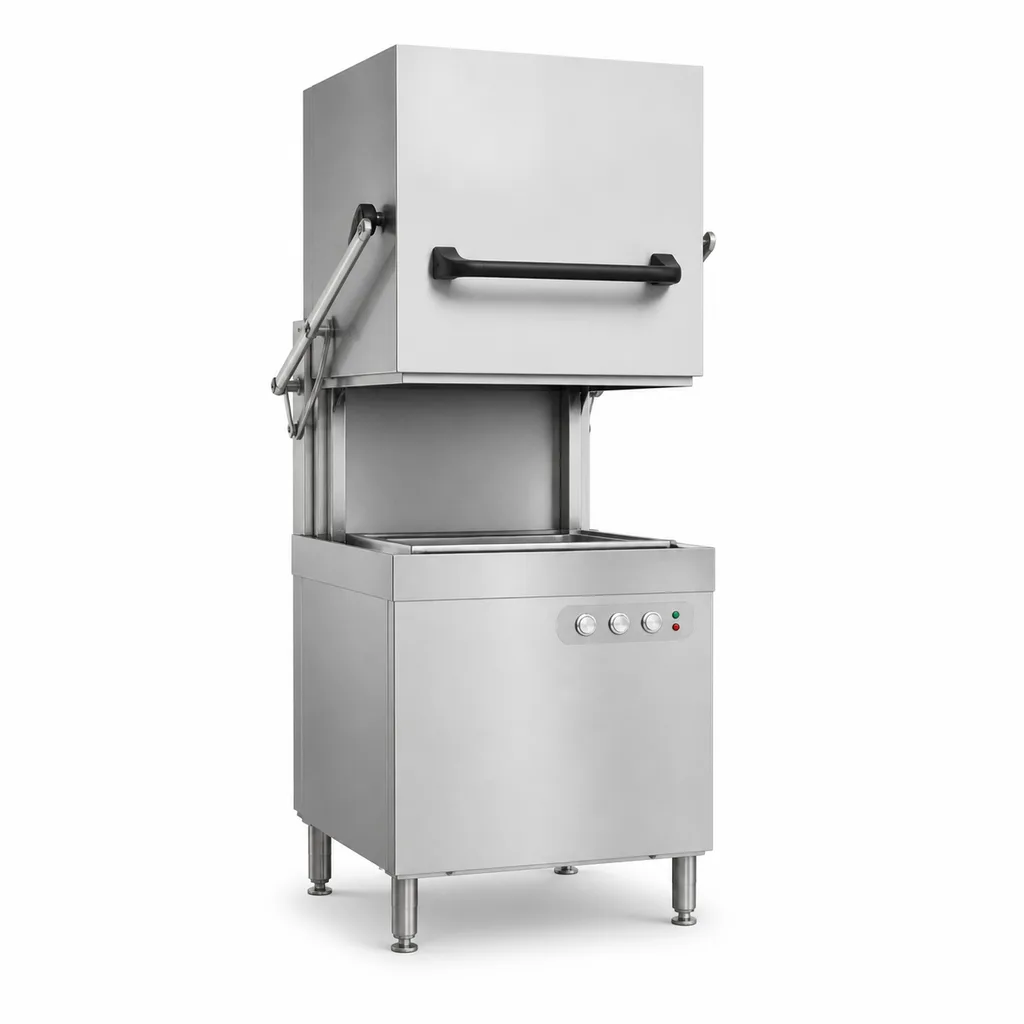
Figure 1: Hood-type commercial pass-through dishwasher undergo scheduled chemical acid descaling and wash arm nozzle inspection.
1. Limescale Chemistry & Thermal Heat Transfer Degradation
Limescale is a dense, rock-like crystalline composite of calcium carbonate (CaCO3) exhibiting an extremely low thermal conductivity (λ ≈ 1.3 W/m·K, compared to λ ≈ 16 W/m·K for 304-grade stainless steel and 380 W/m·K for copper). When scale encrusts an immersion heating element, it acts as a thermal blanket:
Mechanical Consequence: Trapped heat cannot transfer into the water stream, causing internal Incoloy or copper heating sheaths to overheat past 750°C. The metal sheath expands, splits along weld seams, and allows water into the magnesium oxide electrical insulation, resulting in catastrophic ground fault circuit tripping.
2. Chemical Descaling Acid Formulations & Metallurgy Compatibility
Selecting the correct chemical deliming compound is critical to dissolving mineral scale without corroding internal 304-grade stainless steel wash tanks, copper booster tanks, and silicone seals:
| Chemical Descaling Reagent | Active Concentration | Corrosion Rate on 304 Stainless | Mineral Dissolution Speed | Engineering Recommendation |
|---|---|---|---|---|
| Inhibited Phosphoric Acid | 10% - 20% solution with organic corrosion inhibitors | < 0.05 mm / year (Extremely Safe) | Fast dissolution; forms water-soluble calcium phosphate | INDUSTRY GOLD STANDARD for commercial warewashing and steam boilers |
| Sulfamic Acid (H3NSO3) | 5% - 10% aqueous powder solution | < 0.08 mm / year (Non-volatile, low odor) | Moderate-fast; highly stable up to 60°C | Excellent for manual deliming and enclosed recirculation wash tanks |
| Citric Acid (Organic) | 10% - 15% solution | ≈ 0.01 mm / year (Completely inert to steel) | Slow; requires extended soaking and temperatures > 55°C | Ideal for light preventative maintenance and daily sanitization cycles |
| Hydrochloric Acid (Muriatic) | Raw HCl (> 15%) | > 5.0 mm / year (CATASTROPHIC) | Violent dissolution accompanied by toxic fumes | STRICTLY PROHIBITED: Causes irreversible chloride stress cracking and pinhole tank leaks |
3. Step-by-Step Certified Chemical Descaling Protocol
Facility technicians and stewarding teams must follow a rigorous 6-step chemical deliming procedure during scheduled maintenance windows:
- Tank Evacuation & Scrap Removal: Turn off the dishwasher, drain the wash tank completely, and remove all scrap filter screens, wash arms, and rinse nozzles. Clear physical food debris and wash components in a sink with warm water.
- Fresh Water Fill & Heating: Re-insert scrap screens and fill the wash tank with fresh water. Deactivate automatic chemical dispensing pumps (detergent and sanitizer) to prevent dangerous chemical reactions. Heat the wash tank to 50°C - 55°C (122°F - 131°F).
- Acid Dosing & Circulation: Add commercial inhibited phosphoric descaling acid directly into the wash tank according to manufacturer dilution ratios (typically 1 liter of descaler per 10 to 15 liters of tank volume). Close the doors and run continuous wash cycles for 15 to 20 minutes until internal scale dissolves into a clear liquid.
- Manual Detail Brushing: Open doors and inspect interior heating coils and wash manifold corners. Use a stiff non-metallic nylon brush to scrub residual loosened scale blankets.
- Drainage & Neutralization Flush: Drain the acidic solution completely. Fill with fresh water, add 100 grams of sodium bicarbonate (baking soda) to neutralize residual acidity, run for 2 minutes, and drain again.
- Fresh Water Rinse Cycles: Fill and drain the machine twice with pure water. Verify that internal pH is neutral (≥ 7.0) with pH test strips before re-activating chemical detergent dosing.
4. Water Softener Regeneration Physics & Capacity Calculations
Preventing scale formation requires installing a commercial cation-exchange water softener upstream of the dishwasher. Sodium ions (Na+) on synthetic polystyrene resin beads exchange with calcium (Ca2+) and magnesium (Mg2+) ions in the incoming water supply:
Calculation Example: A duplex water softener with 1.5 cubic feet of resin treating water with 12 GPG hardness provides: (1.5 × 30,000) / 12 = 3,750 Gallons of softened water before requiring salt brine backwash regeneration.
5. Acid Dissolution Kinetics & Recirculation Duration Matrix
The speed of calcium carbonate dissolution depends on chemical solution temperature and active proton concentration. Technicians size chemical recirculation duration based on measured scale thickness:
| Visual Scale Severity | Estimated Calcite Crust Depth | Recommended Acid Formulation | Required Bath Temperature | Recirculation Pump Run Time |
|---|---|---|---|---|
| Incipient Film (Light Haze) | < 0.5 mm chalky haze | 8% Citric or 5% Sulfamic solution | 45°C - 50°C (113°F - 122°F) | 10 - 15 minutes continuous wash cycle |
| Moderate Scaling (Coil Encrustation) | 0.5 mm - 1.5 mm solid scale | 12% Inhibited Phosphoric Acid | 50°C - 55°C (122°F - 131°F) | 20 - 30 minutes with mid-cycle scrub |
| Severe Calcite Occlusion | 1.5 mm - 3.0 mm heavy rock layer | 18% Inhibited Phosphoric + Sulfamic blend | 55°C - 60°C (131°F - 140°F) | 45 - 60 minutes dual-stage acid cycle |
| Total Nozzle Jet Occlusion | > 3.0 mm solid blockage | Component removal; 25% acid ultrasonic bath | 60°C (140°F) ultrasonic tank | 30 minutes sonic bath cavitation |
6. Ultrasonic Cleaning Tank Cavitation for Clogged Rinse Nozzles
Fine rinse nozzles with 1.2 mm to 1.8 mm orifices become occluded by rock-hard calcium plugs that resist standard soaking. Ultrasonic cavitation provides microscopic mechanical scrubbing:
Procedure: Disassemble stainless steel wash and rinse arm nozzles. Submerge in a heated 45°C ultrasonic cleaning bath containing a 10% phosphoric acid solution for 15 minutes. Micro-cavitation collapses scale deposits out of threaded orifices without damaging spray patterns.
7. Cation-Exchange Resin Bed Fouling & Iron Removal Protocols
Commercial water softener resin beds degrade over time due to municipal iron contamination and chlorine oxidation:
| Resin Contaminant | Fouling Mechanism & Symptom | Regeneration & Rejuvenation Treatment | Service Lifespan Impact |
|---|---|---|---|
| Iron & Manganese Fouling | Dissolved ferrous iron oxidizes into ferric hydroxide, coating resin beads in orange slime | Annual sodium hydrosulfite (resin cleaner) wash during salt brine cycle | Restores 95% of lost ion-exchange capacity |
| Free Chlorine Degradation | Municipal chlorine (> 0.5 PPM) breaks cross-linked divinylbenzene polymer chains | Install upstream activated catalytic carbon backwash filter | Extends resin bead lifespan from 3 years to 8+ years |
| Silt & Sediment Occlusion | Turbidity particles block water flow channels through resin bed | Increase backwash flow rate to 4.5 GPM per square foot of bed area | Prevents channeling and premature hard water breakthrough |
8. Wash Pump Impeller Mechanical Seal Decalcification
Limescale particles migrate into the dynamic mechanical face seals of commercial wash pumps. Technicians must inspect pump housings during annual overhauls:
- Silicon Carbide vs. Ceramic Face Seals: Acid descaling clears scale deposits around stainless wash pump impellers. If scale crust enters the rotating seal faces, it scores the ceramic ring, leading to water leaks directly into the 2 HP pump motor bearings.
- Viton & EPDM Elastomer Acid Resistance: All chemical descaling agents must only contact fluoropolymer (Viton) or EPDM synthetic rubber O-rings. Standard nitrile (Buna-N) rubber swells and dissolves in concentrated phosphoric acid, causing manifold gasket leaks.
9. Passivation Kinetics & Boiler Dry-Fire Protection
Removing limescale strips the protective metal oxide film from stainless steel heating elements and wash tank walls. Technicians must enforce post-descaling passivation protocols:
| Stage / Procedure | Chemical & Temperature Parameter | Technical Mechanism & Objective |
|---|---|---|
| Alkaline Neutralization Rinse | 0.5% Sodium Bicarbonate or Food-Grade Detergent at 50°C | Neutralizes residual acid trapped in capillary crevices, door hinges, and pressure switches to stop microscopic pitting corrosion. |
| Atmospheric Passivation Recovery | Ambient clean air exposure for 2 to 4 hours post-rinse | Chromium in AISI 304/316 steel reacts with atmospheric oxygen to regenerate a 2-nanometer Cr2O3 passive oxide film. |
| Boiler Low-Water Probe Validation | Dual conductive level sensors (10 kΩ conductivity threshold) | Scale removal uncovers conductive stainless rods. Verify boiler control cuts element power within 500 ms if water level drops below 30 mm above coil elements. |
Diagnostic Engineering: Incoloy Element Pitting vs. Chloride Stress Cracking
Symptom: High-limit circuit breaker trips with ground fault (GFCI / RCD) error code 48 hours after full chemical descaling.
Root Cause Analysis: Hydrochloric acid (muriatic acid) was mistakenly used instead of inhibited phosphoric acid, or municipal water contains > 100 ppm chloride ions. Chlorides attack microscopic fissures in Incoloy 800 / 825 element sheaths under 85°C operating temperatures, leading to transgranular chloride stress corrosion cracking and electrical moisture penetration into internal magnesium oxide insulation.
Corrective Action: Replace heating element bundle; conduct megger insulation test (> 50 MΩ at 500V DC); never allow halogen-based acids inside commercial dishwashers.
Featured Commercial Equipment Models
Hood-Type Pass-Through Washers
Commercial pass-through dishwashers featuring automatic deliming cycles and tool-free wash arms.
View Hood-Type Washers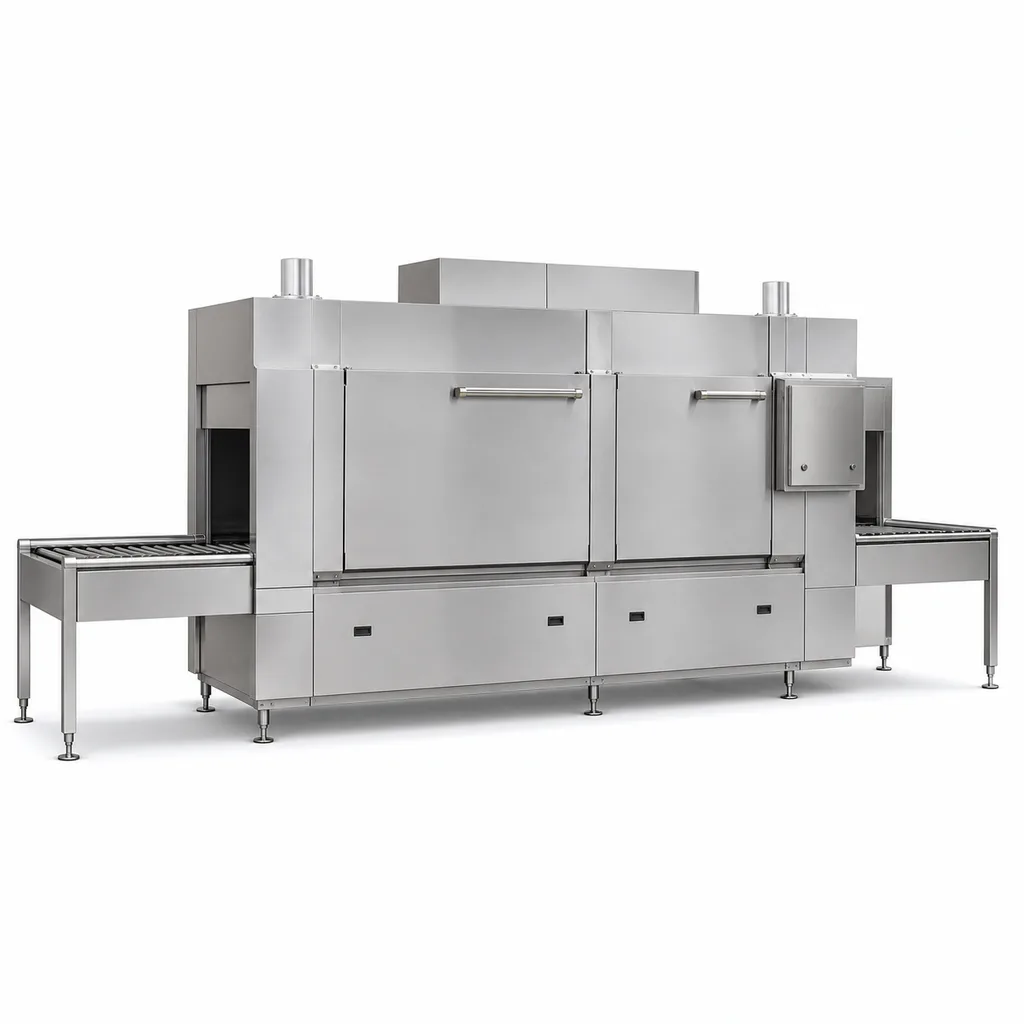
Conveyor Rack Warewashing Lines
High-capacity conveyor dishwashers engineered with accessible service panels and scale-resistant elements.
View Conveyor Washers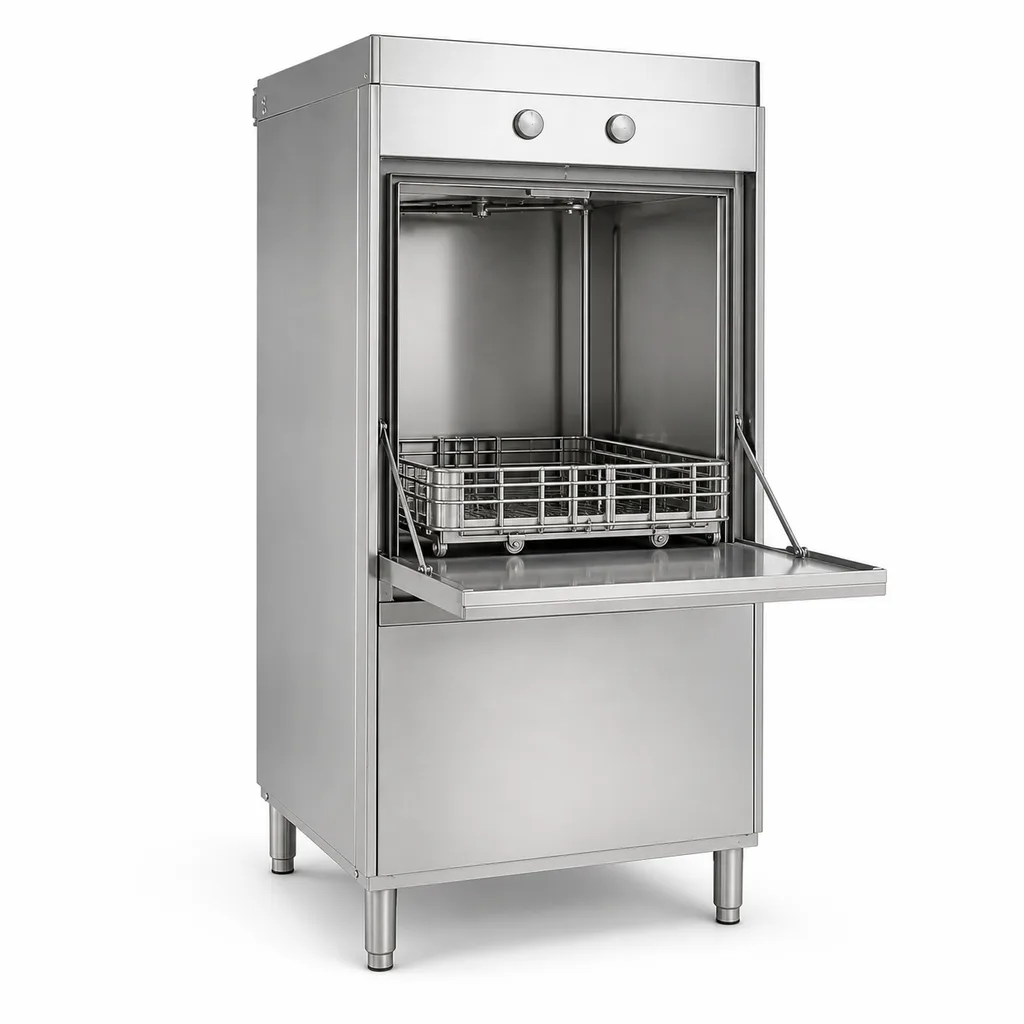
Commercial Utensil & Pan Washers
Heavy-duty pot and pan washing machines with high-pressure descaled wash manifolds for greasy bakeries.
View Utensil WashersIntegrated Booster Heaters
High-efficiency 304 stainless electric and steam booster heaters engineered for rapid descaling access.
View Booster HeatersTurnkey Engineering Solutions & Applications
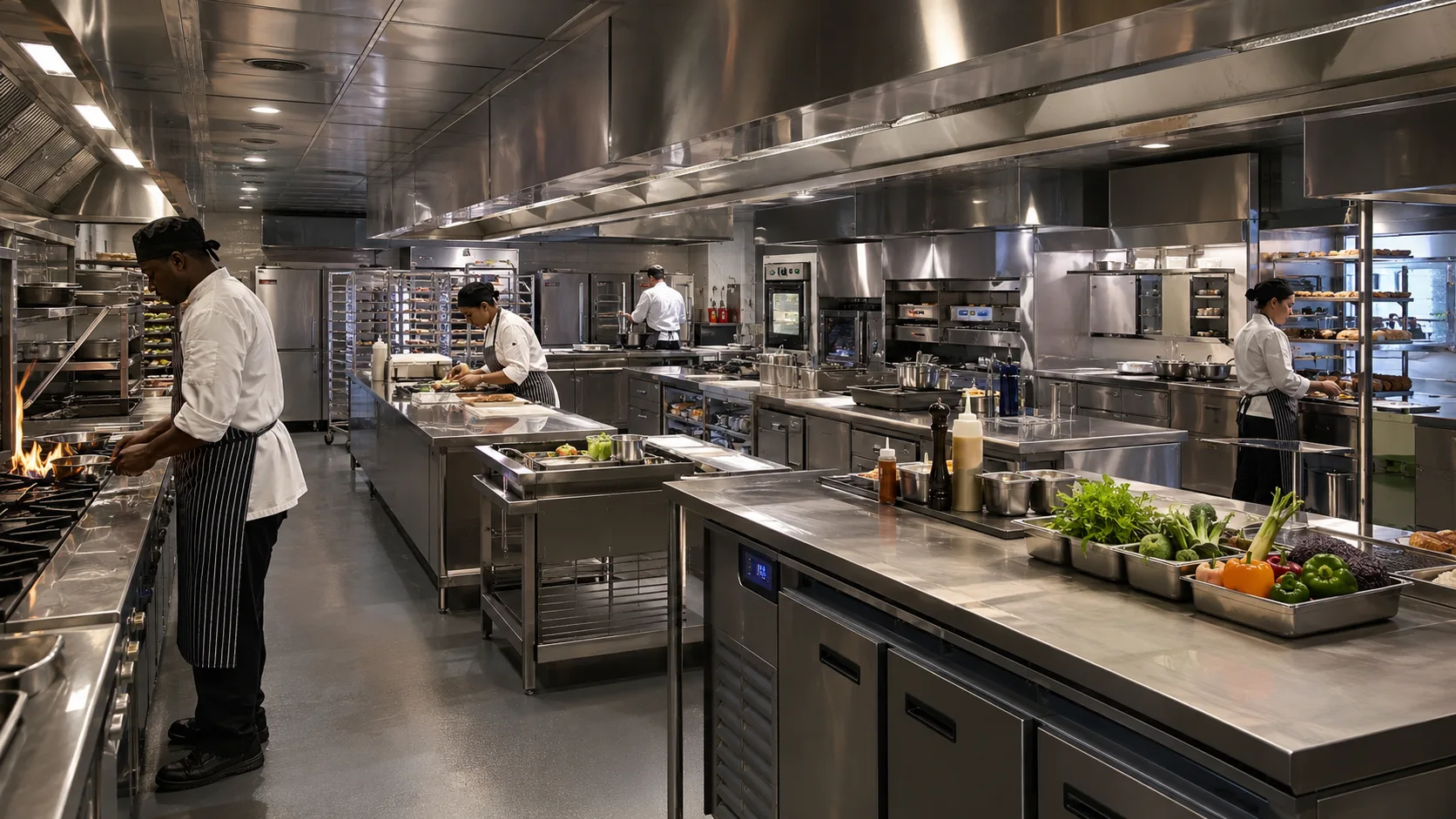
Hotel Banquet Stewarding
Comprehensive hotel warewashing maintenance programs with automated water softening and descaling.
Explore Hotel Solutions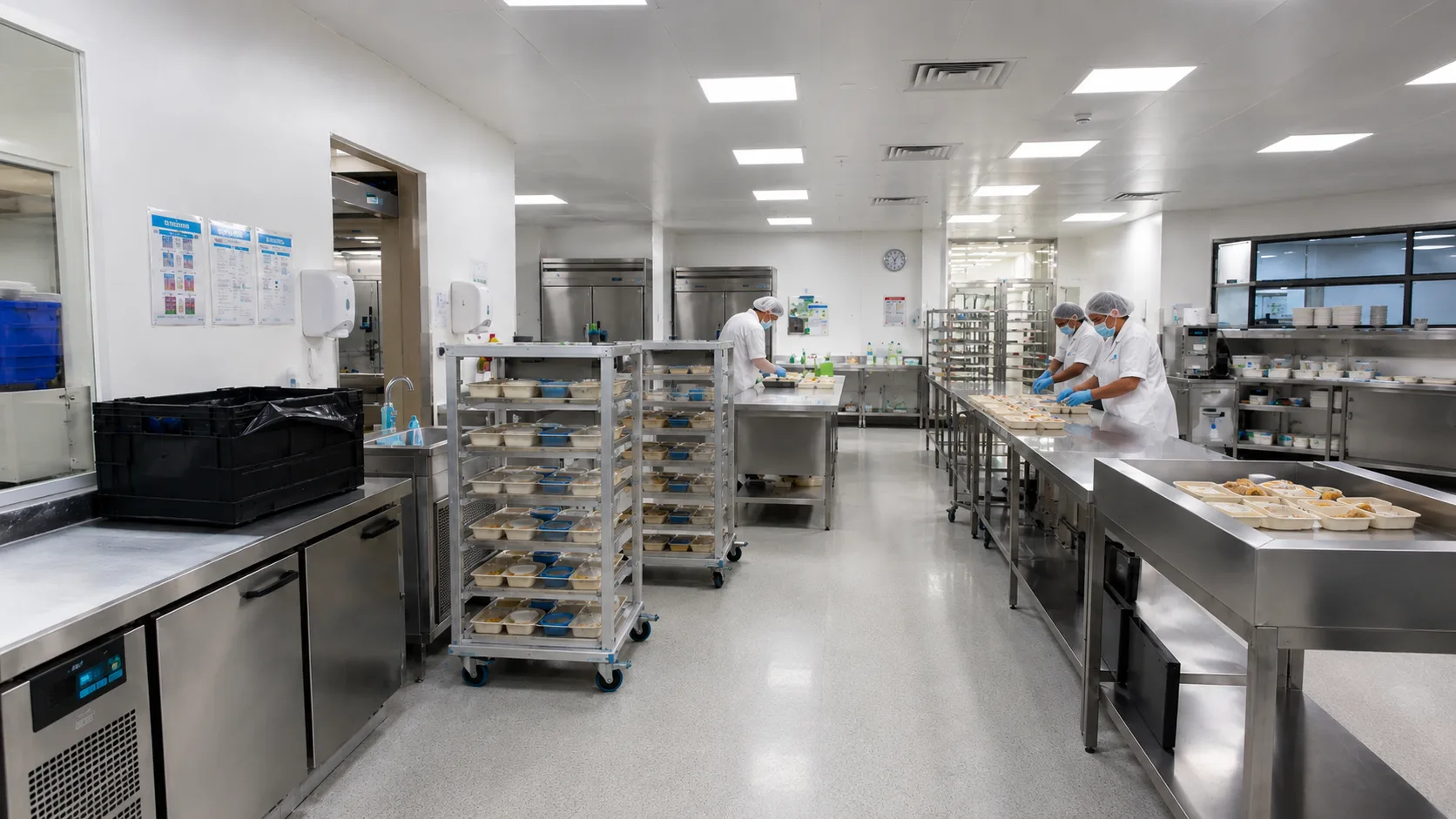
Hospital Healthcare Dishwashing
Sanitation-critical institutional warewashing with validated scale-free thermal disinfection cycles.
Explore Hospital Solutions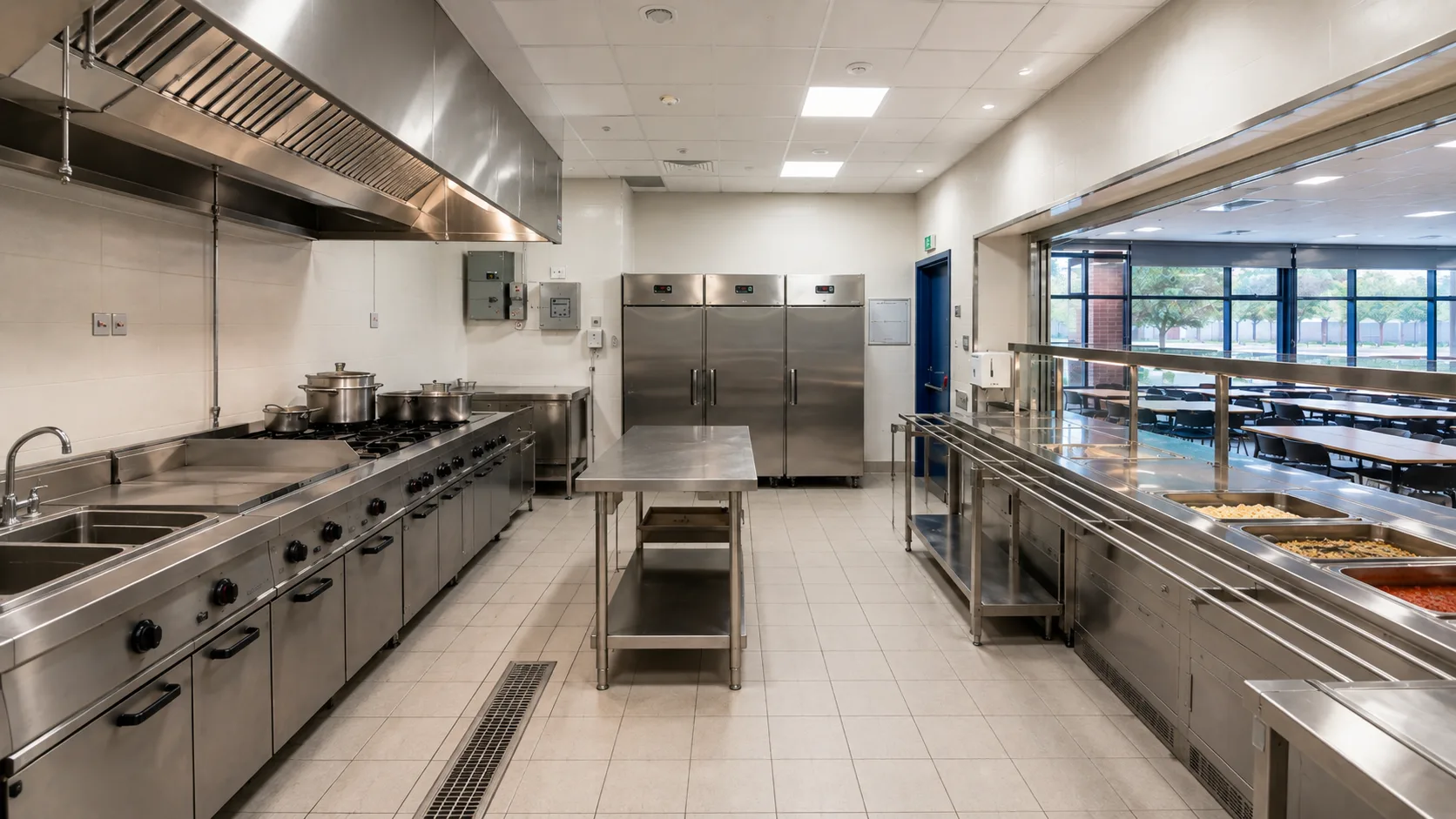
School Canteen Wash Centers
High-volume cafeteria wash centers engineered with durable limescale pre-treatment infrastructure.
Explore School Solutions
Commercial Restaurant Dishrooms
Space-optimized dishwashing layouts designed for fast daily maintenance and weekly chemical deliming.
Explore Restaurant SolutionsFrequently Asked Questions
What chemicals should be used to descale a commercial dishwasher?
Use food-grade inhibited phosphoric acid (10%-20%) or sulfamic acid solutions. Never use raw hydrochloric (muriatic) acid, as chlorides cause severe pitting corrosion and stress cracking in 304-grade stainless steel tanks and destroy silicone seals.
How do I know when a commercial dishwasher needs deliming?
Visible white chalky residue on internal walls, lime buildup on heating element coils, clogged spray nozzle jets, slow wash tank heating times, and cloudy spots on clean glassware indicate urgent deliming is required.
Why must chemical detergent and sanitizer pumps be disconnected during descaling?
Mixing acidic deliming chemicals with alkaline detergents neutralizes the acid, rendering it useless. More critically, mixing acid with chlorine bleach sanitizer generates toxic, lethal chlorine gas (Cl2), creating severe respiratory hazards for kitchen staff.
Can vinegar be used to descale an industrial dishwasher?
Household vinegar (5% acetic acid) is far too weak to dissolve heavy industrial calcium carbonate scale. It would require hundreds of liters and hours of contact time, making it ineffective and cost-prohibitive for commercial operations.
What water hardness requires a commercial water softener for warewashing?
Any water supply exceeding 3.5 grains per gallon (GPG) or 60 PPM hardness requires mechanical water softening to protect booster heating elements, eliminate glass spotting, and reduce detergent consumption by up to 40%.
Plan the Equipment Around Your Kitchen.
Share your menu, peak service demand, available space and site utilities. Tell us which equipment you are considering so we can review the requirements with you.