Commercial Dishwasher Price Guide: Machine Cost vs. True Operating Cost
Commercial dishwasher price ranges by type — undercounter, hood-type, rack conveyor and flight-type — plus 6 cost factors and water, energy and chemical costs.
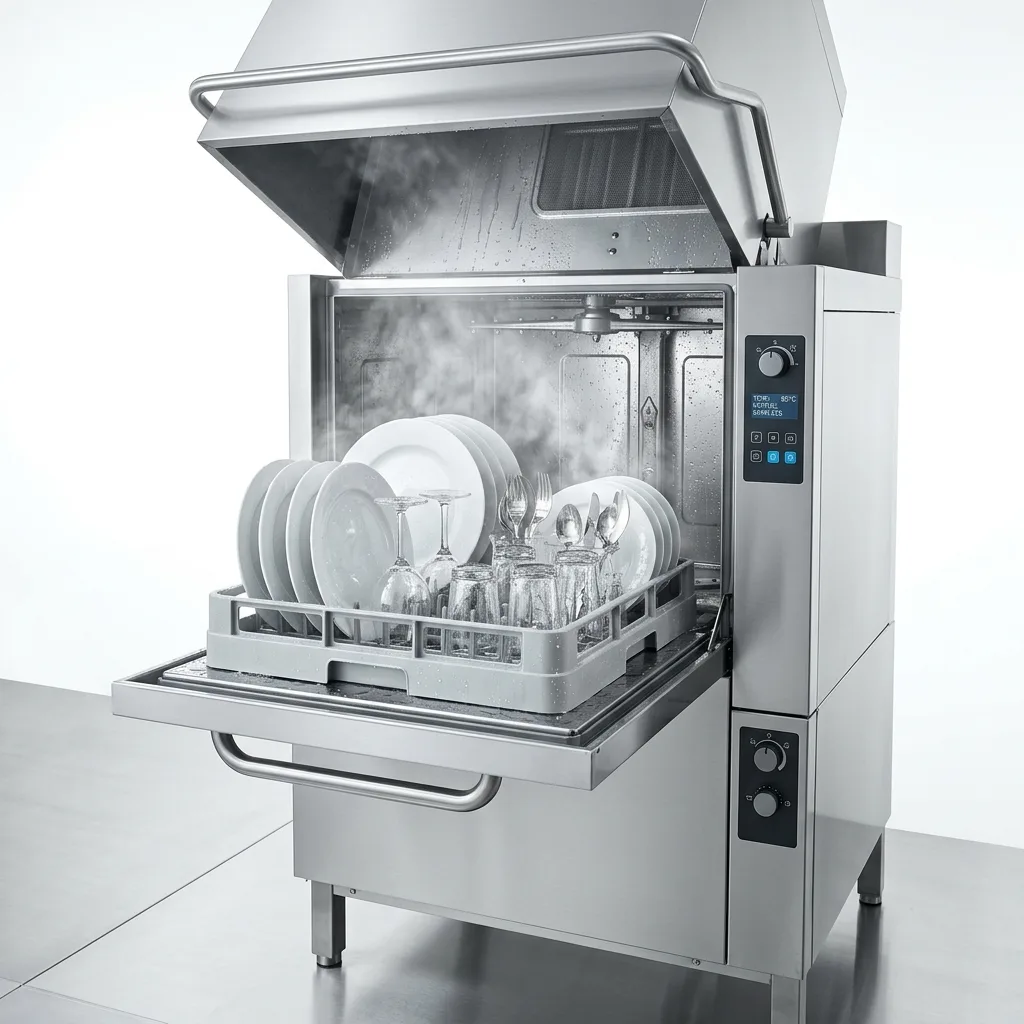
A commercial dishwasher quote that stops at the machine price is missing most of the story. A $4,000 hood-type unit and a $35,000 rack conveyor differ not just in purchase cost but in how much water, energy, detergent, and labor they consume per rack — and over a 10-year service life, those operating costs usually exceed the purchase price several times over.
This guide breaks down realistic price ranges for the four main commercial dishwasher types, explains the six factors that push a quote up or down, and shows how to build a total cost of ownership (TCO) budget before you sign anything.
Key takeaway: Budget by cost per rack, not sticker price. As a rule of thumb, annual operating cost (water + energy + chemicals) runs roughly 30–80% of the machine's purchase price, so a cheaper machine with poor efficiency often costs more within 3–4 years.
Why Purchase Price Is Only the Starting Point
Procurement teams often compare dishwashers line by line on the equipment quote. That misses the point for three reasons. First, a commercial dishwasher runs 4–12 hours a day, and every cycle consumes water, heat, and chemicals — the machine is essentially a meter running on your utility bills. Second, the wrong capacity choice forces either overtime labor (machine too small) or wasted resources (machine too large). Third, serviceability and spare parts availability determine how much of the machine's 8–12 year design life you actually get.
The correct budgeting question is not "what does the machine cost?" but "what does one clean rack cost me over ten years?" That number — typically between $0.40 and $1.50 per rack depending on machine type and local utility rates — is what should drive the selection. For a broader framework on matching equipment to your operation, see our equipment selection resources.
Commercial Dishwasher Price Ranges by Type
The table below gives typical market price ranges for each machine class. These are honest planning figures, not quotes — actual pricing varies with capacity, wash temperature (high-temp vs. chemical sanitizing), steel grade, brand, and regional freight. Always confirm final pricing against your exact configuration.
| Machine Type | Capacity | Typical Price Range | Best Fit |
|---|---|---|---|
| Undercounter | 20–40 racks/hour | $1,500–$5,000 | Cafés, bars, small restaurants up to ~80 seats |
| Hood-type (door/pass-through) | 40–70 racks/hour | $3,500–$10,000 | Restaurants, hotel à la carte kitchens, 100–300 covers |
| Rack conveyor | 100–250 racks/hour | $15,000–$45,000 | Hotel banqueting, hospitals, canteens, central kitchens |
| Flight-type (continuous) | 3,000–10,000+ dishes/hour | $50,000–$150,000+ | Airline catering, large central kitchens, 5,000+ meal operations |
Add 10–20% on top of the machine price for accessories most projects actually need: inlet and outlet tabling, pre-rinse spray units, rack trolleys, water softeners, and — for high-temp machines — a booster heater and condensate hood or heat-recovery unit.
Six Factors That Move the Price Up or Down
1. Throughput Rating
Racks per hour is the biggest single price driver. Doubling capacity within the same type typically adds 40–70% to the price, not 100% — oversizing slightly is cheaper than running two shifts.
2. High-Temp vs. Chemical Sanitizing
High-temp machines (final rinse at 82–88°C) cost more upfront and need a booster heater, but cut chemical spend and dry faster. Chemical-sanitizing models are cheaper to buy but add ongoing sanitizer cost.
3. Stainless Steel Grade and Gauge
Full AISI 304 construction with 1.2–1.5 mm sheet costs more than mixed 304/430 builds with thinner panels, but it is what survives 10 years of caustic detergent and daily washdown.
4. Heat Recovery
A condensate heat-recovery module adds roughly $1,500–$4,000 on hood-type machines, but can cut water-heating energy by 30–50% and often removes the need for a separate exhaust hood.
5. Automation Level
Auto rack detection, variable-speed conveyors, automatic chemical dosing, and HACCP data logging each add cost — and each either saves labor or provides compliance documentation you would otherwise pay for in man-hours.
6. Water Treatment
Hard water regions need a softener ($300–$1,500) or a reverse-osmosis unit ($2,000–$6,000) to prevent limescale. Skipping this is the most common way operators double their maintenance bills.
The Operating Budget: Water, Energy, and Chemicals
For TCO planning, use these consumption benchmarks per rack and scale them by your daily rack count:
- Water: modern machines use 1.0–2.5 liters per rack; older or low-cost models can exceed 4 liters. At 200 racks/day, the difference between 1.5 and 3.5 L/rack is roughly 100,000 liters per year.
- Energy: heating water is 60–70% of a dishwasher's electricity use. A high-temp hood-type machine typically draws 9–15 kW; a rack conveyor 25–60 kW depending on zones.
- Chemicals: detergent and rinse aid typically cost $0.05–$0.15 per rack. Automatic dosing pays for itself by eliminating over-dosing, which is common with manual feeding.
- Labor: a pass-through or conveyor machine with inlet/outlet tabling lets one operator handle the whole dish return; without tabling you need two.
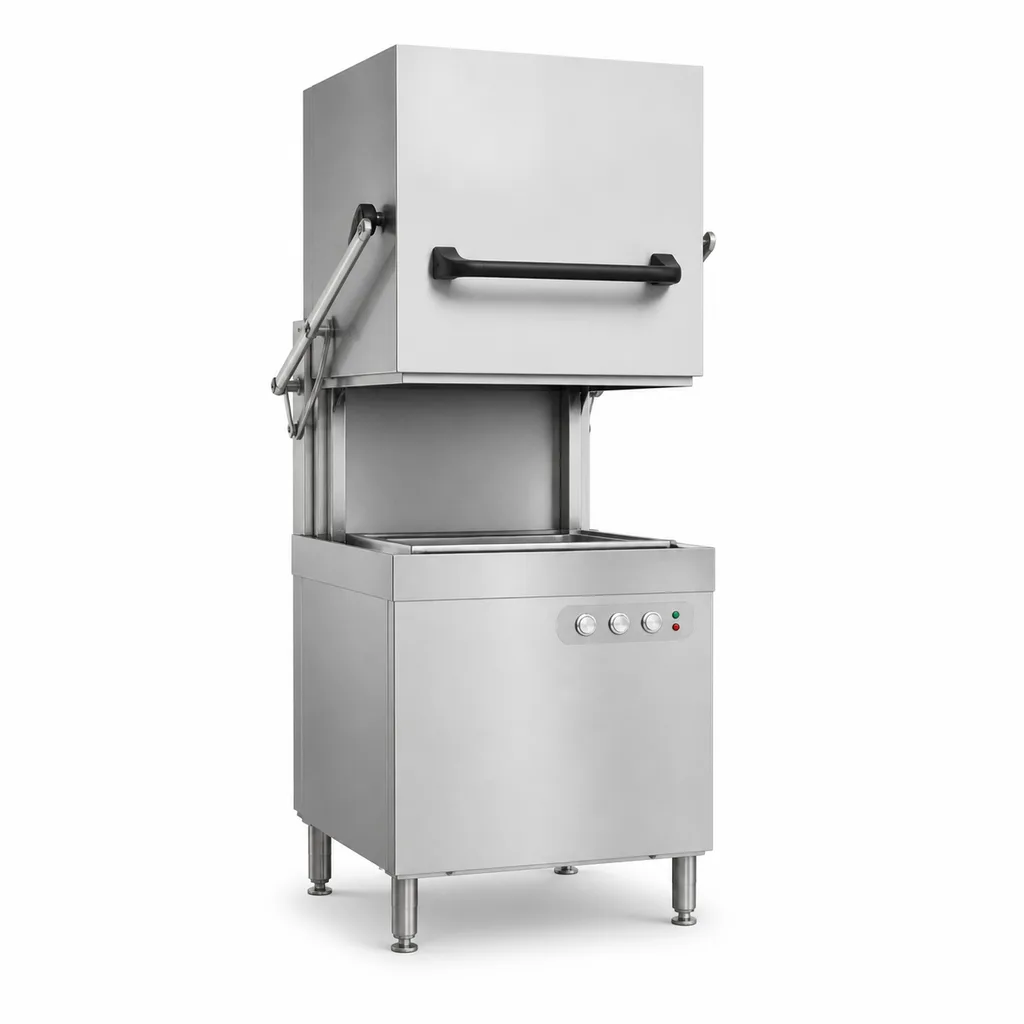
Worked example: a 200-cover restaurant washing 150 racks/day with a hood-type machine at 2.0 L/rack uses about 90,000 liters of water per year, roughly $1,800–$3,600 in energy (depending on local tariffs), and $2,700–$8,200 in chemicals. That is $5,000–$12,000 per year on top of a $6,000 machine — the purchase price is recovered or lost through efficiency within the first two years. You can compare machine configurations in our dishwashing equipment category.
Budgeting Checklist Before You Request a Quote
Suppliers quote what you ask for. Give them this checklist and the quotes you receive will be comparable line by line:
- Peak demand: racks per hour at your busiest 90 minutes, not your daily average — size for the peak.
- Machine class: undercounter, hood-type, rack conveyor, or flight-type, with required racks/hour stated.
- Sanitizing method: high-temp (with booster heater and heat recovery) or chemical sanitizing, decided upfront.
- Utilities on site: available electrical supply (kW and phase), water hardness (ppm), drain capacity, and whether an exhaust hood exists above the machine position.
- Ancillaries: inlet/outlet tabling lengths, pre-rinse unit, rack trolleys, water softener — itemized, not bundled.
- Consumable pricing: cost per rack for detergent and rinse aid from the proposed dosing system, in writing.
- Service terms: spare parts availability, response time, and annual maintenance contract cost. Our spare parts FAQ explains what to check before committing to a brand.
With those seven items pinned down, the TCO comparison between a $4,500 and a $7,000 machine becomes a spreadsheet exercise instead of a guess — and the more efficient machine wins far more often than the cheaper one.
Frequently Asked Questions
How much does a commercial dishwasher cost by type?
Undercounter machines typically run $1,500–$5,000, hood-type units $3,500–$10,000, rack conveyor systems $15,000–$45,000, and flight-type machines $50,000–$150,000+. Exact pricing varies with capacity, sanitizing method, and steel grade, so treat these as planning ranges, not quotes.
What costs should I budget beyond the machine price?
Add 10–20% for accessories such as inlet/outlet tabling, pre-rinse units, rack trolleys, water softeners, and booster heaters. Then budget annual operating costs — water, energy, and chemicals — which typically run 30–80% of the purchase price every year.
Is a high-temp or chemical-sanitizing dishwasher cheaper to run?
High-temp machines cost more upfront and need a booster heater, but they cut chemical spending and dry faster. Chemical-sanitizing models are cheaper to buy but add ongoing sanitizer cost of roughly $0.05–$0.15 per rack for detergent and rinse aid.
How much water and energy does a commercial dishwasher use?
Modern machines use 1.0–2.5 liters of water per rack. Water heating accounts for 60–70% of electricity use: a high-temp hood-type unit draws 9–15 kW, while a rack conveyor draws 25–60 kW depending on the number of wash zones.
How do I calculate the real cost per rack?
Divide your annual water, energy, chemical, and labor costs by the total racks washed per year. Typical total cost per rack falls between $0.40 and $1.50 depending on machine type and local utility rates — this figure, not the sticker price, should drive your selection.
Plan the Equipment Around Your Kitchen.
Share your menu, peak service demand, available space and site utilities. Tell us which equipment you are considering so we can review the requirements with you.