Commercial Kitchen Equipment Service
Commercial kitchen equipment service can run in-house or outsourced. We compare skills, response times, documentation and cost so you can pick the right model.
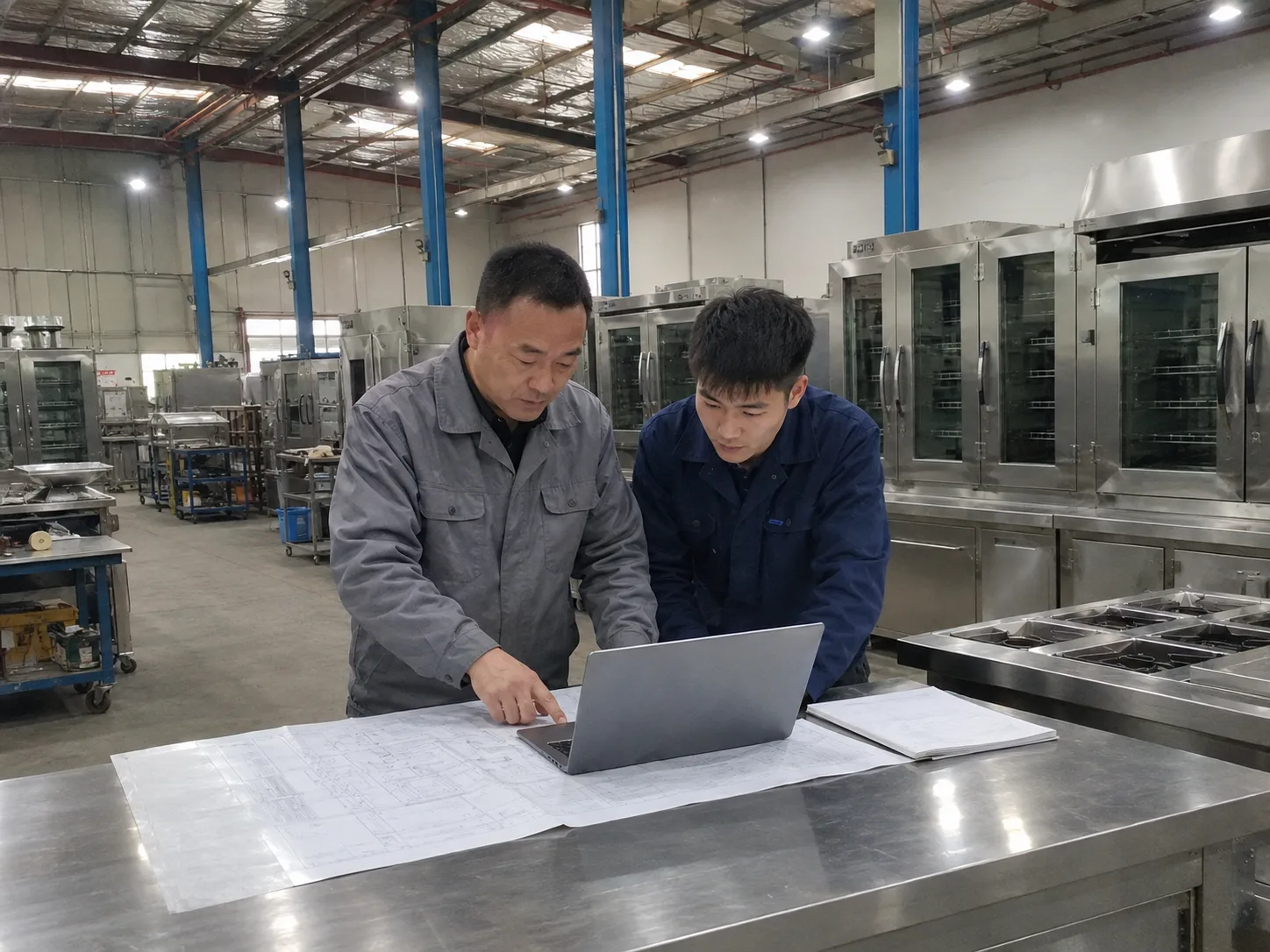
How should a commercial kitchen handle equipment service? Most operations should not choose one model outright. Outsourced maintenance contracts suit sites spread across multiple locations, warranty work needing OEM certification, and repairs needing specialist tools such as refrigeration control-board diagnostics or combi-oven steam-generator service. A full-time in-house technician pays off only at a single large site with enough annual fault volume to keep one mechanic busy, plus the tooling and parts to back them. The common middle ground — used by many mid-size hotel groups and hospital kitchens — is an in-house team for daily faults backed by an outsourced specialist for compressors, fryer gas valves, and combi-oven repairs. This guide shows how to pick that mix and what it costs.
Service strategy is a downtime decision before it is a cost decision. The right structure fixes a failed refrigeration compressor or combi-oven fault inside your service window, with records good enough for a health inspector or insurer. The sections below break the choice into the variables that move first response time and annual cost.
Key takeaway: Outsource specialist repairs and compliance-sensitive work; keep in-house staff for daily faults and preventive checks. The right mix reduces downtime without overstaffing, and stays cheaper than a full in-house team below about six sites.
When to outsource versus building an in-house team
Commercial kitchen equipment service falls into two models: outsourced maintenance contracts and in-house technician teams. Outsourcing works when your cluster spans multiple sites, when OEM certification is required for warranty compliance, or when you lack diagnostic tools for refrigeration control boards and combi-oven steam generators. In-house teams make sense at a single large site with enough volume to justify a full-time mechanic, a calibrated torque wrench, a flue-gas analyzer, and a parts locker. Most mid-size hotel groups and hospital kitchens use a hybrid: in-house for daily faults, outsourced for compressors, fryer gas valves, and combi-oven repairs.
Skill requirements by equipment family
Dishwashers need pump, heater, and chemical-dosing knowledge. Ovens need temperature-sensor calibration, door-seal replacement, and fan-motor balancing. Refrigeration needs EPA-compliant refrigerant handling, compressor diagnostics, and control-board programming. Fryers need gas-valve safety checks, burner alignment, and temperature-probe verification. A technician expert in one family is rarely expert in all four. Outsourced contracts give OEM-certified specialists without the training overhead.
Plan coverage against your equipment mix, not headcount. A kitchen heavy on refrigeration and combi ovens leans more on outsourced specialists than a site running mostly dishwashers and light-duty ovens. List your top five failure modes and map each to a named skill before you write the contract or hire.
Cost comparison and contract structures
An in-house technician costs $55,000 to $85,000 per year in salary and benefits, plus tools, vehicle, and parts. An outsourced contract for the same coverage typically costs $18,000 to $40,000 per year per site, depending on response-time SLA and preventive-visit frequency. The outsourced model is cheaper for two to five sites; the in-house model becomes competitive only at six or more sites with predictable failure rates. Include overtime, training, and recruitment in the in-house calculation.
| Factor | In-house | Outsourced |
|---|---|---|
| First response time | 15–30 min | 1–4 hours |
| Specialist coverage | Limited by team skill | OEM-certified network |
| Documentation | Manual or self-built | Included in portal |
| Annual cost per site | $55k–$85k+ overhead | $18k–$40k |
| Scalability | Slow hiring cycle | Instant coverage |
Documentation and compliance
Health inspectors and insurers increasingly ask for maintenance records. A digital CMMS or service portal should log fault codes, parts replaced, labor hours, and technician certification. In-house teams need a designated administrator; outsourced vendors usually include logging in the contract. If you self-insure, the maintenance log is your primary evidence that failure was not negligence. Make the log a contract deliverable: specify the fields, access rights, and retention when the relationship ends.
Training, certification, and safety
Technicians need more than mechanical skill. Refrigerant handling requires EPA 608 in the U.S. or F-gas in Europe. Gas work needs a gas-safe register card in the UK or local equivalent. Electrical troubleshooting beyond 240 V needs qualified-electrician status. These certifications expire; outsourced vendors track them, while in-house teams need a training budget and compliance calendar. Verify current certificate numbers at start and renewal, because a lapsed cert turns a compliant repair into a liability.
Vendor selection and contract renewal
Evaluate vendors on technician density, parts-warehouse proximity, and response-time track record — not just price. Ask for references from kitchens of similar size. At renewal, benchmark labor rates, parts discounts, and response-time against market terms. If the vendor missed SLA targets, use renewal to add penalty credits or open a competitive tender. Tie payment to measured performance so the vendor stays accountable through the term.
Transition planning and knowledge transfer
Switching models needs a formal transition plan. Document equipment histories, spare-parts lists, and vendor contacts before handover. Moving to in-house, budget for tooling, training, and a parts locker. Moving to outsourced, ensure access to maintenance logs, warranty documents, and building-mechanical drawings. A poor transition can leave equipment uncovered for weeks. Set a parallel-run window of two to four weeks and close the gap only after first-response targets are met.
Browse our support services. For maintenance guidance, see our installation and maintenance support.
Frequently Asked Questions
Should I outsource commercial kitchen equipment service or keep it in-house?
Outsource specialist and compliance-sensitive work; keep in-house staff for daily faults and preventive checks. Most mid-size operators use a hybrid model that balances response speed with specialist access.
What certifications do kitchen equipment technicians need?
Refrigerant handling needs EPA 608 or F-gas certification. Gas work needs qualified-gas-safe status. Electrical work above 240 V often needs a licensed electrician. Outsourced vendors should carry current certification for every trade they perform.
How much does an in-house technician cost versus an outsourced contract?
An in-house technician costs $55,000 to $85,000 per year plus tools, vehicle, and parts. An outsourced contract costs $18,000 to $40,000 per site per year. In-house only becomes competitive at six or more sites.
Why is service documentation important?
Health inspectors, auditors, and insurers ask for maintenance logs. A digital service portal that logs faults, parts, labor, and technician certification protects you against negligence claims and supports warranty disputes.
What should I include in a service vendor evaluation?
Evaluate response-time track record, technician density, parts-warehouse proximity, and references from similar kitchens. Price matters less than uptime reliability.
Plan the Equipment Around Your Kitchen.
Share your menu, peak service demand, available space and site utilities. Tell us which equipment you are considering so we can review the requirements with you.