Wholesale Commercial Restaurant Equipment
Comprehensive B2B procurement guide to wholesale commercial restaurant equipment, comparing factory-direct ocean container sourcing vs local retail dealer markups and auction liquidations.
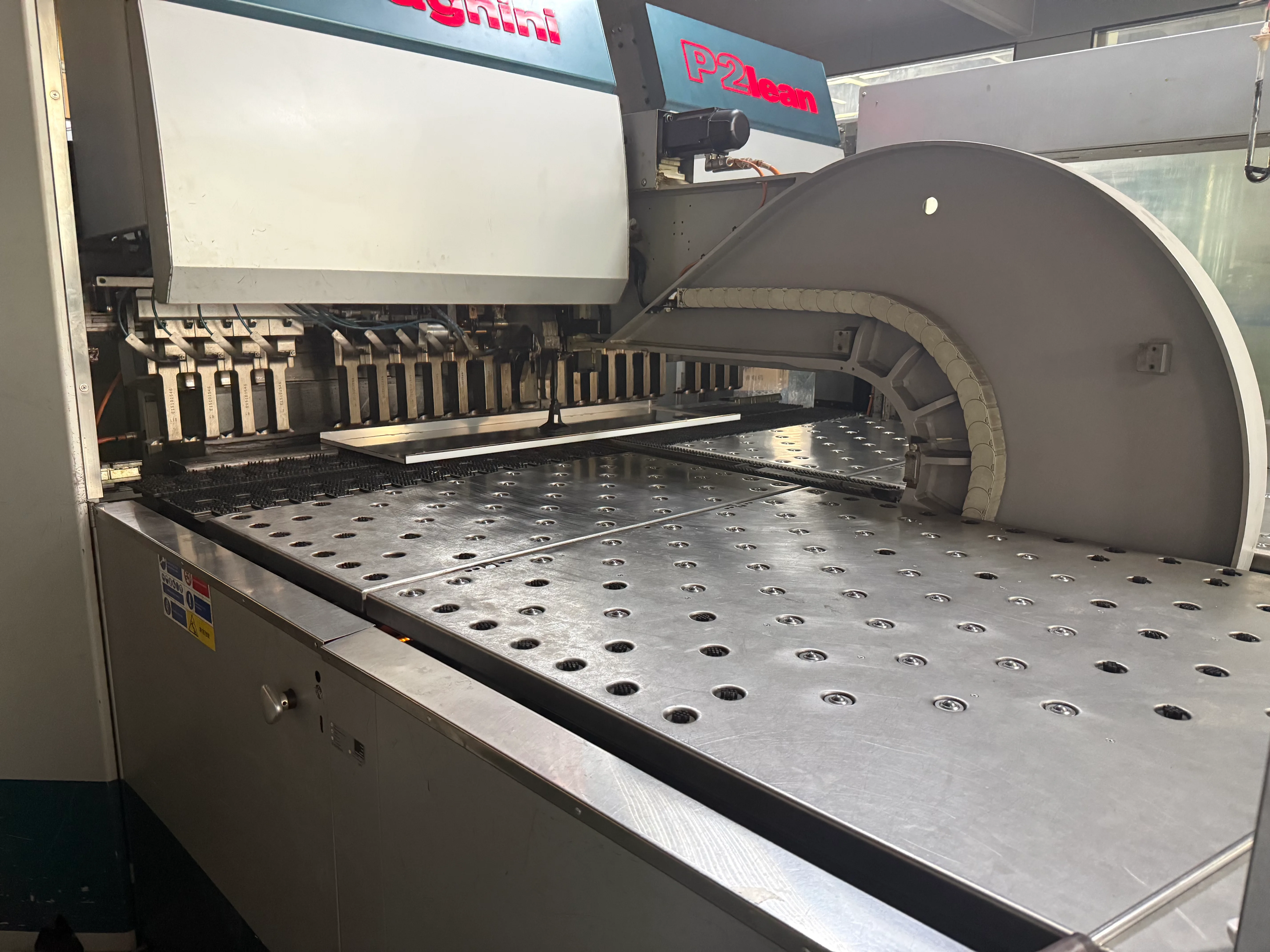
Procuring commercial kitchen equipment for multi-unit restaurant chains, international hotel properties, and large institutional catering operations represents a multi-million-dollar capital commitment. Enterprise purchasing directors must navigate competing supply chain channels: traditional brick-and-mortar restaurant supply stores, regional dealership brokers, equipment auction liquidations, and factory-direct OEM manufacturing contracts. While local retail stores offer immediate shelf availability, they impose dealer markups ranging from 30% to 55%. Direct manufacturer container consolidation, by contrast, delivers massive economies of scale and bespoke engineering customization. This procurement guide details supply chain comparative models, container logistics, Total Landed Cost (TLC) calculations, and international tender risk mitigation.
Figure 1: Original Equipment Manufacturer (OEM) factory floor showing automated CNC fabrication and international container staging.
1. Procurement Channels Comparative Matrix
Evaluating commercial foodservice supply channels requires analyzing pricing, lead times, warranty enforcement, and customization capabilities:
| Procurement Channel | Average Markup over Production Cost | Lead Time Horizon | Custom Engineering Capability | Warranty & Technical Support | Optimal Procurement Scenario |
|---|---|---|---|---|---|
| Factory-Direct OEM Manufacturer | 0% Markup (Direct factory wholesale pricing) | 6 - 10 Weeks (Production + Ocean Freight) | Unlimited: Custom dimensions, voltages, gas types, and CAD/BIM models | Direct factory warranty, 10-year spare parts escrow, factory technician support | New restaurant openings, hotel fit-outs, central commissaries, multi-unit chain expansions |
| Local Restaurant Supply Dealer | 30% - 55% Dealer Markup | Immediate to 2 Weeks (Local warehouse stock) | Strictly modular standard catalogue dimensions only | Local service contractor dispatch, third-party warranty processing | Emergency equipment replacement during active operations, single unit purchases |
| Restaurant Equipment Auctions | Variable (-40% to -70% of retail) | Immediate (As-is where-is) | None (Secondary market assets) | ZERO WARRANTY: Buyer assumes 100% mechanical failure risk | Budget startups with internal mechanical repair technicians |
| Online E-Commerce Wholesale Distributors | 18% - 30% Distributor Markup | 1 - 4 Weeks (Curbside freight delivery) | Limited modular options | Manufacturer pass-through warranty; customer responsible for installation and uncrating | Standard smallwares, reach-in coolers, tabletop auxiliary equipment |
2. Total Landed Cost (TLC) Engineering Formula
Enterprise procurement decisions must not be based solely on the FOB factory invoice price. Global logistics require calculating the comprehensive Total Landed Cost:
Logistics Calculation Benchmark: Sourcing an 8-station cooking and refrigeration package ($140,000 retail value) factory-direct for $78,000 FOB + $6,200 ocean freight + $3,500 customs + $2,800 destination rigging = $90,500 Total Landed Cost ($49,500 Net Capital Savings / 35.4% Capex Reduction).
3. 40-Foot High-Cube (40HQ) Container Consolidation Strategy
Maximizing container cubic volume utilization is the key to minimizing per-unit freight costs. Commercial kitchen equipment packages should be engineered for nested container loading:
| Equipment Category | Packaging & Crating Standard | Container Space Optimization Strategy |
|---|---|---|
| Stainless Steel Worktables & Sinks | Knock-Down (KD) flat-packed in heavy multi-ply corrugated cartons | Stacked horizontally on container floors beneath heavy refrigeration units |
| Reach-In Cabinets & Cold Storage | Solid wooden pallet bases with heavy-gauge protective film | Upright positioning; interior cabinet cavity loaded with KD table shelves and pans |
| Cooking Suites & Ranges | Reinforced fumigated solid timber crates with shock-watch tilt sensors | Positioned along container centerline over axles to prevent transit impact shock |
| Ventilation Canopies & Hoods | Custom protective timber framing | Suspended or nested vertically to utilize upper container headspace |
4. International Procurement Contracts & Risk Mitigation Clauses
When purchasing directly from overseas manufacturers, procurement directors must embed five non-negotiable legal protections into commercial contracts:
- Milestone Payment Structure: 30% down payment upon signed CAD approval; 40% upon successful Factory Acceptance Testing (FAT) video/live inspection; 20% upon Bill of Lading (B/L) issuance; 10% warranty escrow retention held for 90 days post-commissioning.
- Certified Electrical & Gas Orifice Alignment: Written contractual guarantee that all electrical equipment matches the destination country's grid voltage and frequency (e.g., 208V/60Hz 3-phase for North America; 400V/50Hz 3-phase for Europe/Middle East) and gas valves match local gas pressure specifications.
- Mandatory Consignment Spare Parts Package: Contract mandates inclusion of an accompanying 3% to 5% critical spare parts package (switches, thermostats, heating elements, solenoids, relays) packed directly inside the container to guarantee instant first-year maintenance independence.
5. Incoterms 2020 & International Equipment Logistics Liability
When purchasing full container loads directly from overseas original equipment manufacturers (OEMs), procurement directors must clearly define logistics liability using standardized Incoterms:
| Incoterm 2020 Rule | Seller Responsibility Boundary | Buyer Responsibility Boundary | Risk Transfer Point | Procurement Fit |
|---|---|---|---|---|
| FOB (Free on Board) | Manufacture, export packaging, transport to port, export customs clearance, crane loading onto vessel | Ocean freight, marine insurance, destination port drayage, customs tariffs, final rigging | On board vessel at departure port | INDUSTRY STANDARD: Optimal for buyers with established freight forwarders |
| CIF (Cost, Insurance & Freight) | Manufacture, export clearance, ocean freight, and marine cargo insurance to destination port | Destination port terminal handling charges (THC), customs tariffs, final mile delivery | On board vessel at departure port | Convenient for buyers lacking direct maritime logistics contracts |
| DDP (Delivered Duty Paid) | 100% turnkey: Manufacture, shipping, customs clearance, import tariffs, delivery to job site tailgate | Job site offloading, uncrating, internal rigging, and utility hookup | Job site unloading dock | Turnkey contractors wanting zero customs or freight administration |
6. Pre-Shipment Inspection (PSI) Protocols & Factory Acceptance Testing (FAT)
To eliminate receiving damaged or non-compliant equipment overseas, contracts must mandate certified Pre-Shipment Inspections:
- Third-Party Quality Audits (SGS / Intertek / TÜV): Independent inspectors verify sheet metal gauge with digital micrometers, conduct electrical megger insulation tests (> 20 MΩ at 500V DC), verify CE/UL certification nameplates, and test water-tight welds under pressure.
- Export Crating & ISPM 15 Fumigation: Solid timber crates must carry official IPPC heat-treatment stamps (HT) in strict compliance with ISPM 15 phytosanitary standards to prevent port agricultural quarantine impoundments.
7. International Customs Harmonized System (HS) Tariff Classification
Importing commercial kitchen equipment requires precise customs documentation to prevent tariff penalties and port clearance delays:
| Equipment Category | International Harmonized System (HS) Code | Duty Rate Benchmark (WTO MFN) | Mandatory Customs Certification Documents |
|---|---|---|---|
| Commercial Gas / Electric Cooking Ranges | HS 8419.81.00 (Cooking/Heating appliances for food) | 0% - 3.2% (Dependent on bilateral trade treaty) | CE Declaration of Conformity, UL 197 safety certificate |
| Commercial Refrigeration & Freezers | HS 8418.50.00 (Refrigerating display/storage furniture) | 0% - 4.5% | Refrigerant type certificate (EPA/F-Gas low-GWP compliance) |
| Commercial Dishwashers (Industrial) | HS 8422.11.00 / 8422.19.00 (Dishwashing machinery) | 0% - 2.8% | NSF Standard 3 sanitation certificate, electrical megger test log |
| Stainless Steel Worktables & Sinks | HS 7323.93.00 (Stainless steel kitchen articles) | 0% - 3.4% | Mill Test Certificate (MTC) verifying AISI 304 18/10 metallurgy |
8. Factory Acceptance Testing (FAT), Pre-Shipment Inspection (PSI) & AQL
Procuring commercial kitchen equipment directly from overseas manufacturing plants requires rigorous quality gate enforcement before container loading:
| Inspection Stage | Sampling Standard (ISO 2859-1) | Key Test Protocols & Pass/Fail Criteria |
|---|---|---|
| Pre-Shipment Inspection (PSI) | AQL General Level II, Critical: 0, Major: 1.5, Minor: 4.0 | Dimension verification against CAD drawings, stainless steel gauge validation using digital ultrasonic thickness meters, and packaging burst strength test. |
| Electrical Safety Hi-Pot & Megger Test | 100% Full Inspection on Powered Units | Dielectric withstand test at 1,500V AC for 1 second with leakage current < 5 mA; insulation resistance > 100 MΩ under 500V DC megohmmeter. |
| Gas Combustion & Leakage Verification | 100% Inspection on Burners & Manifolds | Electronic combustible gas detector leak test at 50 mbar test pressure; flue gas analysis verifying CO / CO2 ratio < 0.02 under full firing rate. |
| Refrigeration Temperature Pull-Down Run | AQL Special Level S-3 (Selected sample units) | 2-hour temperature pull-down logging in 38°C ambient test room; validation of thermostat cutoff point, suction pressure, and evaporator frosting uniformity. |
Supply Chain Risk Defense: Ocean Transit Moisture & Desiccant Sizing
Symptom: Stainless appliances arrive at destination port with brown surface oxidation spots and rusted circuit breaker contacts inside wooden crates.
Root Cause Analysis: "Container rain" caused by severe temperature swings during 30-day ocean transit across tropical equatorial corridors. Moisture condensing on container ceilings drips onto unsealed equipment packing.
Corrective Action: Mandate heavy-duty vacuum-sealed PE moisture barrier bags with nitrogen purging for all electronic control boards; install calcium chloride container desiccant poles (minimum 2 kg per 20GP, 4 kg per 40HQ) along interior container side walls.
9. Factory Audit Scorecards (ISO 9001 / SMETA) & 5% Spare Parts Buffer
Large-scale hotel chains and procurement contractors safeguard international equipment manufacturing runs through rigorous factory grading and spare parts lifecycle planning:
| Procurement Control Dimension | Assessment Criteria & Benchmark | Risk Mitigation Protocol |
|---|---|---|
| Factory Quality Management (ISO 9001:2015) | Traceability of incoming stainless steel coils, automated laser welding robotic calibration, and calibrated digital torque wrenches on assembly lines. | Disqualifies non-certified sweatshops; guarantees that sheet metal tolerances remain within ±0.5 mm for modular kitchen line alignment. |
| Social & Environmental Audit (SMETA / BSCI) | Worker safety gear, compliant spray booth exhaust filtration, and ethical labor standards. | Protects multinational hospitality brands from international supply chain reputational risks and customs labor sanctions. |
| 5% Critical Spare Parts Buffer Kit | Includes high-wear components: digital thermostats, heating elements, contactors, magnetic door gaskets, and pilot thermocouples. | Packed directly inside container crates; prevents high-cost air freight express fees and multi-week kitchen downtime during initial commissioning and warranty phases. |
Featured Commercial Equipment Models
Factory Direct Turnkey Packages
Comprehensive custom cooking, refrigeration, and warewashing equipment manufactured directly at wholesale pricing.
View Factory Lines
Container Staging Equipment
Standardized commercial kitchen equipment platforms engineered for high-density 40HQ container consolidation.
View Container Lines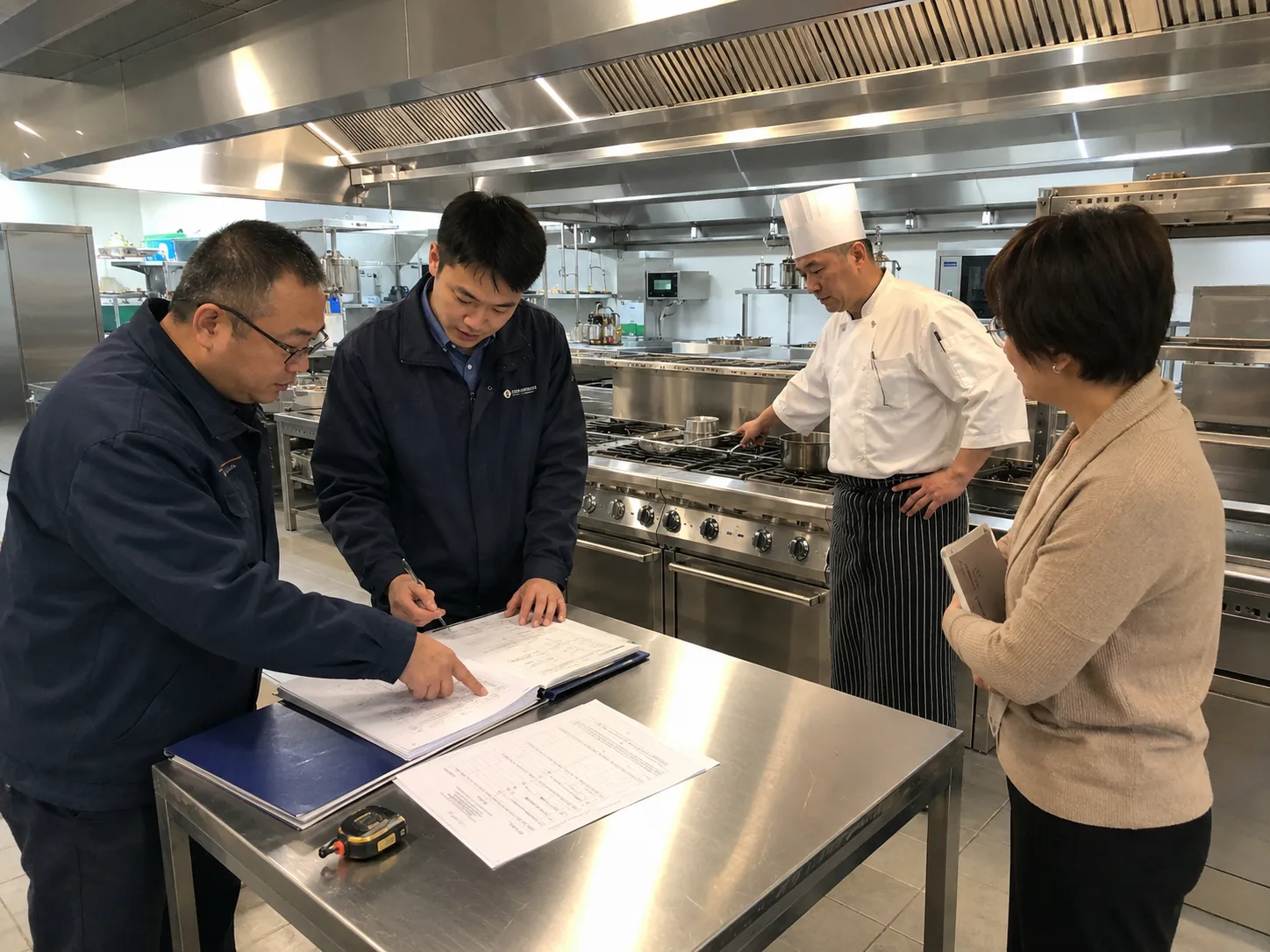
Turnkey Culinary Installations
Complete commercial culinary fit-out packages coordinated from initial engineering drawings to final delivery.
View Project Packages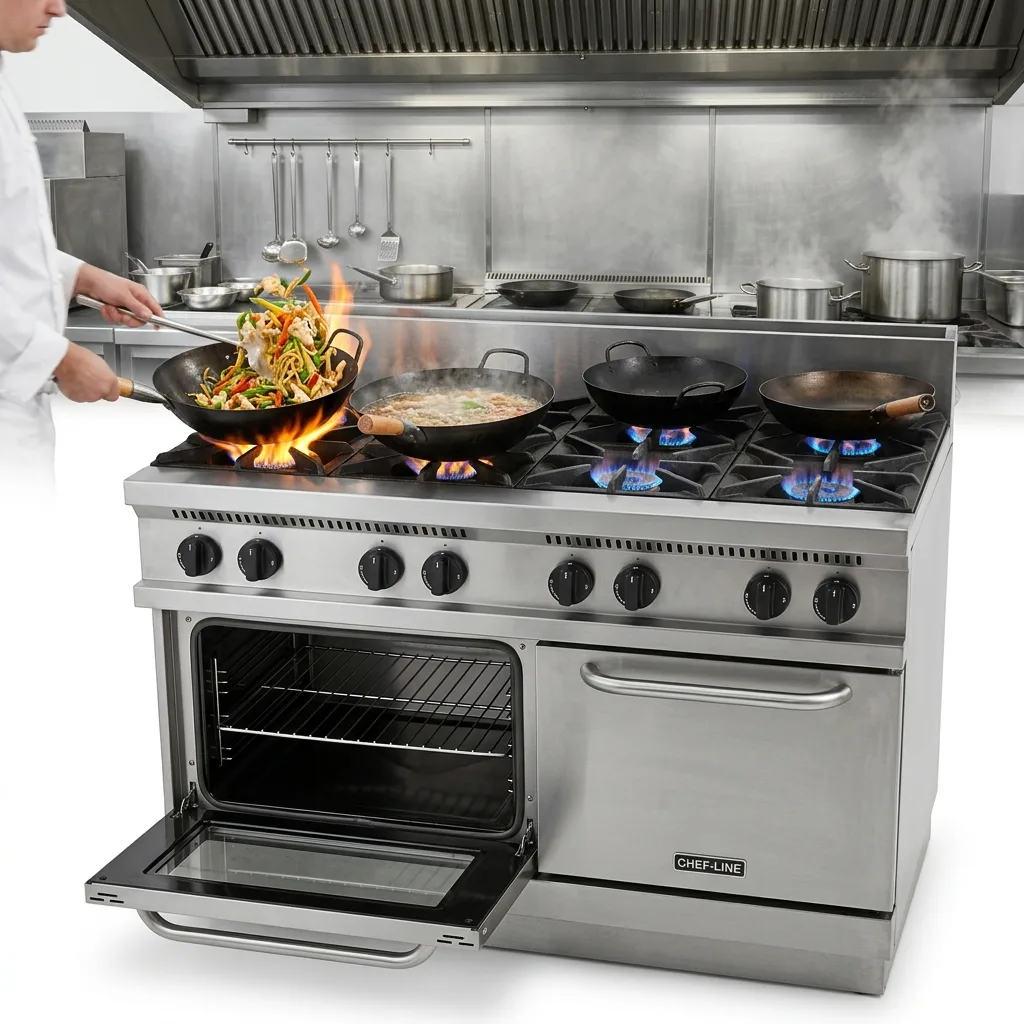
Commercial Gas & Electric Ranges
Heavy-duty commercial cooking ranges built with international CE/UL compliant electrical and gas valves.
View Commercial RangesTurnkey Engineering Solutions & Applications
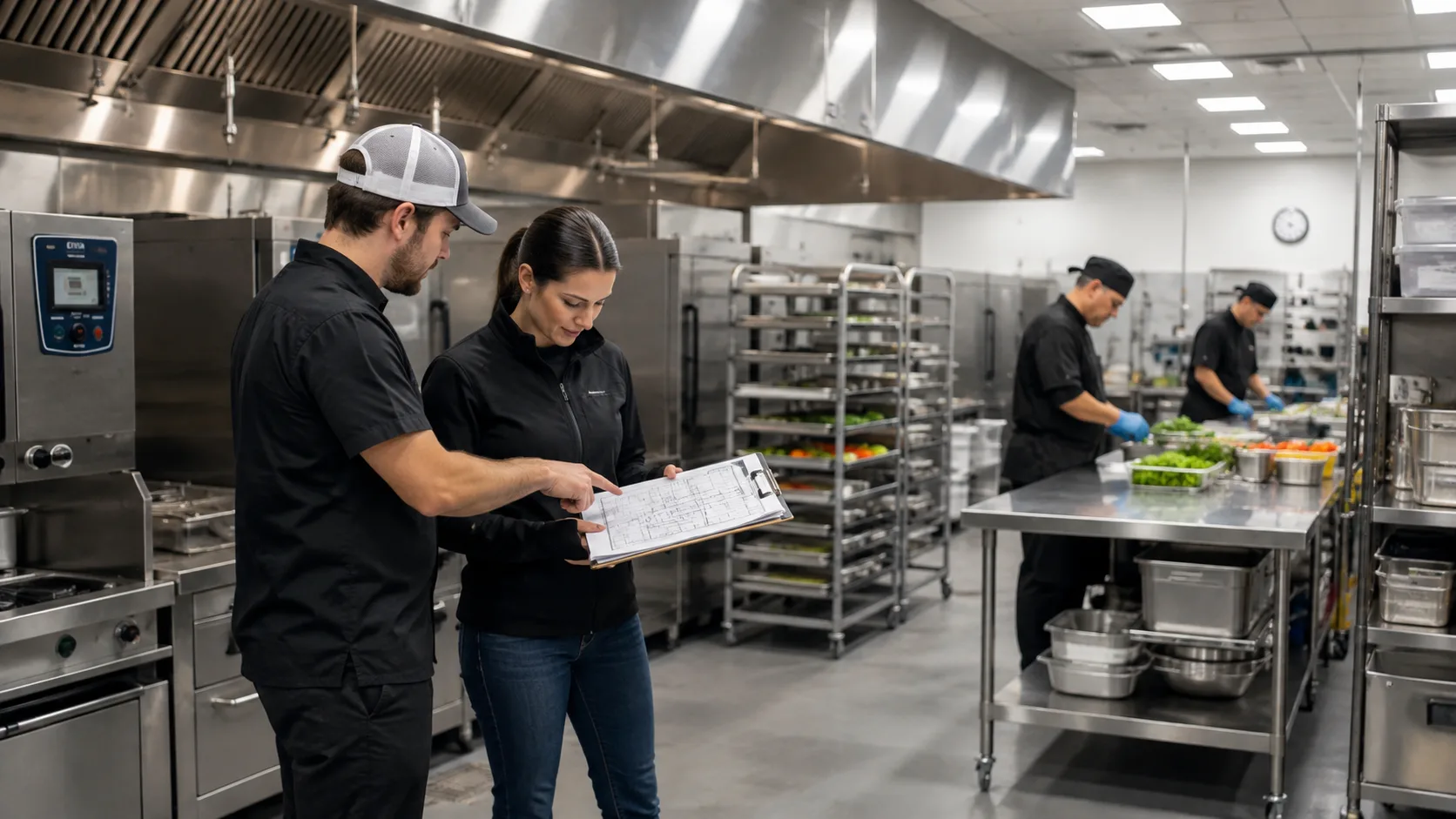
Central Commissary Sourcing
Direct factory container procurement programs engineered for large commissary food factories.
Explore Central Kitchen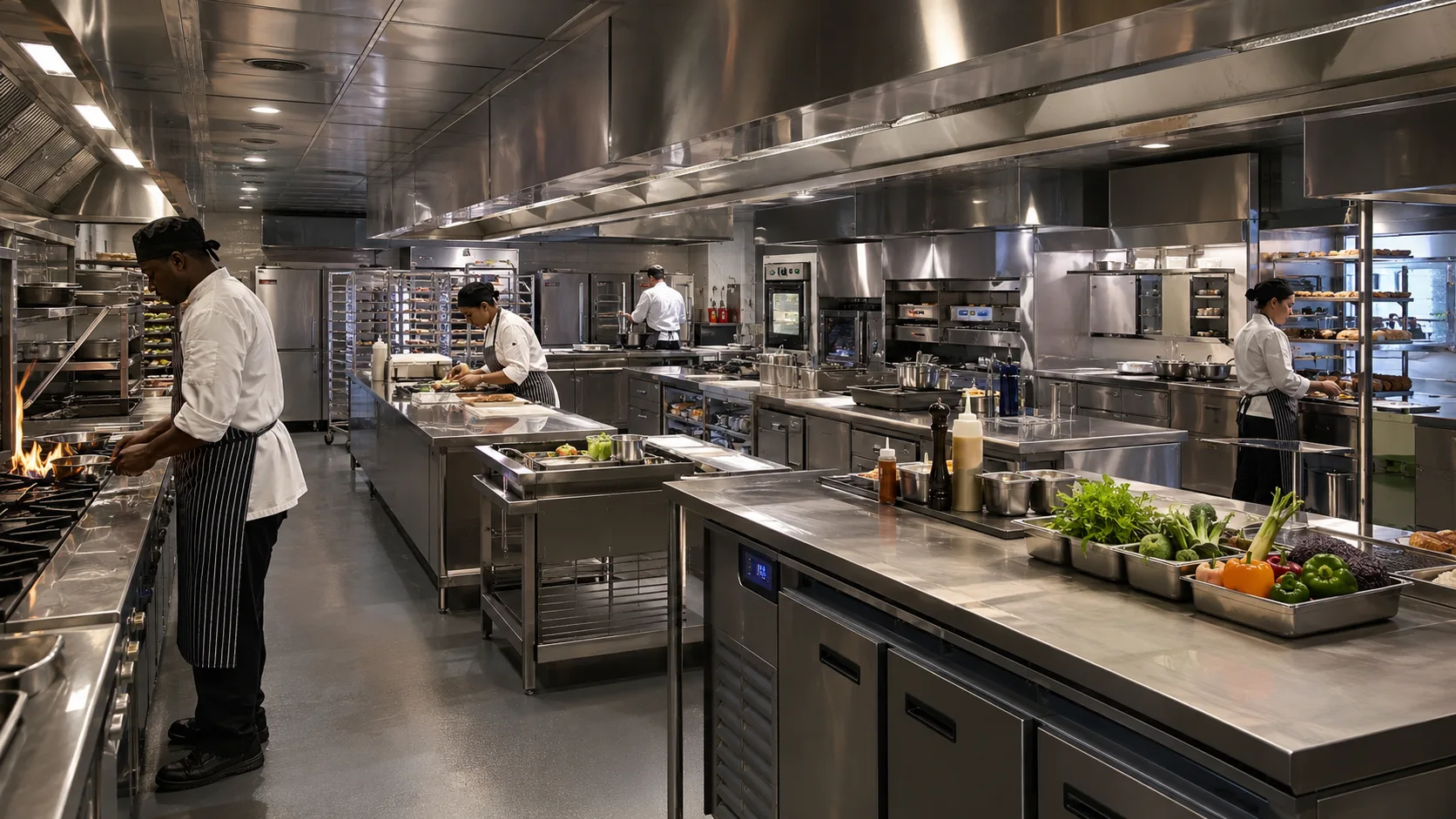
Hotel Group Procurement Programs
Multinational corporate procurement standards engineered for luxury hotel and resort chains.
Explore Hotel Solutions
Restaurant Franchise Chain Supply
Standardized container supply chains delivering turnkey equipment packages to restaurant franchise rollouts.
Explore Restaurant Solutions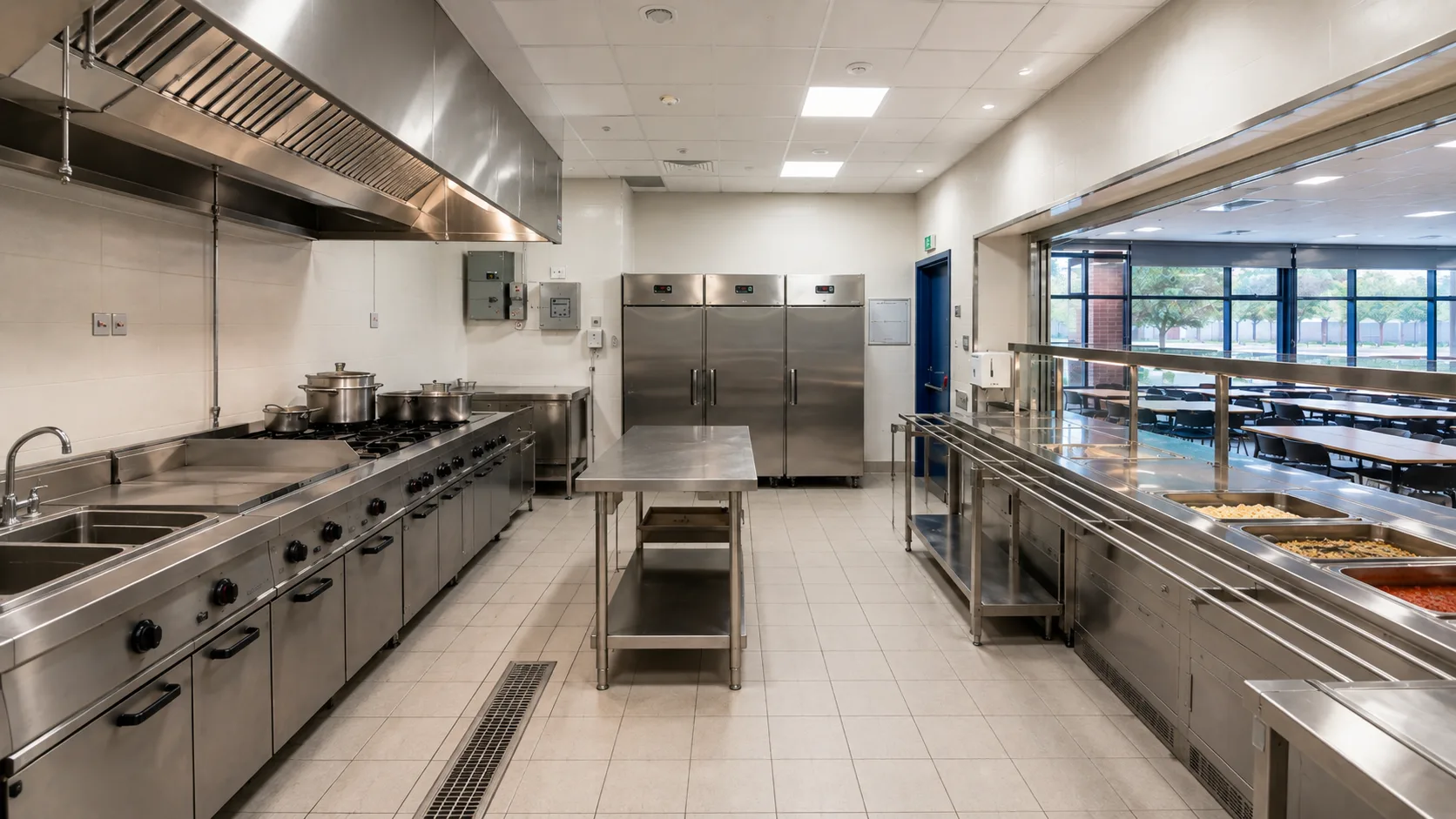
Public Tender Educational Supply
Compliance-driven institutional kitchen procurement programs tailored for public school districts.
Explore School SolutionsFrequently Asked Questions
How much money can be saved by buying commercial kitchen equipment factory-direct?
Buying directly from certified OEM manufacturers saves 25% to 45% compared to local retail dealers by eliminating multiple intermediary markups, making it highly advantageous for complete restaurant fit-outs and multi-unit chain rollouts.
What is the typical lead time for factory-direct restaurant equipment orders?
Production lead times typically range from 3 to 5 weeks, with ocean freight adding 3 to 5 weeks depending on destination port, for a total lead time of 6 to 10 weeks. This aligns perfectly with the standard 8 to 14-week commercial construction fit-out timeline.
How is warranty service handled when purchasing equipment directly from the factory?
Reputable OEM manufacturers provide direct factory warranties backed by international spare parts consignment packages shipped with the equipment, paired with local third-party commercial service contractor networks for on-site maintenance.
What are the risks of purchasing commercial kitchen equipment at auctions?
Auction equipment is sold strictly 'as-is' with zero warranties. Used equipment often has hidden cracked boiler elements, leaking refrigeration compressors, or uncalibrated gas valves that require thousands of dollars in emergency repairs, wiping out any initial savings.
How can operators verify equipment quality before overseas shipment?
Require a formal Factory Acceptance Test (FAT) prior to crating. The manufacturer must execute live thermal tests, electrical insulation megger checks, and dimensional verification on camera, followed by signed quality inspection certificates.
Plan the Equipment Around Your Kitchen.
Share your menu, peak service demand, available space and site utilities. Tell us which equipment you are considering so we can review the requirements with you.