A rack conveyor dishwasher is a site decision before it is a buying decision, because it commits the dishroom to a linear footprint, a three-phase or steam utility load, and a water and drain route that the rest of the kitchen does not share. Get the site right and the machine clears hundreds of racks an hour without a second thought; get it wrong and the delivery-day surprise is a wall in the wrong place or a breaker that trips on the first load. This guide works through the four site elements — space, utilities, the steam-versus-electric split and throughput — using the documented dimensions and loads of the HDW rack conveyor range, from the HDW220 up to the HDW8000L.
Plan the Linear Footprint First
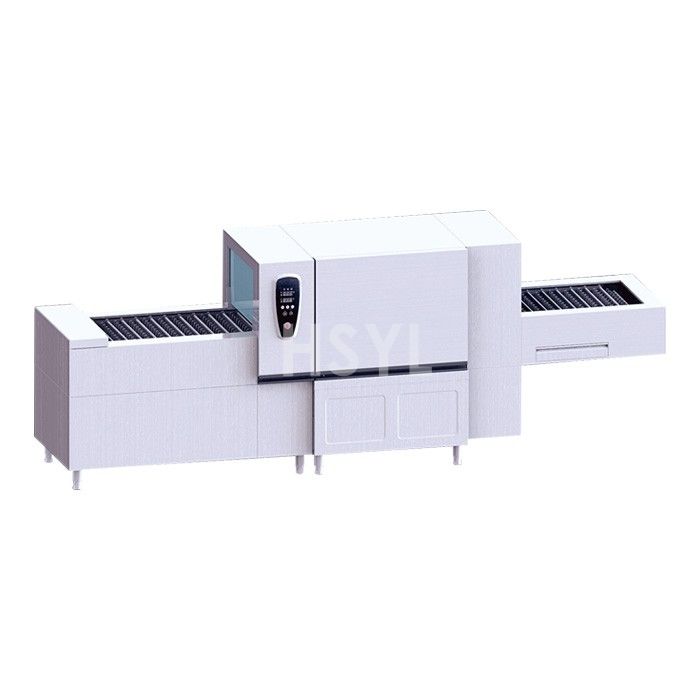
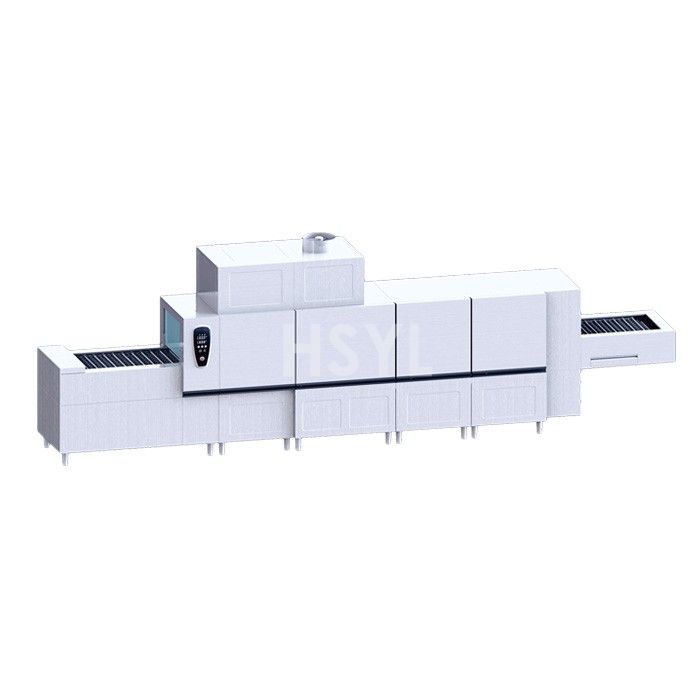
A conveyor machine is a line, not a box. It needs clean-side and dirty-side tabling, an operator path that does not cross the belt, and service clearance behind the machine. The documented frames give the starting numbers:
| Model | Machine Dimension (mm) | Throughput | Note |
|---|---|---|---|
| HDW220 | 2050 × 810 × 1520 | 220 baskets/h | 41 kW electric, 380 V |
| HDW260-EL-R | 2632 × 810 × 2030 | 260 baskets/h | 45 kW electric, 380 V |
| HDW260-SL-R | 2632 × 810 × 2030 | 260 baskets/h | 10 kW + 70 kg/h steam |
| HDW3000 | Confirmed on spec sheet | By product code | Steam-heated, configured to order |
| HDW8000L | Confirmed on spec sheet | By product code | Steam-heated, configured to order |
Add working tabling at both ends — dirty racks stage on the in-feed side, clean racks clear on the out-feed side — plus rear service access, and the true footprint is roughly double the machine length. On the largest units the exact dimensions are confirmed against the product code at quotation time, so bring the floor plan to the RFQ rather than assuming a catalog number. The HDW3000 and HDW8000L carry their throughput in the model code and their dimensions on the sheet.
The Four Utility Elements
- Power. The electric-heated machines are real loads: 41 kW on the HDW220 and 45 kW on the HDW260-EL-R at 380 V three-phase. That is a dedicated circuit, not a spare socket, and it must be sized before the machine is ordered.
- Steam. The steam-heated models cut the electrical load sharply — the HDW260-SL-R draws 10 kW and takes 70 kg/h of steam — but they add a steam line from the boiler plant, sized and routed to the dishroom. Pick the heat source the site can deliver, not the one you prefer.
- Water. The conveyor's rinse demand is continuous. The HDW220 and HDW260 document 320 to 400 litres per hour of rinse water, so the incoming supply must hold that rate at pressure, not just fill a tank.
- Drain and exhaust. A conveyor discharges significant hot, steamy water through the shift. The drain must handle the flow without backing up, and the machine needs exhaust or condensate handling so the dishroom does not turn into a steam room.
The commercial kitchen equipment utility schedule turns these four into a connection-by-connection checklist across the whole kitchen — use it to coordinate the conveyor's hookups with the rest of the line instead of treating the dishroom as an island.
The Steam-versus-Electric Site Split
For the conveyor tier, the energy decision shapes the whole utility plan. An all-electric site carries the 45 kW load of the HDW260-EL-R directly on the board — straightforward if the capacity exists. A site with an existing steam boiler feeds the HDW260-SL-R for a 10 kW electrical draw plus 70 kg/h of steam — far gentler on the electrical supply, but only if the steam plant already exists and can be routed to the dishroom. There is no universally correct answer; there is the answer that matches the building's existing services. The full trade-off, including running cost, is covered in the steam vs electric heated dishwasher guide.
Match Throughput to the Peak, Not the Total
The conveyor's capacity should be sized to the worst 30 minutes of the busiest sitting, not to the daily total. The HDW220 clears 220 baskets an hour, the HDW260 clears 260, and the HDW3000 and HDW8000L step up for the largest institutional duty — but a machine sized to a comfortable daily average will stall exactly when the banquet rush hits. Count the racks the busiest service actually generates in its peak half-hour, add buffer, and the model falls out of the number. For central-kitchen and banquet applications where the conveyor anchors the warewashing line, the central kitchen solution shows how the dishroom sequences with production, holding and dispatch.
Related Equipment & Systems
Before committing to a conveyor, confirm it is even the right form — the hood vs undercounter vs conveyor guide sorts the type by racks per hour. And the water feeding the machine decides its wash quality and scale life, covered in the dishwasher water quality guide. The full dishwashing lineup sits under commercial dishwashing equipment.