A bain marie is a hot-holding appliance, not a cooker. Its job is to hold food that already arrived hot at a safe serving temperature — the widely applied floor is 60 °C — through service without overcooking it. The first decision is how it heats: wet heat bathes the pans in hot water for gentle, moist holding, and dry heat applies direct heat for fast recovery. On the HSYL line the anchor is the CK-BWTC-01 bain marie food warmer, a gas-heated countertop unit documented at 4 kW for the single-well 400 mm build and 8 kW for the twin-well 800 mm build.
Wet Heat: Moisture Protection for Sauces and Curries
Wet heat surrounds the food pans with hot water, so the heat is gentle, even and moist. That is why it is the default for anything water-rich — curries, sauces, stews, rice and gravies — which dry out or scorch under direct heat. The water bath cannot overheat the food the way an element can, and the moisture keeps the surface from forming a skin through a long service. The cost is practical: the water level needs watching through the shift, the reservoir needs daily draining and periodic descaling in hard-water areas, and recovery after opening the lids is slower because the water is a thermal buffer.
Dry Heat: Speed for Fried and Baked Items
Dry heat runs an element directly under the pans, so it heats fast and recovers quickly when the lids open during a rush. That makes it the right call for fried foods, baked items and anything a moist environment would soften — a fried coating goes limp in the steam of a wet unit within half an hour. The cost is the opposite of wet heat: no water to manage, but direct heat can scorch the base of a thin pan or dry out the edges of a dish held too long, so lids and shallow pans matter more. The rule of thumb that survives contact with a real service: wet protects moisture, dry buys speed.
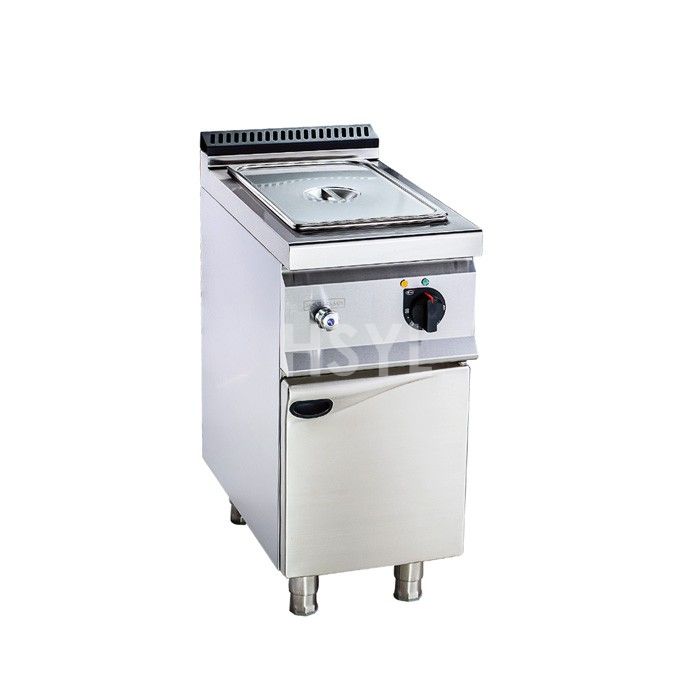
The Third Variable: Gas or Electric
Most bain marie buying guides assume electric, but the energy source is a separate decision from wet versus dry. The CK-BWTC-01 is gas-heated — 4 kW on the single well and 8 kW on the twin — which suits a kitchen that already runs gas and wants the well to reach holding temperature without loading the electrical board. The trade runs the usual way: gas needs a gas line and adequate ventilation, while an electric unit is self-contained but draws the full load on the electrical supply. Ask for the energy source alongside the wet-versus-dry question, because a gas unit and an electric unit are different site decisions even when both hold the same GN pans.
GN Layout: The Pan Is the Menu
The bain marie's wells take standard Gastronorm pans, and the pan layout is where the menu gets written. A single 1/1 GN well holds one dish; divide it into 1/2 or 1/3 fractions and the same well holds a sauce, a side and a protein. Count the dishes held hot at peak and add one for flexibility, then check the well depth against the pan depth you already run — a well sized for shallow pans limits portion size, and a deep well wastes heat under a shallow pan. The GN pan size guide covers the full EN 631 interface if the kitchen is standardizing its pan inventory across holding, cooking and serving.
The CK-BWTC-01 at a Glance
| Build | Gas Power | Net Size (mm) | Well |
|---|---|---|---|
| Single-well | 4 kW | 400 × 734 × 920 | 1 well |
| Twin-well | 8 kW | 800 × 734 × 920 | 2 wells |
Where a field is not published — the product page lists capacity, voltage and electric power as specification-to-confirm — treat it as a pre-quotation question rather than an assumption. The full hot-holding lineup sits under commercial food holding equipment, and the hot holding temperature guide sets the 60 °C floor and the food types this unit exists to protect.