Both machines put steam into a cabinet, so they are often quoted against each other. They are built for different duties. A steamer cabinet is a single-mode batch engine: atmospheric or near-atmospheric steam, compartment by compartment, hour after hour. A combi oven is a multi-mode cooking engine: it steams, but it also runs dry convection heat and a controlled combination of the two, with program memory stepping a product through several stages automatically. This guide compares the two on menu boundary rather than on feature lists, using the published data of HSYL's combi models — the countertop programmable touchscreen combi oven (HSYL-CK-CO01), the compact CK-HCO-2A and the floor-standing HCO10.2E — against the HSC steamer cabinet range.
Start with the Cooking-Mode Boundary, Not the Feature List
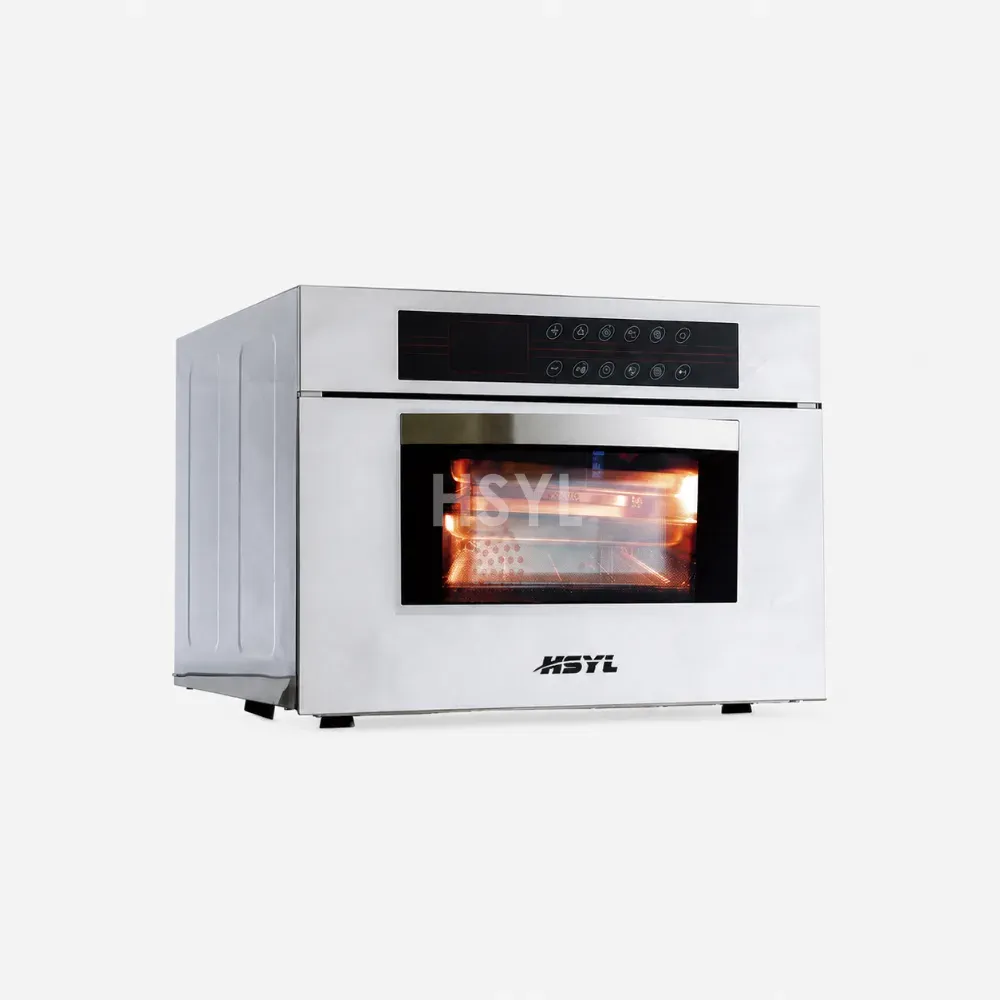
The documented mode ranges of the HSYL-CK-CO01 show where the two machine families overlap and where they separate. Its convection mode runs 30–300 °C, its steam mode runs 30–130 °C with low-, normal- and high-temperature steaming, and its combination mode runs 30–300 °C with controlled humidity. A steamer cabinet covers only the steam band of that range — and covers it with a different working principle: no fan-driven dry heat, no humidity drain, just saturated steam around the pans.
That overlap in the steam band is what creates the wrong question, "can a combi oven steam?" It can. The right question is whether your steaming is a batch duty or a mixed-menu duty. Steaming rice, vegetables or dim sum in repeated full-load batches is a throughput problem: cost per pan, compartment independence and recovery speed decide it, and that is steamer-cabinet territory. Steaming is one step inside a varied menu — a steamed fish course here, a roast there, regeneration of chilled banquet plates before service — and that is a programmability problem, which is combi territory. The CK-CO01 stores 200 cooking programs of up to 15 steps each with a multi-point core probe; that capability only pays for itself when the menu actually changes mode across the day.
The Four-Step Menu Boundary Test
Run your menu through this sequence before comparing any two quotations:
- Map every hot menu item to a cooking mode. Write each item under steam-only, dry heat, or combination. Do this from recipes, not from memory of last month's service.
- Split each list by batch pattern. Mark items produced in repeated full loads against a service window (rice for 400 covers) separately from items produced to order or in small mixed batches (à la carte proteins, banquet regeneration).
- Count simultaneous steam timings. If the steam-only list contains two or more products that must finish at different times in the same service window, you need either multiple independent compartments or more than one chamber — a single-chamber machine of either type serializes them.
- Check utilities before price. A floor combi in this class draws 32 kW on a 3NAC-400V three-phase supply with an R3/4" water inlet at 0.15–0.6 MPa; a steamer cabinet may be gas-fired with only 1N~220V for controls. A site that cannot supply one side of that comparison has already made the decision.
If the steam-only, full-load list from step 2 dominates your peak hour, the steamer cabinet is the primary machine and the combi — if budget allows — is the second machine for everything else. If the list is short and the menu changes mode all day, the combi covers the whole menu and the cabinet is the optional second machine for overflow batch steaming.
Model Data: Three Combi Ovens Against the HSC Steamer Range
| Model | Class | Cooking Modes | Power | Electrical Supply | Batch Capacity | Dimensions (mm) |
|---|---|---|---|---|---|---|
| CK-HCO-2A | Compact combi | — | Steam 1.5 kW / bake 1.6 kW | 220V-50Hz | — | 598 × 508 × 420 (L×W×H) |
| HSYL-CK-CO01 | Countertop combi | Convection 30–300 °C; steam 30–130 °C; combination 30–300 °C | Steam 1.7 kW / convection 2 kW | 220V-50Hz | — (tray capacity not published) | 598 × 610 × 478 |
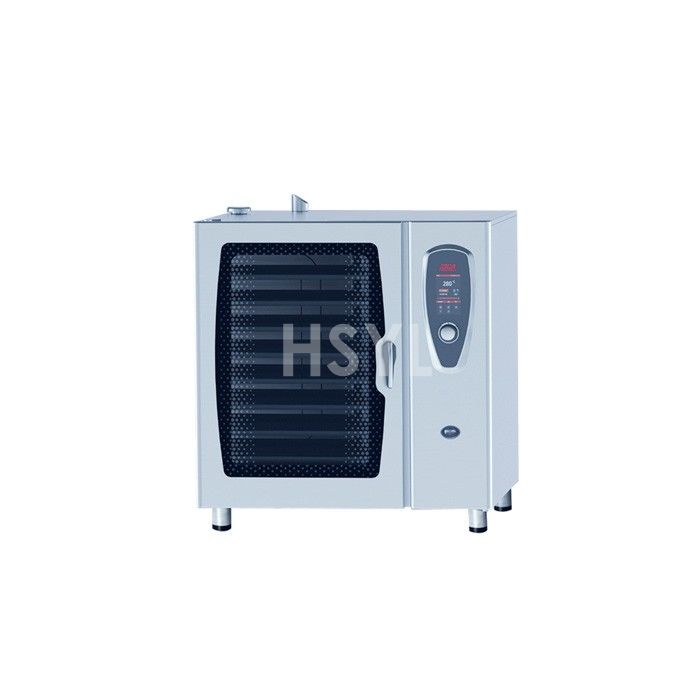
| HCO10.2E (CK-HCO10-2E) | Floor combi | — | 32 kW | 3NAC-400V three-phase | 10 × 2/1 GN; published daily output 150–300 | 1100 × 970 × 1230 |
| HSC-4T-E | Tabletop steamer cabinet | Steam only, independently controlled compartments | 5 kW | 3N~380V | 4 × 1/1 GN | 845 × 735 × 730 (D×W×H) |
| HSC-10U-E(S) | Floor steamer cabinet | Steam only | 27 + 2 kW | 3N~380V | 2×1/1 GN ×8 + 4×1/1 GN ×2 (24 pans) | 1300 × 800 × 1870 |
| HSC-4U/5U/8U-G(S) | Floor steamer cabinet, gas | Steam only | 16–20 kW gas | 1N~220V for controls and ignition | 10–20 pans by model | 835–1300 × 800 × 1630–1900 |
Fields marked "—" are not published for that model; confirm them on the model specification sheet before quotation. Read the power column as a capacity proxy: the two small combis at 1.5–2 kW are mixed-menu machines for cafés, satellite stations and test kitchens, while the 10 × 2/1 GN HCO10.2E floor-model combi oven at 32 kW is the central-kitchen duty class. The compact CK-HCO-2A commercial combi oven sits between a countertop fryer and a full combi in footprint (598 × 508 mm) for sites where space decides first. On the steamer side, the HSC Intelligent Steamer Cabinet Range scales from a 4-pan tabletop to a 24-pan floor cabinet while keeping one working principle — pure steam — across the whole range.
When the Correct Answer Is Both Machines
The both-machines case is not a sales upsell; it follows directly from the boundary test. A hotel banquet kitchen that steams rice and vegetables for 400 covers between 17:30 and 18:30 and also roasts, bakes and regenerates plated courses in the same window has two full-volume duties colliding in one hour. Running the batch steaming through the combi serializes it behind the roasting programs; running the mixed menu through the steamer cabinet is impossible because the cabinet has no dry-heat mode. The steam volume goes to the cabinet — where independent compartments on the HSC tabletop models and a 45 kg water tank on the range support continuous batch work — and the mode variety goes to the combi.
Two documents settle the final configuration: your menu split from the four-step test, and the model specification sheet for the shortlisted units. For the combi side of that shortlist, the combi oven selection guide works through sizing a combi against real production duty once you have decided a combi belongs in the kitchen at all — which is the question this page exists to answer first.
Five Mistakes in the Combi-vs-Steamer Decision
- Buying a combi to steam one product in volume. If the menu is rice plus one steamed dish, all day, every day, the convection mode, program memory and core probe are paid for and never used. Cost per steamed pan is lower in a dedicated cabinet at the same volume.
- Expecting a 2 kW countertop combi to replace a batch steamer. The countertop combis document 1.5–1.7 kW on steam; the HSC floor cabinets document 27 kW and above. Steam output per minute is a different class, whatever the brochure overlap.
- Treating one combi chamber as multi-compartment steaming. A combi chamber runs one program at a time. Two steamed products on two timings either queue or compromise; the HSC tabletop models carry independent temperature, heating and time controls per compartment precisely for that case.
- Comparing purchase price before comparing supply. A 32 kW three-phase combi and a gas steamer with a 220V control line are not interchangeable line items; the site may only be able to feed one of them. Confirm voltage, phase, gas and water pressure (the HCO10.2E specifies 0.15–0.6 MPa inlet) before shortlisting.
- Sizing by daily totals instead of the peak window. A daily output figure — the HCO10.2E publishes 150–300 per day — says nothing about whether the machine clears your busiest fifteen minutes. Size both machine types from the peak batch, then check the daily figure as a sanity check.
Related Equipment & Systems
The full lineup of both machine families sits under commercial cooking equipment. Buyers still mapping the wider hot-line decision can browse the equipment selection guides for the same treatment applied to ranges, fryers and holding equipment.