This guide works through those three decisions using the model data of HSYL's four steamer ranges — the HSC Intelligent Steamer Cabinet Range, the HSO Electric and Gas Steamer Cabinet Range and the HDUS/HSUS Chinese Steamer Range — so each selection criterion lands on a real configuration instead of a generic checklist.
Match the Cabinet to the Pan Format First
Pan format is not an accessory choice; it decides which product family you are buying from. Three formats dominate commercial steaming, and they do not interchange:
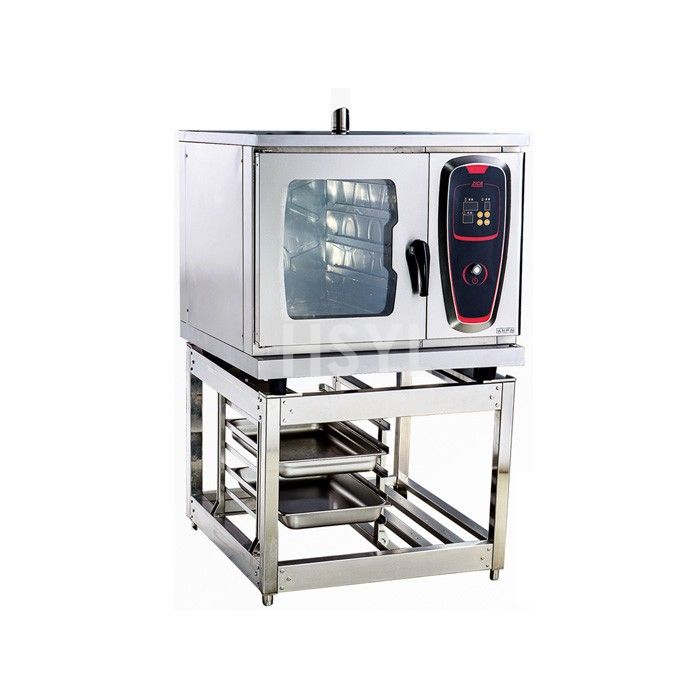
- GN pans (1/1, 1/2, up to 2/1). The Gastronorm interface is the standard for canteens, central kitchens and hotel batch production because the same pans move from steamer to holding to the serving line. The HSC range is built around it: configurations accept 1/1 GN, 1/2 GN, 2/1 GN pans and 12-inch dishes. If your kitchen already runs GN inventory, start here — our GN pan size guide covers the full EN 631 interface.
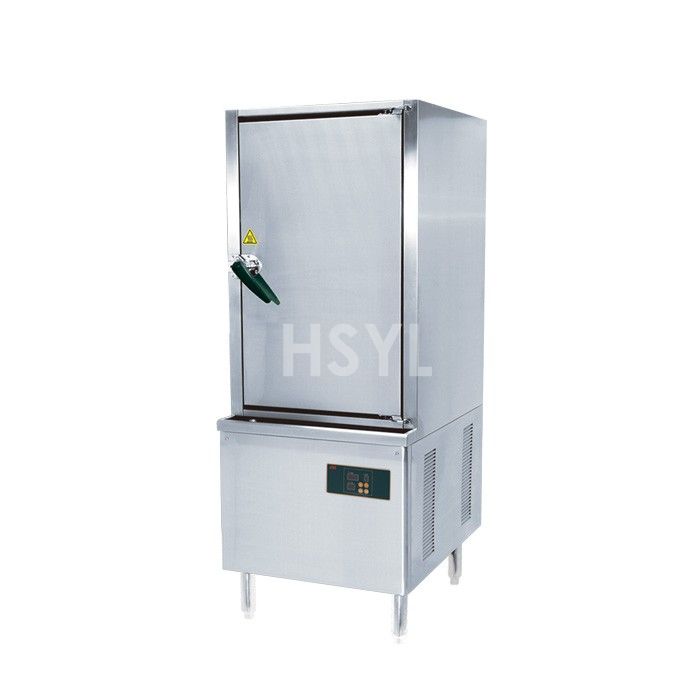
- 400 × 600 mm trays. The HSO range runs on 400 × 600 mm trays, the format common in Asian rice-and-dish batch steaming and bakery-adjacent workflows. Tray racking holds more product per level than GN for rice service, but the trays do not transfer into GN-based holding equipment.
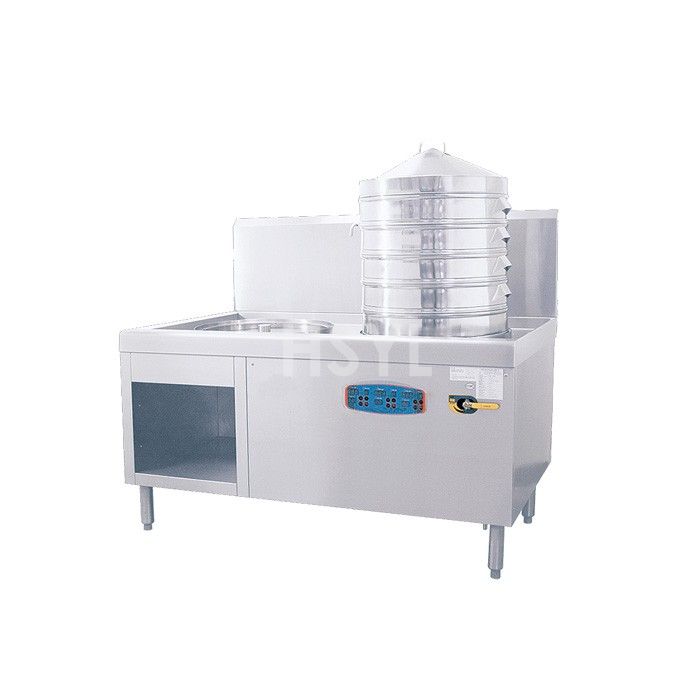
- Open deck steaming (Chinese steamer range). The HDUS/HSUS series is a deck steamer: single or double head, designed for bamboo baskets, dim sum service and open-vessel steaming rather than enclosed cabinet batches. It is a different machine for a different menu, not a bigger cabinet.
Write down the container that leaves your steamer and travels to the next station. That container is your format decision.
Gas or Electric: Decide from Site Utilities, Then Check Performance
The gas-vs-electric question is a utility question before it is a cooking question. Across the four ranges, the documented requirements are:
| Range / Model | Energy | Power | Electrical Supply |
|---|---|---|---|
| HSC-4T-E / HSC-6T-E (tabletop) | Electric | 5 kW / 10 kW | 3N~380V |
| HSC-4U-G(S) / HSC-5U-G(S) (floor) | Gas | 16 kW gas | 1N~220V for controls and ignition |
| HSC-8U-G(S) (floor) | Gas | 20 kW gas | 1N~220V for controls and ignition |
| HSC-10U-E(S) (floor) | Electric | 27 + 2 kW | 3N~380V |
| HSO-1G / HSO-2G / HSO-3G | Gas | 25 kW / 42 kW / 42 kW | Not published — confirm on the model specification sheet |
| HSO-1E / HSO-2E / HSO-3E | Electric | 21 kW / 39 kW / 27 kW | Not published — confirm on the model specification sheet |
| HDUS-E / HSUS-E (deck) | Electric | 45 kW / 27 kW | Not published — confirm on the model specification sheet |
| HDUS-G / HSUS-G (deck) | Gas | 56 kW / 42 kW | Gas line with flame-failure protection |
Read the table as a filter, not a menu. A site without three-phase 380 V capacity eliminates the HSC electric models before cooking performance is even discussed; a site without a gas line and flue route eliminates every gas row. Where a supply value is not published, treat it as a pre-quotation question, not an assumption — confirm voltage, phase and available capacity with your electrician before requesting a quotation.
Where both energy sources are available, the documented design differences matter more than generic "gas is faster" claims. The HSC tabletop models record a 9-minute boil-up time, and the gas tabletop configuration uses a heat-recovery design that recycles flue-gas heat to preheat inlet water. The HSO range preheats feed water to above 90 °C through its recycling system and generates steam on demand rather than holding a full boiler at temperature. Both approaches cut the energy spent reheating cold inlet water — the comparison to make is recovery design against recovery design, not gas against electric in the abstract.
Size by Pans per Batch and Compartment Independence, Not Door Count
Cabinet capacity is commonly quoted as a door or compartment count, which hides the number that matters: pans per batch. The HSC floor models document their GN loads directly — HSC-4U runs 2×1/1 GN ×3 plus 4×1/1 GN ×1 (10 pans), HSC-5U runs 2×1/1 GN ×4 plus 4×1/1 GN ×1 (12 pans), HSC-8U runs 2×1/1 GN ×6 plus 4×1/1 GN ×2 (20 pans) and HSC-10U runs 2×1/1 GN ×8 plus 4×1/1 GN ×2 (24 pans). The 45 kg water tank supports continuous batch operation on the range.
Convert that to meals with your own menu data: weigh a loaded 1/1 GN pan of your actual product, multiply by pans per batch, and divide the peak meal count by the batch output to get the number of batches per service. Then check the batch cycle time your menu requires against that count — a cabinet that theoretically holds the full service in one batch is the wrong size if your menu mixes rice at one timing with seafood at another.
That mixed-menu case is where compartment independence decides. The HSC tabletop models carry independent temperature, heating and time controls for each compartment, so different products can run different programs simultaneously; the LED-programmed HDUS/HSUS deck steamers save time-temperature programs per head for the same reason. If the menu steams one product in volume, a single large chamber is simpler and cheaper per pan. If it steams three products on three timings, independent compartments replace a second machine.
Model Data: HSC, HSO and HDUS/HSUS at a Glance
| Model | Format | Power | Dimensions (mm) | Pan / Tray Load | G.W. / N.W. (kg) |
|---|---|---|---|---|---|
| HSC-4T-E | Tabletop | 5 kW electric, 3N~380V | 845 × 735 × 730 (D×W×H) | 4 × 1/1 GN | — |
| HSC-6T-E | Tabletop | 10 kW electric, 3N~380V | 845 × 735 × 965 (D×W×H) | 6 × 1/1 GN | — |
| HSC-4U-G(S) | Floor, gas 16 kW | 1N~220V controls | 835 × 800 × 1630 | 2×1/1 GN ×3 + 4×1/1 GN ×1 | 235 / 187 |
| HSC-5U-G(S) | Floor, gas 16 kW | 1N~220V controls | 835 × 800 × 1900 | 2×1/1 GN ×4 + 4×1/1 GN ×1 | 345 / 294 |
| HSC-8U-G(S) | Floor, gas 20 kW | 1N~220V controls | 1300 × 800 × 1630 | 2×1/1 GN ×6 + 4×1/1 GN ×2 | 322 / 263 |
| HSC-10U-E(S) | Floor, electric 27+2 kW | 3N~380V | 1300 × 800 × 1870 | 2×1/1 GN ×8 + 4×1/1 GN ×2 | 357 / 295 |
| HSO-1G | Floor, gas 25 kW | — | 580 × 880 × 1800 | 400 × 600 trays | — |
| HSO-2G | Floor, gas 42 kW | — | 1150 × 880 × 1800 | 400 × 600 trays | — |
| HSO-3G | Floor, gas 42 kW | — | 900 × 880 × 1850 | 400 × 600 trays | 264 / 213 |
| HSO-1E | Floor, electric 21 kW | — | 736 × 845 × 725 | 400 × 600 trays | 92.5 / 64.5 |
| HSO-2E | Floor, electric 39 kW | — | 736 × 845 × 965 | 400 × 600 trays | 119 / 88 |
| HSO-3E | Floor, electric 27 kW | — | 900 × 880 × 1850 | 400 × 600 trays | 244 / 193 |
| HDUS-E (double head) | Deck | 45 kW electric | 1050 × 900 × 1250 | Baskets / open vessels | — |
| HDUS-G (double head) | Deck | 56 kW gas | 750 × 900 × 1250 | Baskets / open vessels | — |
| HSUS-E (single head) | Deck | 27 kW electric | 750 × 900 × 1250 | Baskets / open vessels | — |
| HSUS-G (single head) | Deck | 42 kW gas | 1050 × 900 × 1250 | Baskets / open vessels | 174 / 124 |
Fields marked "—" are not published for that model; request the confirmed specification sheet by model code before freezing a layout. For tray and basket handling between steamer and pass, the steamer cabinet trolley (CK-CZZG-01) is quoted to the selected cabinet configuration. The full lineup sits under commercial cooking equipment.
Five Selection Mistakes That Show Up After Installation
- Sizing by door count. A 4-door and a 10-pan cabinet can be the same machine described two ways. Specify pans per batch and batches per service instead.
- Confirming voltage but not phase. The HSC electric models require 3N~380V three-phase; the HSC gas models still need 1N~220V for controls and ignition. Sites that budget only "gas" or only "a socket" discover the second supply at commissioning.
- Ignoring inlet-water condition. Every range here auto-fills against dry-burn, and the HDUS/HSUS series fits a manual descale valve — scale management is a scheduled task, not an option. Hard-water sites should plan descaling intervals and water treatment before selecting a steam generator size.
- Mixing formats across the workflow. Steaming in 400 × 600 trays while the holding and serving line runs GN creates a re-panning step at the busiest point of service. Pick one interface end to end.
- Buying one large chamber for a mixed menu. Without independent compartment controls, the fastest product dictates the cycle or the slowest product delays the batch. Match compartment independence to menu diversity, not to budget.
Related Equipment & Systems
Steaming capacity only pays off when the line around it keeps up. For canteen-scale batch production, see the school canteen kitchen solution for how steamer cabinets connect to holding and the serving line; buyers comparing steam-based cooking engines more broadly should also read the commercial combi oven selection guide to confirm whether a steamer cabinet or a combi oven fits the menu.