Direct Answer / Key Takeaway: “Ventless” does not mean “no engineering.” It means the appliance package manages vapor/odor/grease through onboard filtration and controls so a traditional Type I hood may be reduced or omitted where the authority having jurisdiction (AHJ) permits. Always confirm local code before freezing the kitchen drawing.Ventless Combi vs Hooded CombiTopicHoo
“Ventless” does not mean “no engineering.” It means the appliance package manages vapor/odor/grease through onboard filtration and controls so a traditional Type I hood may be reduced or omitted where the authority having jurisdiction (AHJ) permits. Always confirm local code before freezing the kitchen drawing.
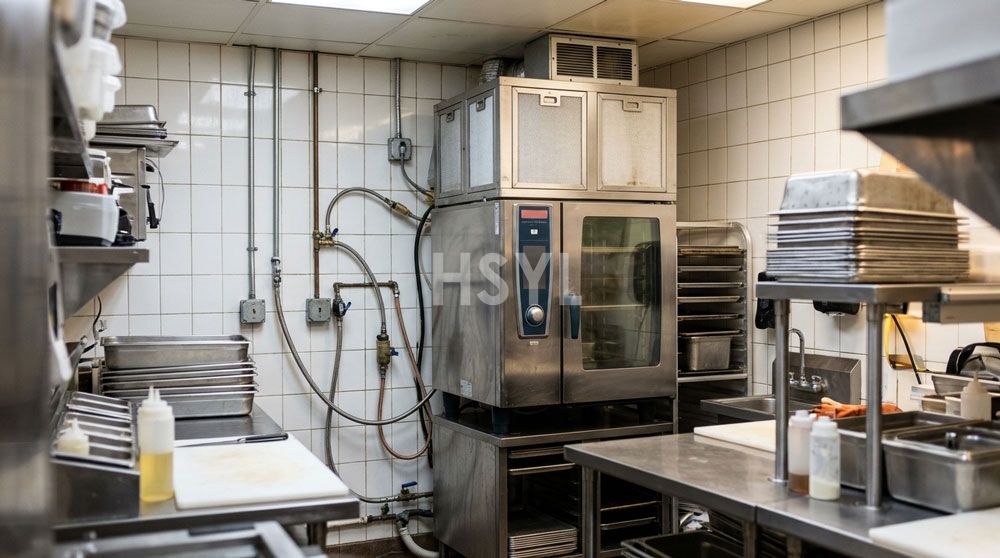
Ventless Combi vs Hooded Combi
| Topic | Hooded combi | Ventless / recirculating combi |
|---|---|---|
| Exhaust dependency | Needs correctly sized hood + duct + makeup air | Relies on certified filtration / recirculation package |
| Best for | Heavy roasting, high grease, continuous production | Sites with duct limits, historic buildings, small footprints |
| Risk if mis-specified | Over/under exhaust CFM | Filter saturation, odor complaints, code rejection |
| Project documents | Hood schedule + MEP | Filtration service plan + AHJ approval path |
Related:
- Commercial ventless overview
- Commercial combi ovens
- Combi oven selection: match real production duty
- Combi oven cooking modes explained
- Utilities & ventilation hub
Decision Gate: Can This Menu Run Ventless?
Answer these before deleting the hood:
- What is cooked? High-grease proteins and continuous frying-like loads are poor ventless candidates.
- How many hours/day at peak vapor? Filter change interval must be realistic for the operator.
- What does local code say? Some jurisdictions still require Type I hoods for specific appliances.
- Is makeup air already constrained? Ventless helps duct problems; it does not fix an overloaded electrical room.
- Who services filters? A ventless unit without a filter discipline becomes an odor and fire-risk problem.
If the project is a central kitchen or heavy banquet roast line, start with a standard combi + hood path unless the consultant’s specification explicitly requires ventless.
Specification Inputs for a Ventless Combi RFQ
| Input | Why it matters |
|---|---|
| Tray count (6 / 10 / 20) and GN size | Production capacity |
| Electric vs gas | Utility and filtration package availability |
| Menu grease classification | Determines if ventless is even eligible |
| Install room volume / adjacent spaces | Odor and heat rejection |
| Filter type & change interval | Operating cost and compliance |
| Water inlet quality | Combi steam generator / boilerless needs |
| Drain and condensate | Site plumbing |
| AHJ / consultant requirement text | Exact compliance language |
Integrate with Existing Combi Engineering Pages
Use ventless as a site option on top of normal combi duty sizing:
- Capacity / mixed load: Combi oven mixed product load trial
- Mode logic: Combi oven cooking modes explained
- Vs steamer: Combi oven vs steamer cabinet
- Factory models: HCO10-2E, CK-HCO-2A, 20-tray roll-in
Project Caution List
- Do not advertise “no ventilation needed” as a universal claim.
- Do not compare ventless energy figures to hooded figures without stating exhaust fan energy separately.
- Do not place a ventless combi beside an open fryer and claim the room is ventless overall.
- Keep filter SKUs inside the spare parts planning list before shipment.
Review factory evidence Email : info@hsylkitchen.com