Best Commercial Oven Guide
Pick the best commercial oven by matching type to menu and output. We compare convection, deck, combi and conveyor ovens for bakeries, restaurants and central kitchens.
How to define the best commercial oven for your kitchen
"Best" depends entirely on what you bake or roast, how many covers you serve, and how much floor space you can sacrifice. Convection ovens dominate high-volume baking because forced-air circulation cuts cook time by 20% to 30% and improves color consistency. Deck ovens remain the standard for artisan bread and pizza, where bottom heat and stone hearth feel matter more than throughput. Combi ovens justify themselves when a kitchen needs steaming, roasting, and proofing from a single footprint. Conveyor ovens only make sense at very high throughput—subway-style sandwich lines, high-volume pizza chains, or institutional catering—where labor cost per unit is the overriding metric.
Convection ovens
Full-size electric convection ovens in the 10-20 kW range can handle 8 to 15 full-sheet pans per cycle. Gas versions run slightly higher output but require ventilation with adequate BTUH exhaust capacity. Look for humidification injection if you bake bread or pastries: a 10% humidity boost improves crust development and reduces weight loss by 1.5% to 2.5% per loaf.
Deck ovens
Stone or composite hearth decks hold heat differently than forced-air cabinets. A five-deck stone oven can hold 20 to 30 pizzas per deck depending on diameter, and the thermal mass recovers quickly between loads. The trade-off is footprint: a 3-deck oven needs roughly 1.2 m by 1.8 m of floor space and a dedicated ventilation canopy.
Combi ovens
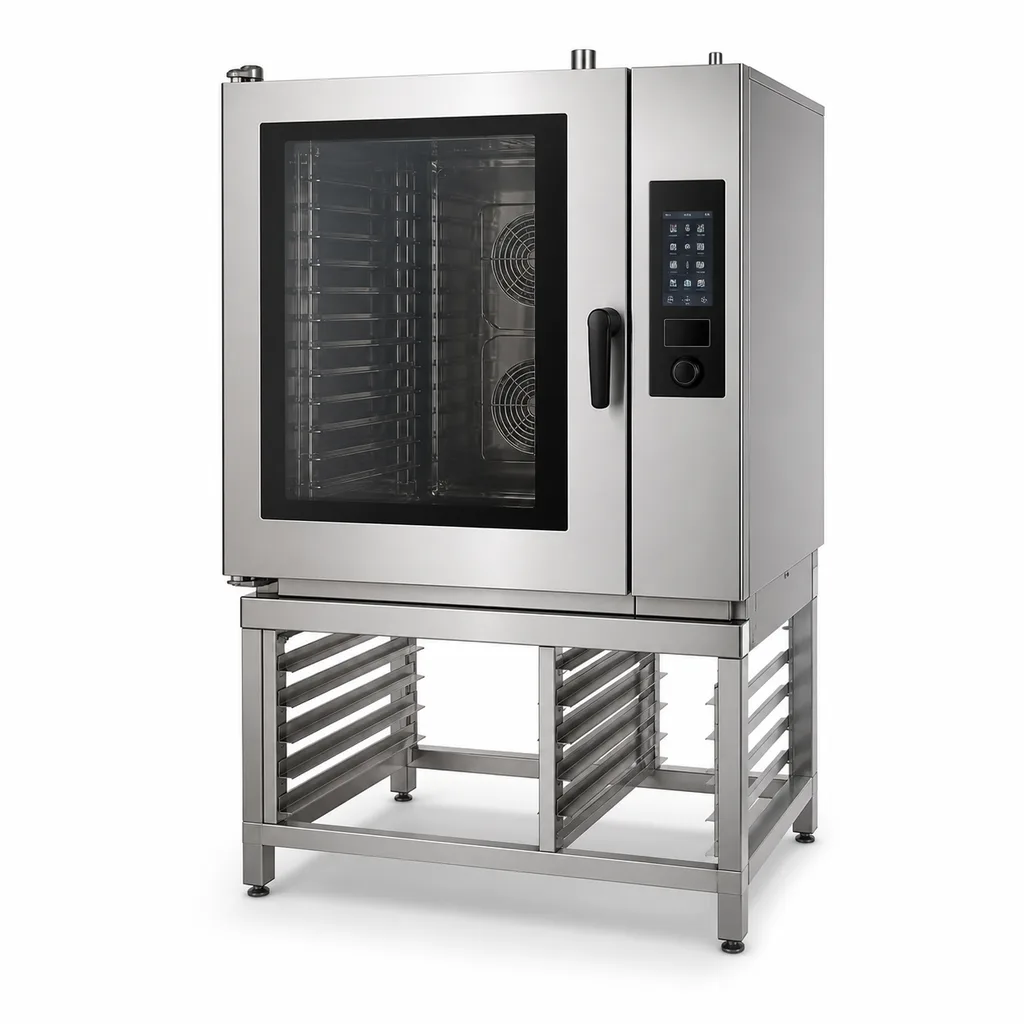
Modern combi ovens combine saturated steam and convection in one chamber. A 10-grid combi can replace a steamer, a convection oven, and a holding cabinet in a 2-meter footprint. The ROI calculation should include labor reduction: one operator can manage a combi oven that would otherwise need three separate machines.
Conveyor ovens
Conveyor ovens are purpose-built for repetitive products. A 24-inch belt oven running at 340°F can produce 200 to 300 12-inch pizzas per hour with consistent bake. Energy use is high, and product variety is low, but labor cost per unit drops dramatically once the belt is loaded.
Selection matrix by menu type
Use the table below to cross-reference your primary menu with oven type. The recommendation assumes a single-shift operation running five to six days per week.
| Menu profile | Best oven type | Typical output | Footprint note |
|---|---|---|---|
| Artisan bakery | Deck oven | 200–400 loaves/day | Needs ventilation canopy |
| High-volume restaurant | Convection oven | 400–800 covers/day | Standard vent hood |
| Compact hotel kitchen | Combi oven | 300–600 covers/day | Minimal ductwork |
| Pizza chain or fast casual | Conveyor oven | 500+ pizzas/day | Longer duct run |
Key takeaway: Match the oven to your highest-margin product first. A bakery that expands into sandwiches still needs a deck oven for bread; adding a small convection oven handles the side menu without duplicating the primary investment.
Power, ventilation, and installation constraints
Electric convection ovens in the 10 kW class need a dedicated 3-phase supply. Gas deck ovens add the complexity of a properly sized exhaust canopy and, in some jurisdictions, a fire suppression system. Combi ovens use significant water for steam generation; water pressure, hardness, and filtration all affect boiler life. Before finalizing a specification, confirm that your kitchen has the amperage, gas pressure, water quality, and flue routing for the machine you want.
Refurbished ovens and procurement channels
Refurbished commercial ovens from authorized OEM programs can reduce purchase price by 25% to 40% while keeping the remaining warranty intact. These units are typically ex-display, returned under warranty, or lightly used in hotel and catering chains. The risk is cosmetic wear and worn door seals, which affect energy efficiency and temperature uniformity. Always inspect the hearth, door gasket compression, and control calibration before accepting a refurbished unit. Buying directly from OEM refurbishment programs is safer than buying from auction sites or unverified brokers.
Total cost of ownership
Purchase price is only the first line item. Over five years, energy, water, cleaning chemicals, and maintenance labor can exceed the capital cost by 30% to 60%. A combi oven that reduces labor and energy through timed programs may cost more upfront but deliver lower lifetime cost than three separate units. Ask vendors for energy-use data in kWh per cycle and water-use data in liters per hour; these numbers are far more predictive of real cost than wattage alone.
Browse the full cooking equipment range at /cooking-equipment/. For ventilation and utility planning, see /hygiene-haccp/.
Frequently Asked Questions
What makes one commercial oven better than another?
The best commercial oven depends on menu type, output volume, and available utilities. Convection ovens excel at high-volume baking, deck ovens for artisan bread and pizza, combi ovens for compact multi-function kitchens, and conveyor ovens for repetitive high-throughput operations.
Do I need a combi oven if I already have a convection oven and steamer?
A combi oven replaces multiple appliances in one footprint, which reduces labor and cleaning time. It makes sense when floor space is limited or your menu includes steamed, roasted, and proofed items in the same service window.
Can a convection oven bake bread?
Yes, especially with humidity injection. However, crust development and oven spring are more consistent on a stone or composite hearth deck, which is why bakeries still prefer deck ovens for artisan loaves.
What utilities does a commercial deck oven require?
Gas deck ovens need adequate BTU exhaust and often a fire suppression system. Electric versions need 3-phase power and a standard vent hood. Always verify local codes before ordering.
How do I calculate total oven cost?
Add purchase price, energy consumption per cycle, water usage, cleaning chemicals, and scheduled maintenance over five years. These operating costs often exceed the capital price by 30% to 60%.
Plan the Equipment Around Your Kitchen.
Share your menu, peak service demand, available space and site utilities. Tell us which equipment you are considering so we can review the requirements with you.