Commercial Kitchen Equipment Price: Full Cost Breakdown by Zone
Commercial kitchen equipment price breakdown: budget share by zone, unit price ranges, restaurant vs central kitchen totals, and hidden costs to plan for.
A quotation for a full commercial kitchen is never a single number. It is a stack of budgets — cooking line, refrigeration, warewashing, preparation, stainless fabrication — plus a layer of costs that never appear on an equipment list at all: exhaust ductwork, electrical upgrades, freight, duty. Buyers who compare unit prices without this framework routinely end up 25–40% over budget before opening day.
This breakdown works from the top down: how the equipment budget splits across functional zones, what the total looks like at two very different project scales, and which hidden costs you should price before signing any purchase order.
Key takeaway: For most projects, equipment accounts for roughly 55–65% of the total kitchen budget. The remaining 35–45% goes to ventilation, utilities, installation, freight and duties — so a "cheap" equipment quote does not mean a cheap kitchen.
What a Commercial Kitchen Budget Actually Covers
Every figure in this guide is a range, not a quote. The commercial kitchen equipment price for any single unit depends on capacity, steel grade, component brands, certification requirements and order volume — the same 10-tray combi oven can legitimately differ by 40% between configurations. Treat the numbers below as planning brackets for early budgeting, and refine them against actual quotations once your equipment schedule is fixed.
The equipment budget itself divides into five functional zones. Their shares stay surprisingly stable across project types, which makes the percentage split a useful sanity check on any supplier proposal: if a quote puts 60% of the money into refrigeration, either the menu is unusually cold-chain-heavy or something is mis-specified.
Budget Share by Functional Zone
Across hundreds of restaurant and canteen projects, the equipment budget typically distributes as follows. The unit price ranges cover entry-level to heavy-duty configurations.
| Zone | Share of equipment budget | Representative units | Typical unit price range |
|---|---|---|---|
| Cooking | 30–40% | Ranges, combi ovens, fryers, steamers | $1,000–$25,000 per major unit |
| Refrigeration | 15–20% | Reach-ins, undercounters, walk-ins, blast chillers | $1,500–$20,000 per unit |
| Warewashing | 10–15% | Hood-type and rack conveyor dishwashers | $3,000–$40,000 per machine |
| Food preparation | 8–12% | Mixers, slicers, vegetable prep machines | $500–$5,000 per machine |
| Stainless fabrication | 10–15% | Work tables, sinks, shelving, wall cabinets | $150–$800 per item |
Two observations matter more than the numbers themselves. First, cooking dominates because it carries the highest per-unit prices and the most units per line. Second, stainless fabrication looks trivial per item but adds up fast — a mid-size kitchen easily needs 30–60 fabricated pieces, so a $150–$800 unit range becomes a $10,000–$25,000 line item.
Where the Money Concentrates: Three Zones to Price Carefully
Three zones decide whether your budget holds. Price these first, with real specifications, before filling in the rest.
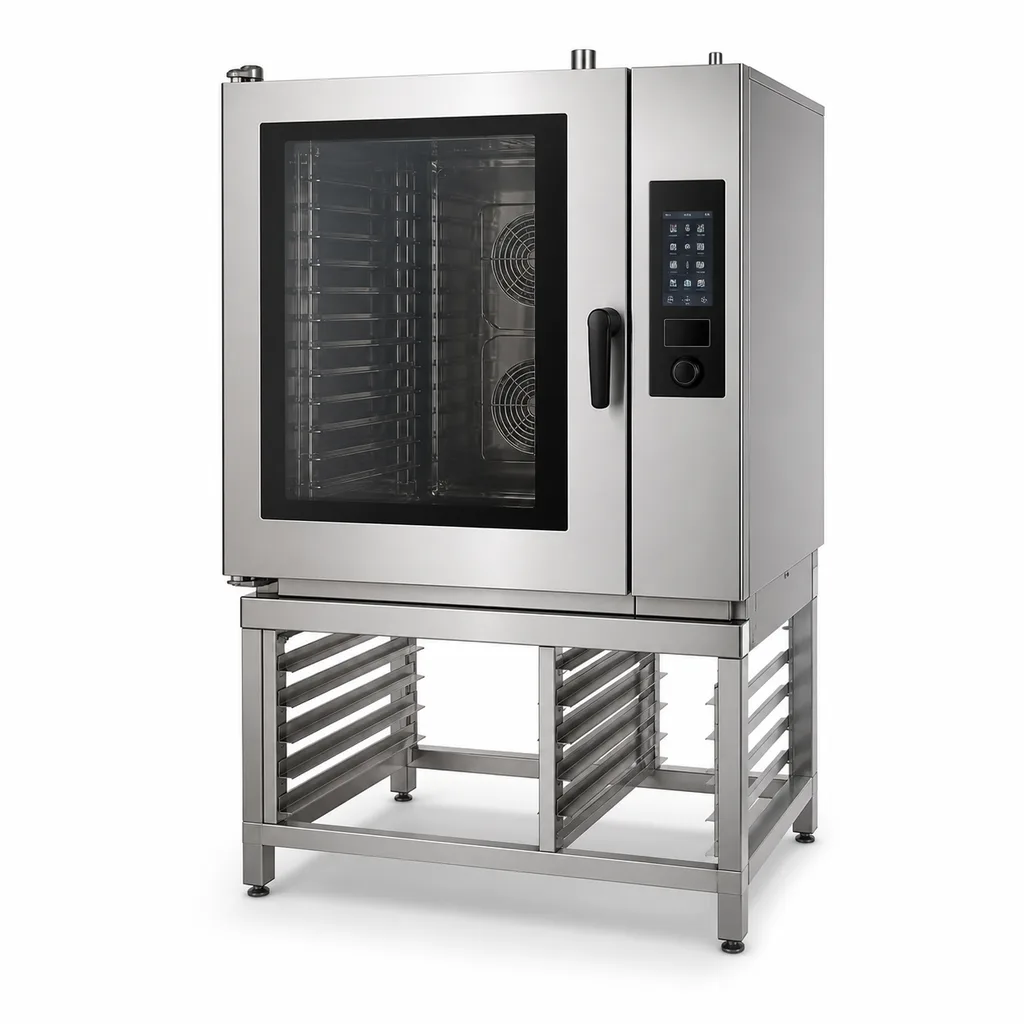
Cooking Equipment
The largest single line items. A 10-tray combi oven typically runs $8,000–$25,000 depending on boiler design and controls; a heavy-duty range with oven base adds $2,000–$6,000 per section.
View cooking equipment →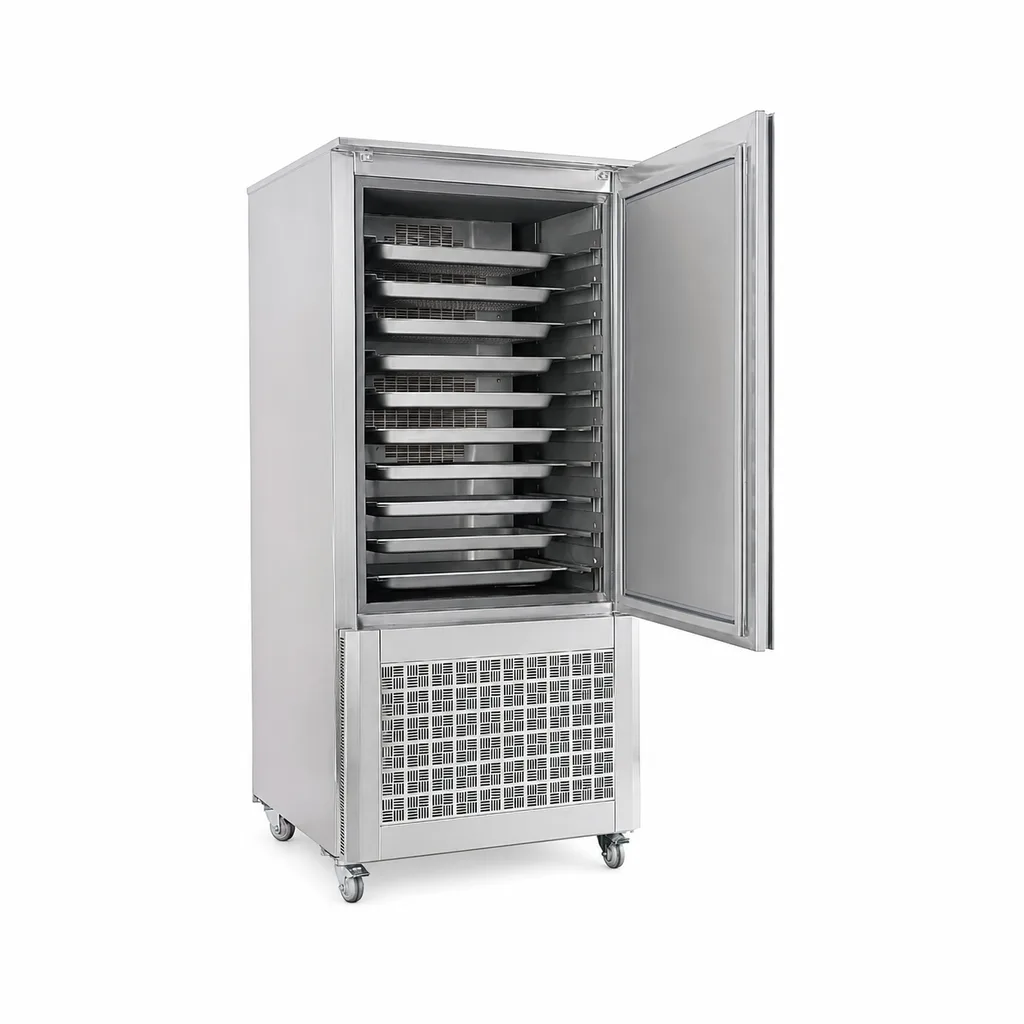
Refrigeration
Reach-in cabinets typically cost $1,500–$5,000; walk-in cold rooms run $5,000–$15,000 depending on panel size and refrigeration duty; blast chillers start near $8,000.
View refrigeration →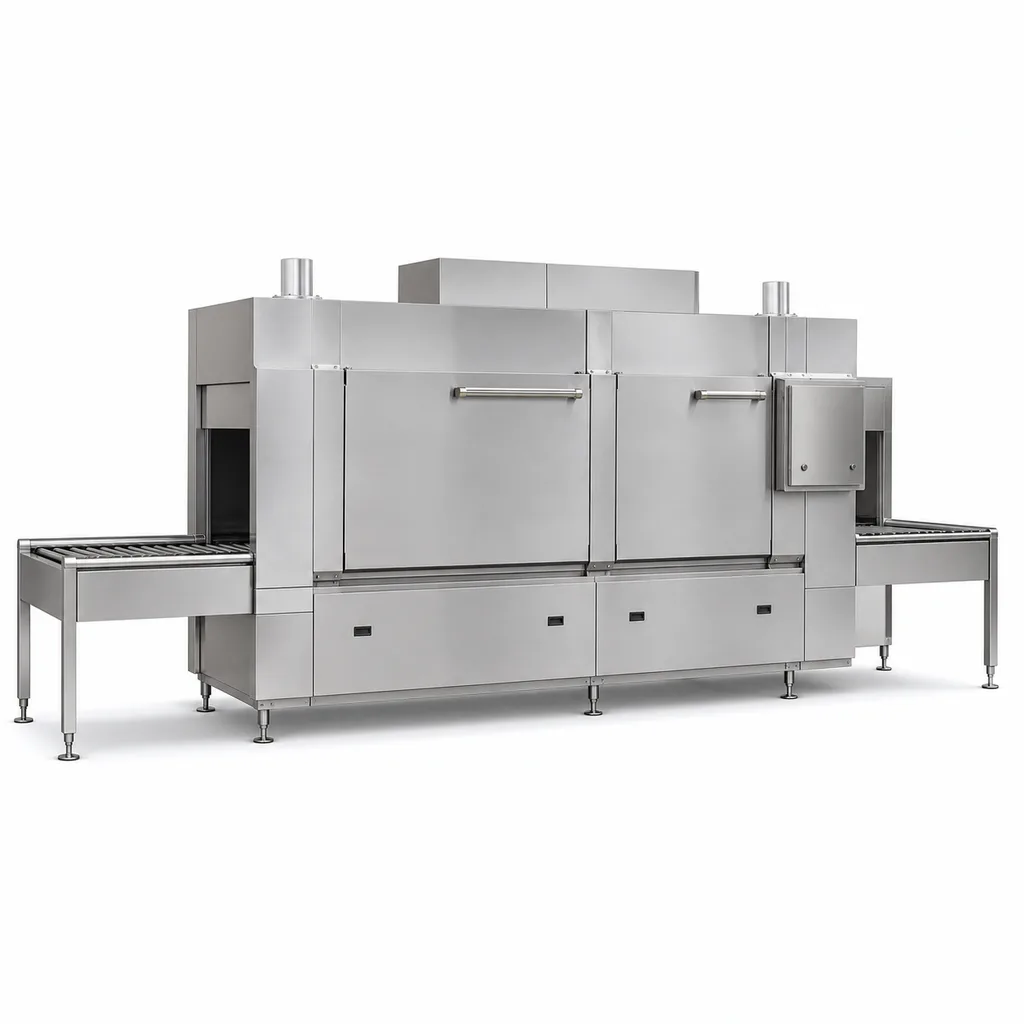
Warewashing
The widest price spread of any zone: a hood-type machine at $5,000–$10,000 handles up to about 60 racks per hour, while a rack conveyor line at $15,000–$40,000 handles 150–300.
View dishwashing →Small Restaurant vs. Central Kitchen: Total Budget Scale
Capacity, not floor area, drives the total. Two reference points bracket most projects:
- Compact restaurant kitchen (60–80 seats): equipment typically totals $30,000–$80,000 — a 4–6 burner range or small combi oven, two to three refrigeration units, one hood-type dishwasher, prep tables and sinks.
- Central kitchen (3,000–5,000 meals/day): equipment typically totals $250,000–$800,000+, driven by tilting braising pans, rice lines, blast chillers, rack conveyor warewashing and segregated cold rooms for each process stage.
The 10× gap in equipment spend reflects throughput, not luxury. A central kitchen replaces many small units with a few high-capacity machines, each of which costs more than a restaurant's entire cooking line. Layout, process zoning and utilities scale with it — which is why central kitchen budgeting should start from a process design, not a product catalog. Our central kitchen planning guide covers that sequence in detail.
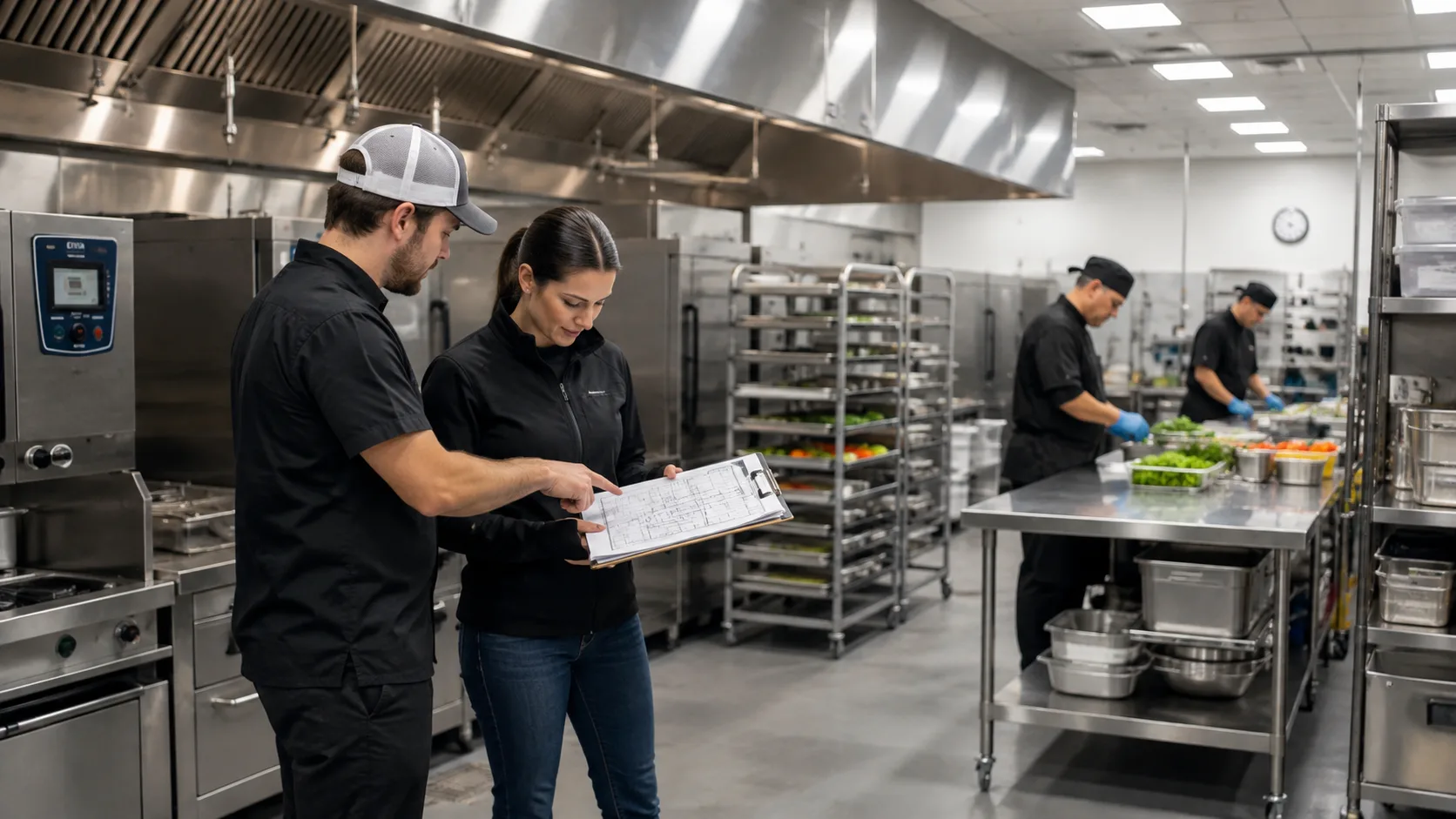
The Costs That Never Appear on an Equipment Quotation
These items routinely add 35–45% on top of the equipment total. Budget them explicitly before comparing suppliers:
- Exhaust and ventilation (10–15% of project cost): hoods, ductwork, make-up air and fire suppression. Often the single largest non-equipment line, and the most common source of budget overruns when the building was not designed for a kitchen.
- Electrical, plumbing and gas rough-in (5–10%): three-phase power upgrades, floor drains, grease traps, gas piping to code. A 380V combi oven is useless on a single-phase supply.
- Installation and commissioning (3–8% of equipment value): rigging, leveling, connection and startup testing. Conveyor dishwashers and walk-in cold rooms almost always need professional installation.
- International freight (5–15% of FOB value): ocean freight for crated equipment, plus insurance. Stainless fabrication ships bulky — freight per dollar of value is higher than for compact machines.
- Import duty and taxes (0–25% by destination): varies widely by country and HS code classification; confirm rates with your customs broker before fixing the budget.
- Flooring, drainage and water treatment: quarry tile or resin floors, sloped drainage, and water softeners where hardness would scale up combi ovens and dishwashers within a year.
A practical way to hold the total: fix the functional budget shares first, shortlist equipment by capacity within each zone — starting from the full product range — and only then negotiate unit prices. Projects budgeted in that order rarely blow their contingency; projects budgeted unit-by-unit rarely keep it.
Frequently Asked Questions
How much does it cost to equip a small restaurant kitchen?
For a compact 60–80 seat restaurant, equipment typically totals $30,000–$80,000, covering a 4–6 burner range or small combi oven, two to three refrigeration units, one hood-type dishwasher and stainless prep tables. The all-in project cost runs higher, since equipment is only 55–65% of the total budget.
Which zone takes the largest share of a kitchen equipment budget?
Cooking, at 30–40% of the equipment budget. It carries the highest per-unit prices — a 10-tray combi oven typically runs $8,000–$25,000 depending on configuration — followed by refrigeration at 15–20% and warewashing at 10–15%.
Why is a rack conveyor dishwasher so much more expensive than a hood-type machine?
Throughput. A hood-type dishwasher at $5,000–$10,000 handles up to about 60 racks per hour, while a rack conveyor line at $15,000–$40,000 handles 150–300 racks per hour. The price gap reflects capacity, not just size.
What hidden costs should I budget beyond the equipment itself?
Plan for an additional 35–45% on top of the equipment total: exhaust and ventilation (10–15% of project cost), electrical/plumbing/gas rough-in (5–10%), installation and commissioning (3–8% of equipment value), international freight (5–15% of FOB) and import duty (0–25% by destination).
How much does central kitchen equipment cost compared to a restaurant?
A central kitchen producing 3,000–5,000 meals per day typically needs $250,000–$800,000+ in equipment, versus $30,000–$80,000 for a 60–80 seat restaurant. The roughly 10× gap is driven by throughput: a few high-capacity machines replace many small units.
Plan the Equipment Around Your Kitchen.
Share your menu, peak service demand, available space and site utilities. Tell us which equipment you are considering so we can review the requirements with you.