Commercial Refrigeration Walk-In Cold Room
Comprehensive engineering guide to commercial refrigeration and walk-in cold rooms, polyurethane insulation thickness, BTU compressor sizing calculations, R448A/R290 refrigerants, and HACCP cold chain telemetry.
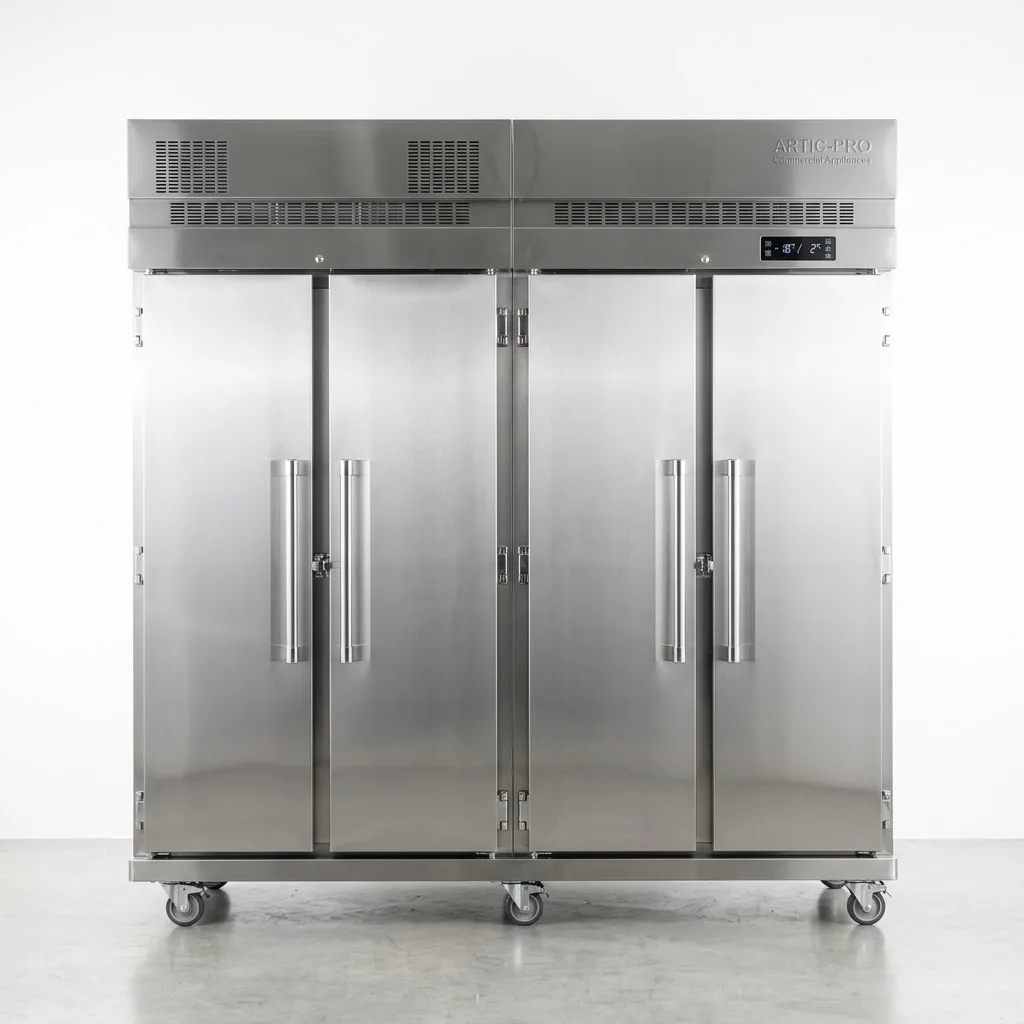
Commercial refrigeration is the physiological backbone of food safety, ingredient preservation, and regulatory compliance in modern culinary facilities. From compact undercounter reach-in drawers to massive multi-compartment walk-in cold storage complexes, refrigeration systems must maintain precise temperature regimes under punishing continuous door-opening cycles and elevated kitchen ambient temperatures. This technical engineering guide covers polyurethane insulation panel specifications, thermodynamic cooling load and compressor sizing calculations, green refrigerant transitions (R448A, R290, CO2), electric vs. hot gas defrost systems, and automated HACCP cold chain telemetry.
Figure 1: Modular commercial walk-in cold room installation featuring cam-lock polyurethane panels and remote condensing units.
1. Cold Room Temperature Regimes & Food Hygiene Classifications
Commercial kitchens segregate cold storage into dedicated environmental zones to prevent microbial proliferation and cross-flavor contamination:
| Refrigeration Zone | Operating Temperature Range | Relative Humidity (% RH) | Primary Foodstuffs Preserved | Critical Microbial Hazard Controlled |
|---|---|---|---|---|
| Chilled Produce Cold Room | +4°C to +8°C (39°F - 46°F) | 85% - 95% (High humidity) | Fresh vegetables, unpeeled fruits, fresh herbs | Prevents dehydration, cell wilting, and mold growth |
| Meat & Dairy Chill Room | 0°C to +2°C (32°F - 36°F) | 75% - 85% | Raw beef, poultry, pork, fresh dairy, pasteurized milk | Halts Salmonella, E. coli, and Listeria bacterial doubling |
| Fresh Seafood Storage (Fish Well) | -1°C to +1°C (30°F - 34°F) | Direct melting crushed flake ice | Whole fresh fish, mollusks, crustaceans, fillets | Suppresses enzymatic breakdown and volatile amine development |
| Commercial Freezer Storage | -18°C to -22°C (-0.4°F - -7.6°F) | 60% - 70% | Pre-frozen proteins, ice cream, par-baked doughs, frozen vegetables | Halts all microbial metabolism; arrests cellular oxidation |
| Industrial Blast Chilling / Freezing | Pulldown: +70°C +3°C in < 90 min; -18°C in < 240 min | High-velocity forced laminar airflow | Cooked batch dishes, banquet meal prep, catering sauces | Prevents micro-crystal ice formation and foodborne spore germination |
2. Polyurethane Insulation (PUF) Panel Engineering
Modular walk-in cold rooms are constructed from tongue-and-groove polyurethane foam (PUF) sandwich panels secured by eccentric cam-locks:
| Cold Room Typology | Recommended PUF Thickness | Core Foam Density | Thermal Conductivity (λ) | Thermal Resistance (R-Value) |
|---|---|---|---|---|
| Cooler (+2°C to +10°C) | 80 mm - 100 mm (3.15" - 4.0") | 40 - 42 kg/m³ (High-density rigid) | 0.022 W/m·K | R-29 to R-36 (ASTM C518) |
| Freezer (-18°C to -25°C) | 120 mm - 150 mm (4.7" - 6.0") | 42 - 45 kg/m³ with fire retardant | 0.020 W/m·K | R-43 to R-54 |
| Ultra-Deep Freeze (-35°C) | 150 mm - 200 mm (6.0" - 8.0") | 45 kg/m³ with thermal break | 0.019 W/m·K | R-54 to R-72 |
Floor Insulation & Heater Mat Safety: Freezers operating below 0°C must incorporate sub-floor insulation panels with an under-slab low-voltage electric heating mat. Without sub-slab heating, freezing temperatures migrate downward into ground soil, freezing subsurface groundwater and causing frost heave that cracks concrete slabs and destroys the building foundation.
3. Thermodynamic Cooling Load Sizing Calculations
Compressor condensing units must be sized to overcome four distinct thermal heat gain components:
Component Engineering Definitions:
• Q_transmission = Wall/Ceiling/Floor Area × U-Factor × (T_ambient - T_room) × 24 hrs
• Q_air_infiltration = Room Volume × Air Changes/Day × Enthalpy Difference (Δh)
• Q_product_load = Mass × Specific Heat (above/below freeze) × ΔT + Latent Heat of Fusion
• Q_internal = Personnel Heat (250W/person) + LED Lighting (10W/m²) + Fan Motors (kW) + Defrost Heaters
Required Compressor Capacity (BTU/hr) = (Q_total × 1.15 Safety Factor) / Operating Run Hours (16 - 18 hrs/day)
4. Green Refrigerant Transition: Low-GWP Regulations
Global environmental regulations (EU F-Gas Regulation, US EPA AIM Act) are phasing out legacy hydrofluorocarbons (HFCs) with high Global Warming Potential (GWP):
| Refrigerant Gas | Chemical Category | GWP Rating (CO2 = 1.0) | Operating Pressure Characteristics | Regulatory Lifecycle Status |
|---|---|---|---|---|
| R404A / R507A | Legacy HFC Blends | 3,922 (Extremely High) | High condensing pressures; moderate discharge temps | BANNED for new installations in major jurisdictions; service phase-down |
| R448A / R449A | HFO/HFC Transitional Blends | 1,387 (65% reduction vs R404A) | Direct drop-in replacement; higher discharge temperatures requiring fan cooling | Approved for retrofit and medium-term commercial cold room installations |
| R290 (Propane) | Natural Hydrocarbon | 3.0 (Ultra-Green) | Exceptional thermodynamic COP; low charge limit (150g - 500g max per circuit) | Future standard for standalone reach-in commercial refrigerators and display freezers |
| R744 (Carbon Dioxide - CO2) | Natural Refrigerant | 1.0 (Zero ODP, GWP = 1) | Transcritical cycle; high operating pressures (> 1,200 PSI / 80 bar) | Rapidly expanding in large central commissary plants and supermarket walk-ins |
5. Defrost Engineering: Electric Resistance vs. Hot Gas Defrost
Moisture entering walk-in evaporators freezes onto aluminum fin matrices, restricting airflow and insulating cooling tubes:
- Electric Resistance Defrost: Electric heating rods embedded directly inside the evaporator coil energized by a defrost timer or demand sensor. Reliable and inexpensive to manufacture, but consumes 3 kW to 15 kW of electrical power and introduces radiant heat spikes into the cold storage room.
- Reverse-Cycle Hot Gas Defrost: Solenoid valves divert hot, high-pressure discharge vapor from the compressor directly into the evaporator coil, melting frost from the inside out. Hot gas defrost completes in 6 to 10 minutes (versus 25 to 40 minutes for electric defrost), uses 70% less electricity, and prevents temperature fluctuations that degrade ice cream and delicate food products.
6. Automated HACCP Cold Chain Telemetry & Sensor Calibration
Public health authorities and international food safety audits (HACCP, ISO 22000, BRCGS) mandate continuous, automated temperature tracking:
- Wireless LoRaWAN / Wi-Fi Data Loggers: Calibrated RTD Pt100 temperature sensors mounted in glycol thermal buffer bottles (simulating internal food core temperature rather than rapid air spikes during door openings).
- Automated SMS / Cloud Alert Triggers: The telemetry system sends instant SMS notifications to facility managers if cold room temperatures exceed +4°C for more than 45 continuous minutes or if door microswitches detect an open door for over 10 minutes.
7. Cold Room Air Infiltration & Strip Curtain Aerodynamics
Door openings account for up to 35% of the total thermal heat load on commercial walk-in coolers and freezers:
Thermal Barrier Engineering: Installing heavy-duty overlapping polar-grade PVC strip curtains (2 mm thick, 50% overlap) or high-velocity heated air curtains reduces ambient room air infiltration by 75% to 85%, cutting compressor runtime by up to 2.5 hours per day.
8. Pressure Relief Port (Equalizer Vent) Engineering
When a walk-in freezer door closes, hot kitchen air trapped inside cools rapidly from 25°C to -20°C within 30 seconds. This thermal contraction creates a severe internal vacuum:
Mechanical Risk: Without a heated two-way pressure relief port, the negative pressure (up to -200 Pa) makes the door impossible to pull open, or in large cold rooms, exerts tons of inward atmospheric pressure that buckles ceiling sandwich panels. Electrically heated two-way pressure relief valves equalize pressure instantaneously without icing up.
9. Electronic Expansion Valves (EEV) vs. Mechanical Thermal Valves
Modern commercial cold rooms replace traditional mechanical thermal expansion valves (TXV) with stepper-motor electronic expansion valves (EEV):
| Expansion Technology | Superheat Control Precision | Seasonal Ambient Adaptation | Energy Efficiency Gain |
|---|---|---|---|
| Mechanical TXV (Bulb & Diaphragm) | ±3.0°C superheat tolerance; prone to hunting during door openings | Requires manual seasonal spring adjustment for winter/summer head pressures | Baseline commercial standard |
| Electronic EEV (Microprocessor Stepper) | ±0.5°C superheat precision; continuous 480-step needle modulation | Automatically adapts to fluctuating floating head pressures | 12% to 18% annual compressor energy savings |
10. Hot Gas Defrost Systems vs. Electric Defrost Engineering
Rapid defrosting of commercial evaporator coils is crucial to avoid room temperature rise in commercial walk-in freezers maintaining -18°C to -25°C:
| Defrosting Method | Cycle Duration | Temperature Spike in Cold Room | Compressor & Piping Complexity |
|---|---|---|---|
| Electric Resistance Heaters | 25 - 40 minutes | Cabinet air rises by +6°C to +10°C; coil elements radiate dry radiant heat | Simple wiring; electric elements inside coil fins draw 3.5 kW to 8.0 kW electrical power during defrost cycle. Elements prone to burnout after 3-5 years. |
| Reverse Cycle Hot Gas Defrost | 8 - 15 minutes | Cabinet air rises by only +2°C to +3°C; coils heat evenly from inside the copper tube walls | Requires 4-way reversing valve or 3-valve hot gas bypass manifold, liquid drain check valves, and suction accumulator to prevent liquid refrigerant slugging into compressor. |
Civil Engineering Warning: In commercial walk-in freezers operated below 0°C (-18°C), ground subsoil eventually freezes without sub-slab ventilation or electric heating mats. Ice lenses form and expand, cracking 150 mm reinforced concrete slabs and buckling wall panels. Always specify underfloor sub-ventilation pipes (100 mm PVC at 1.0 m centers) or low-wattage floor heating cables (15 - 20 W/m²).
Featured Commercial Equipment Models
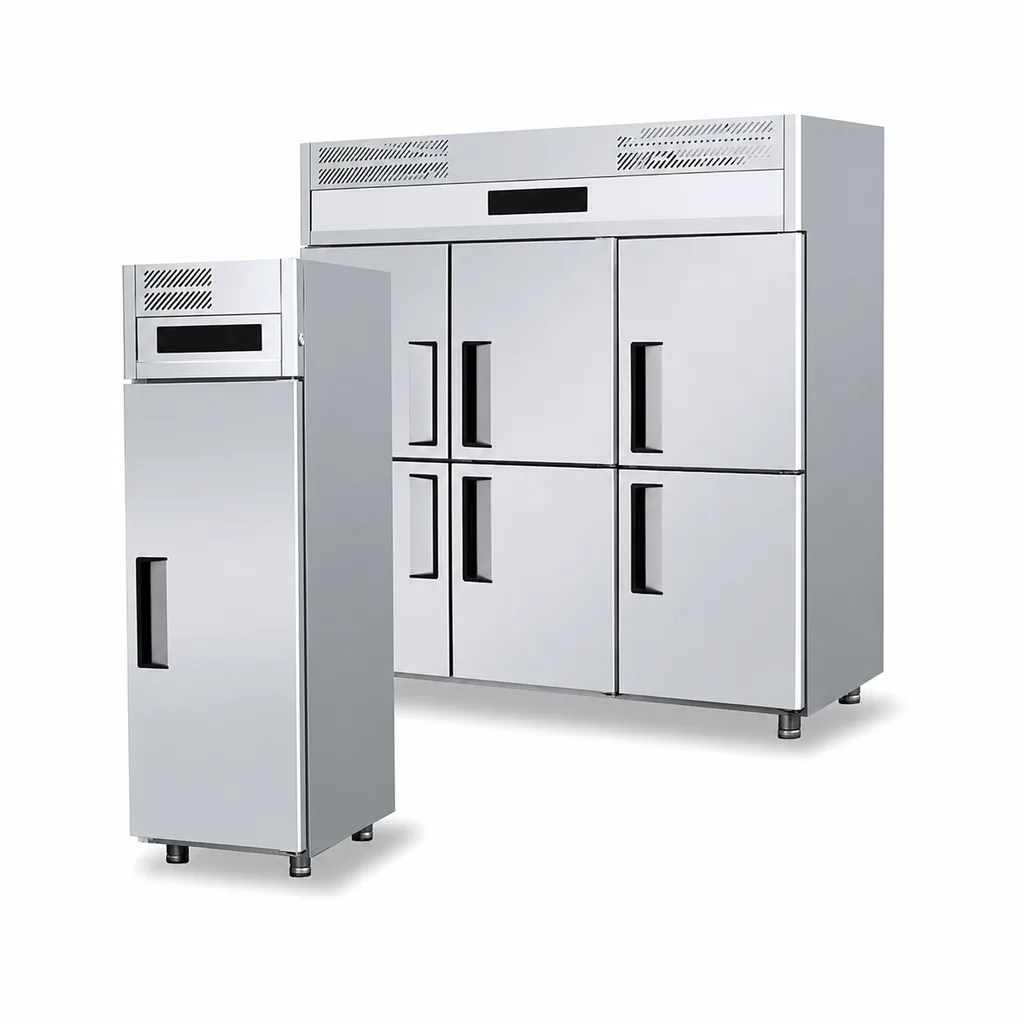
Commercial Reach-In Storage Freezers
Heavy-duty 304 stainless steel upright storage freezers engineered for 43°C high-ambient performance.
View Upright Freezers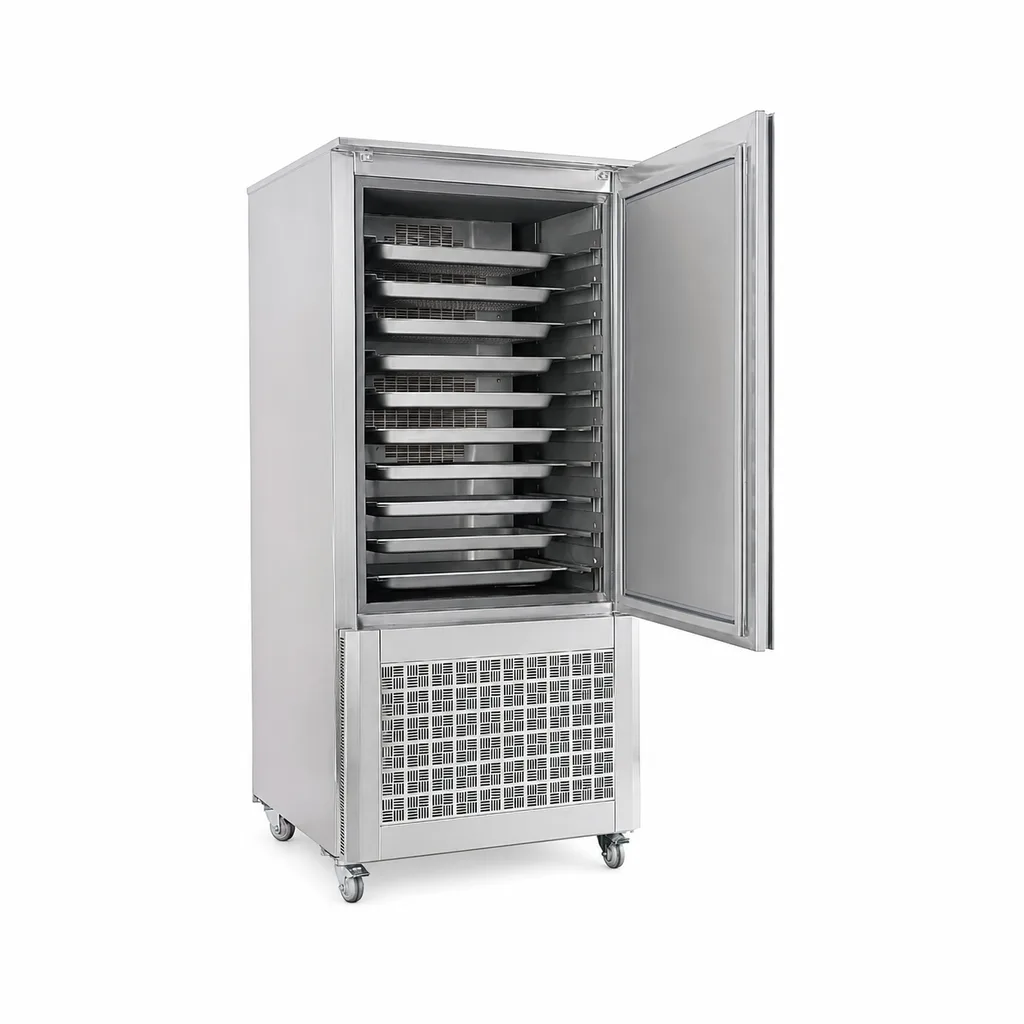
Industrial Blast Freezing Cabinets
Rapid cook-chill blast freezers capable of pulling down hot banquet batches from 70°C to -18°C in 240 minutes.
View Blast Freezers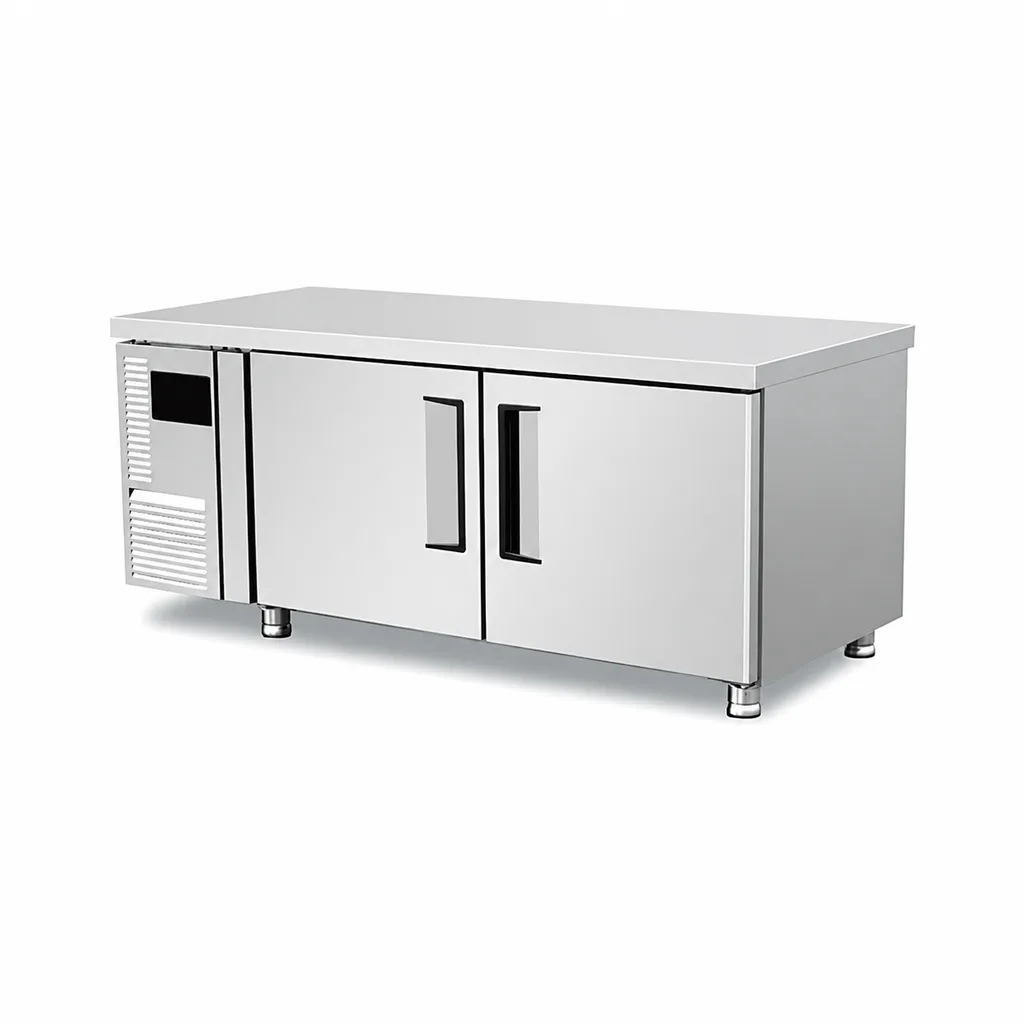
Undercounter Prep Refrigerators
Space-efficient refrigerated chef bases and sandwich prep tables with insulated self-closing doors.
View Undercounter UnitsModular Walk-In Cold Room Units
Engineered cam-lock polyurethane insulated cold rooms tailored with remote low-noise condensing units.
View Cold Room SystemsTurnkey Engineering Solutions & Applications
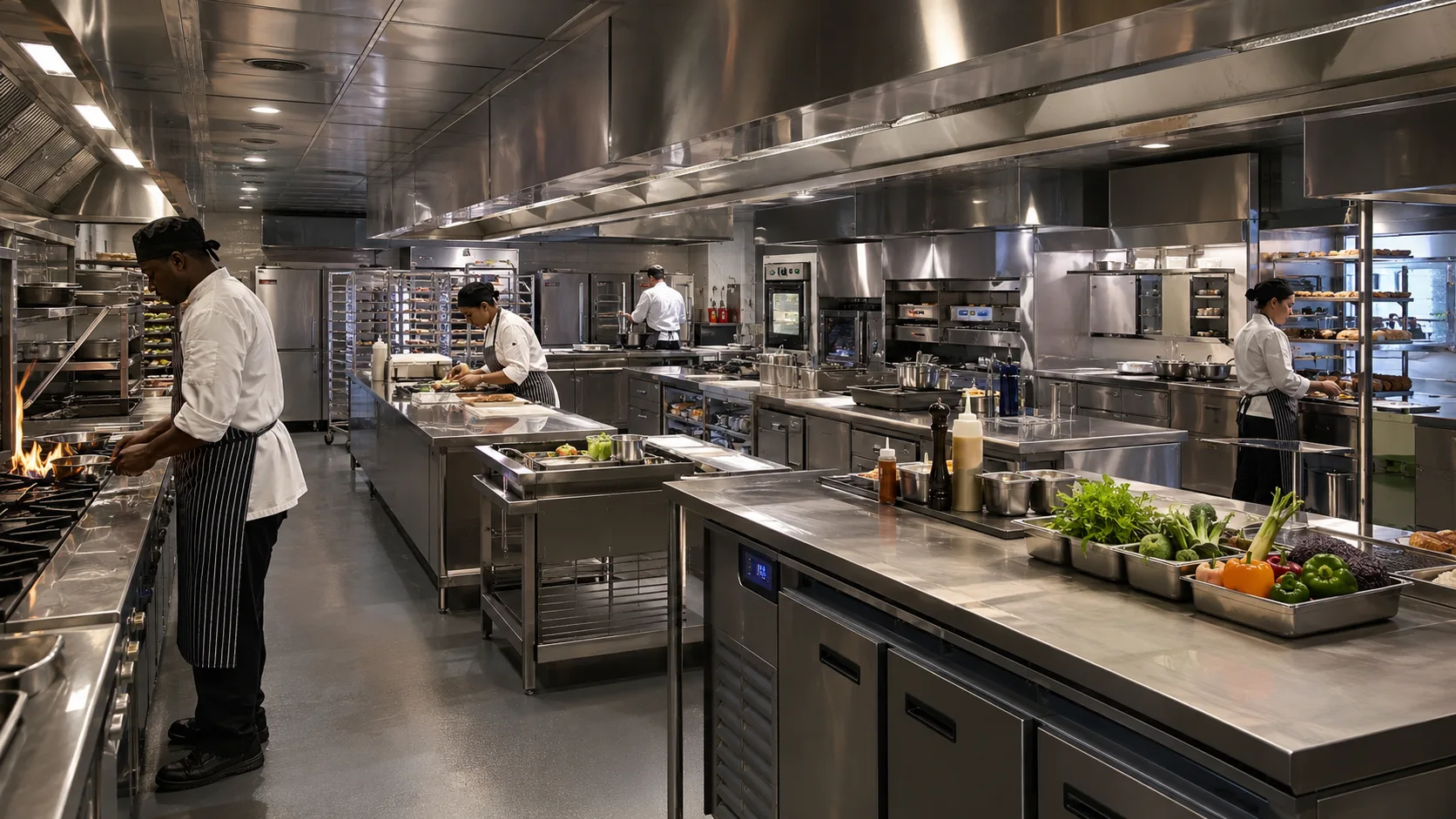
Hotel Multi-Temperature Cold Storage
Centralized walk-in cooler and freezer complexes supporting multi-outlet luxury resort operations.
Explore Hotel Solutions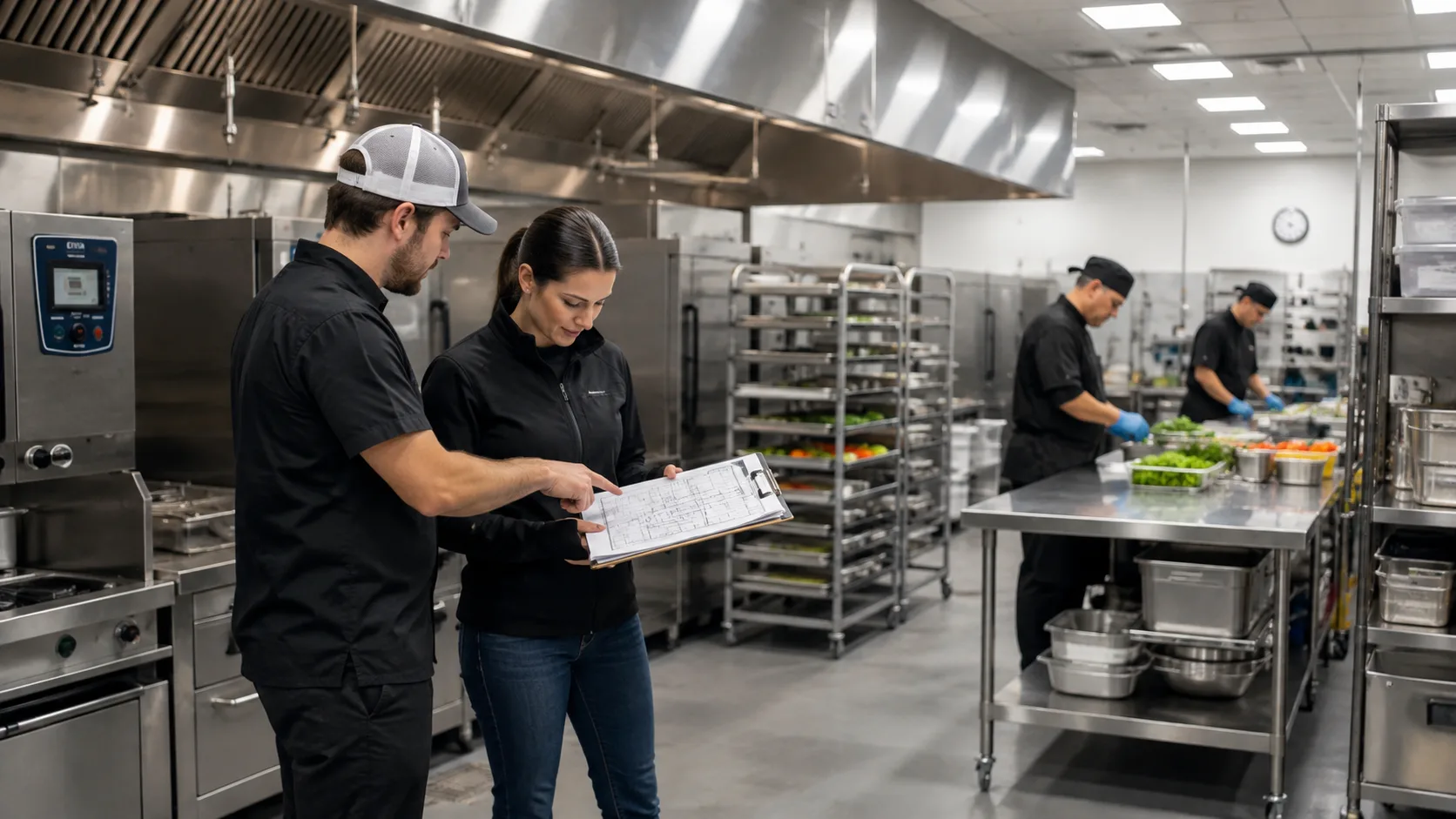
Central Commissary Cold Chain Lines
Industrial cold storage halls, vacuum chilling bays, and refrigerated staging docks for food factories.
Explore Central Kitchen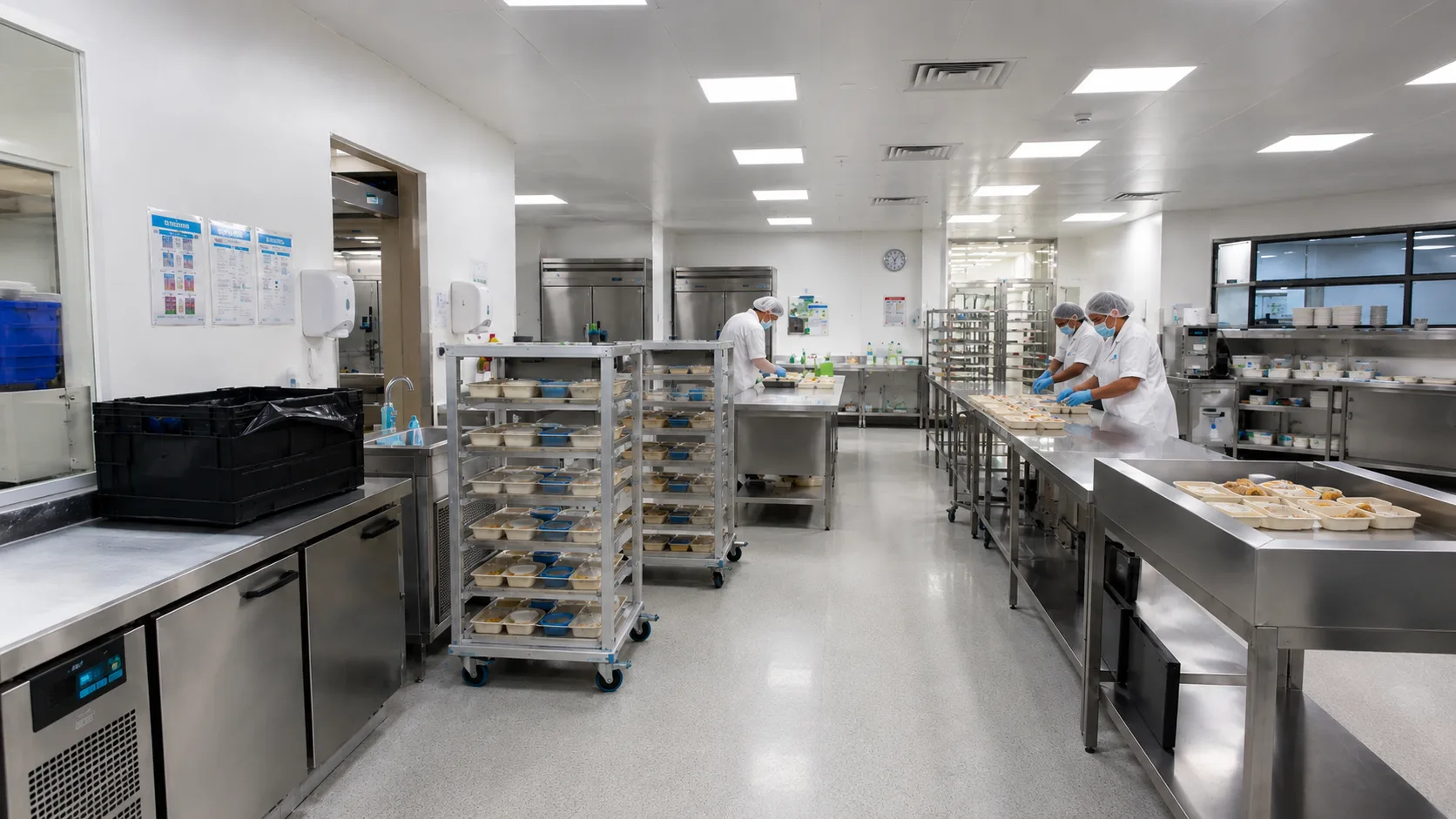
Healthcare Cold Chain Facilities
HACCP-certified temperature-critical refrigeration suites engineered for institutional patient feeding.
Explore Hospital Solutions
Commercial Restaurant Walk-Ins
Compact, high-density walk-in cooler and freezer combinations engineered for commercial kitchen backyards.
Explore Restaurant SolutionsFrequently Asked Questions
What thickness of polyurethane (PUF) insulation is required for a commercial walk-in freezer?
Commercial walk-in freezers operating between -18°C and -22°C require high-density rigid polyurethane foam (PUF) panels with a minimum thickness of 120 mm to 150 mm (R-43 to R-54) to prevent heat transmission and compressor overloading.
Why do walk-in freezers require sub-floor heating mats?
Freezers operating below freezing transfer cold into the soil beneath the building foundation. Sub-slab heating mats prevent groundwater from freezing and expanding (frost heave), which can crack concrete floor slabs and compromise structural walls.
What is the difference between R404A and R448A/R290 refrigerants?
R404A is a legacy HFC refrigerant with an extremely high Global Warming Potential (GWP 3,922) that is being phased out globally. R448A is a modern transitional blend with a 65% lower GWP (1,387), while natural R290 (propane) has a GWP of only 3.0 and is standard for standalone commercial coolers.
Why is hot gas defrost superior to electric defrost in commercial refrigeration?
Hot gas defrost diverts hot compressor discharge vapor directly inside the evaporator tubes, melting ice from the inside out in 6 to 10 minutes while consuming 70% less electrical energy. Electric defrost takes 25 to 40 minutes and radiates unwanted heat into the cold room.
How many operating hours per day should a commercial cold room compressor run?
Commercial refrigeration condensing units are engineered to run between 16 and 18 hours per day under design ambient conditions. The remaining 6 to 8 hours allow for scheduled defrost cycles, coil draining, and compressor off-cycle lubrication stabilization.
Plan the Equipment Around Your Kitchen.
Share your menu, peak service demand, available space and site utilities. Tell us which equipment you are considering so we can review the requirements with you.