Commercial Salamander Grills
Choose a commercial salamander grill by finishing task, usable plate area, controls and mounting. Compare alternatives and plan a workable finishing station.
A commercial salamander grill is worth considering when the missing step in your kitchen is browning, melting or finishing food from above. It can brown a gratin without occupying the main oven for that final step. It is less useful when the real bottleneck is baking whole batches, holding meals or producing grill marks from below.
Choose the finishing task first, then the usable grid, heat controls and mounting arrangement. A wide body does not necessarily give you a wide heated area. A larger appliance will not help if staff cannot load and retrieve plates efficiently during service.
Choose the appliance by the result you need
| Your main task | Equipment to compare | The distinction that matters |
|---|---|---|
| Melt toppings and brown plated food | Salamander or a purpose-built cheese melter | A salamander can offer adjustable distance and heating zones. A cheese melter may suit a narrower finishing task; compare the actual duty and controls. |
| Bake trays through to the centre | Convection or another enclosed baking oven | Overhead surface heat is not equivalent to controlled baking throughout a loaded chamber. |
| Cook on a hot surface or create contact marks | Griddle or charbroiler | Contact cooking and heat from below produce a different result from overhead finishing. |
| Keep completed dishes ready for collection | Suitable holding equipment | A browning appliance is not a general holding system. Prolonged finishing can damage food. |
For a menu consisting mainly of melted sandwiches, compare the working speed and staff attention of the actual cheese melter and salamander offered. For dishes with different heights and browning requirements, adjustable distance and separately controlled zones may be more valuable than additional nominal width. Neither feature should be assumed from the product name.
Turn your plates into a usable grid requirement
Measure the largest plate, oval platter and tallest dish, including handles and anything projecting above the rim. The opening must accommodate the item at the selected rack position. The operator must be able to remove it without tilting hot contents.
Illustrative fit check, not a product specification: two round plates with an outside diameter of 260 mm occupy at least 520 mm side by side before handling gaps are included. A 500 mm usable grid cannot hold that arrangement, even if the appliance body is described as 600 mm wide. A grid wider than 520 mm still needs a plate test: its edges may not receive the same useful heat, and the plates need room to move.
Use paper outlines at actual plate sizes to compare drawings before a demonstration. Mark the usable grid boundary and heated area separately. This eliminates units that fit the counter but cannot finish your normal order combination.
- Mixed plate sizes: check the busiest combination, not only identical small plates.
- Tall bowls: compare clearance at the rack position that gives the desired finish.
- Quiet service: an independently controlled zone may avoid heating the whole area for one plate, if the offered model has that function.
Select controls that match the cook's work
Moving food closer to the upper heat source changes the intensity at its surface. Adjustable rack positions help a cook change the finishing process, but the adjustment mechanism must also be practical with the intended crockery and protective gloves.
Two controls do not necessarily mean two independently measured cooking temperatures. Some appliances regulate energy input rather than a chamber temperature. Compare what the control changes and whether the cook can reproduce the result at the same rack position.
For repeated identical orders, a timer can assist consistency but does not verify that food is safely cooked. For mixed dishes, visibility and access may matter more: the operator needs to see the surface colour and remove one plate without disturbing another. Include those movements in the demonstration.
Counter, wall or range mounting: choose the working position
| Arrangement | Reason to consider it | Constraint to resolve |
|---|---|---|
| Counter mounted | Places finishing beside preparation or plating | Consumes worktop space and needs approved support and clearances |
| Wall mounted | Can free the surface below | Needs approved brackets, adequate wall support and a workable loading height |
| Range mounted | Places finishing above the hot line | Requires an approved equipment combination; reaching over active cooking can obstruct the operator |
Draw the route from the main cooking station to the salamander, then to the pass. A useful layout lets plates follow that route without crossing raw preparation, blocking a burner or occupying the only landing surface. Provide a stable place for hot crockery immediately after unloading.
Gas and electric versions both add heat to the working area. Electric operation does not establish that a hood is unnecessary. Give the ventilation designer the installation instructions and the proposed cooking duty.
Compare the finish and the queue before buying
- Use the same recipe, starting temperature, portion depth and crockery on each candidate appliance.
- Record the rack position, control setting and time to an agreed surface finish for the normal plate combination.
- Repeat with another order waiting. Include loading, unloading and the operator's attention, not only heating time.
- Inspect the centre and edges of each dish. Include any necessary rotation or repositioning in the service time.
- After safe shutdown and cooling, follow the cleaning instructions and check access to removable spillage parts.
An appliance that produces an attractive single plate can still create a queue when every plate needs individual attention. Compare completed acceptable orders with the staffing you actually have.
Specify a finishing station, not just an appliance width
Use the range and salamander cost breakdown to separate the appliance from mounting and installation work. If the requirement is direct contact cooking, compare the commercial griddle models instead.
For a salamander enquiry, give HSYL the dishes, plate dimensions, simultaneous plate requirement, mounting position and site utilities. The quotation should identify an actual salamander model and its usable grid, controls and mounting kit. A general range or grill listing is not a substitute for that specification.
Discuss a salamander finishing station with your plate sizes and cookline layout.
Related cookline equipment for your finishing station
Plan the equipment around the finishing task as well as the finishing appliance itself. These products are cookline references, not salamander models.
700-Series Modular Cookline
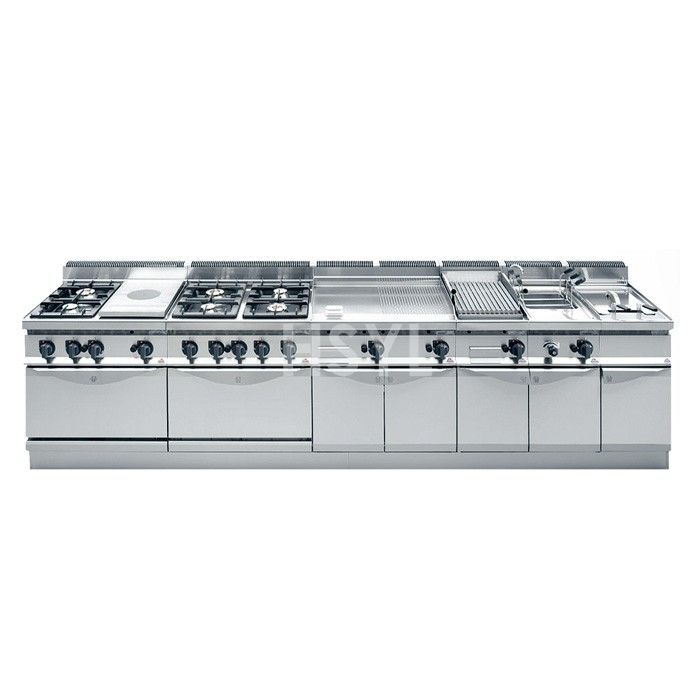
Coordinate the finishing station with the adjacent cooking line. Use the modular cookline reference to discuss working height, plate travel, service access and hood arrangement; specify any salamander separately.
View product details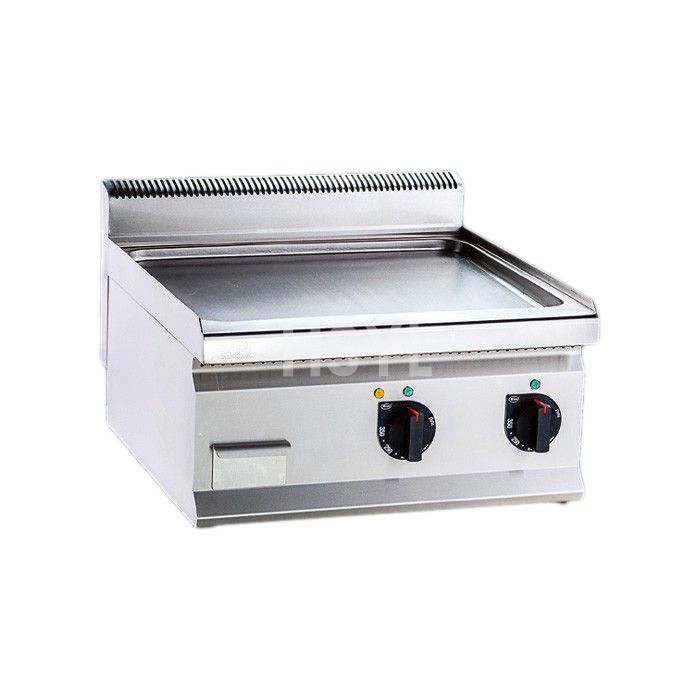
HG Electric Griddle Range
Keep primary flat-plate cooking separate from overhead browning. Compare the griddle station for the menu that precedes finishing; an electric griddle is not a substitute for a salamander.
View product detailsFrequently Asked Questions
Can a salamander grill replace a convection oven?
Usually not for a menu built around baking complete trays. A salamander applies intense overhead heat for tasks such as browning, melting and finishing exposed surfaces. A convection oven heats an enclosed chamber for a different cooking process. If you want one appliance to do both jobs, test each food from its actual starting condition before choosing it.
How do I check whether two dinner plates will fit?
Measure the complete plate diameter and compare it with the usable heated rack area, not the appliance's external width. Two 260 mm plates already occupy 520 mm side by side before gaps, edges and handling space are considered. Bring the actual plates to a trial and check both fit and even finishing across the load.
Is a cheese melter the same as a salamander?
The names alone are not enough to establish equivalent performance. A unit intended mainly for melting cheese or light finishing may not suit heavier browning tasks. Ask for the intended applications, usable rack dimensions, heat adjustment and a trial with your food. Buy the demonstrated finishing result rather than assuming the labels are interchangeable.
Should I choose a wall-mounted or countertop model?
A countertop model uses working surface that may also be needed for plating. A wall-mounted model can free that surface, but the support, mounting height, surrounding materials and extraction arrangement must suit the selected appliance. Compare the complete plate-loading and unloading movement; a space-saving mounting position is not useful if staff cannot handle hot plates comfortably.
Does this guide identify an available HSYL salamander model?
No specific salamander model is listed in this guide. Use it to define the finishing task, plate arrangement and installation needs, then ask HSYL to confirm whether a suitable model can be offered. The cookline photograph illustrates layout context; it does not show a salamander model or confirm one is in HSYL stock.
Plan the Equipment Around Your Kitchen.
Share your menu, peak service demand, available space and site utilities. Tell us which equipment you are considering so we can review the requirements with you.