Direct Answer / Key Takeaway: Compare flight-type tunnel dishwashers (3,000-8,000 plates/hr) vs. rack conveyor machines (200-260 racks/hr). Calculate peak dish loads, steam vs. electric kW draw, and 5-year TCO.
Selecting between a rack conveyor dishwasher and a flight-type tunnel dishwasher is the single largest capital and utility decision in a commercial dish pit. If an institutional kitchen serving 1,200 covers per hour installs a single-tank rack conveyor machine, soiled trays back up into the dining room while scullery staff spend 40% of their shift lifting wet plastic peg racks. Conversely, specifying a 4.28-meter flight-type tunnel machine for a 300-seat bistro wastes floor space and idle wash-tank heating energy. Within our Commercial Kitchen Capacity & Equipment Sizing Hub, this engineering guide establishes the mathematical throughput formulas, thermal utility balances, and 5-year lifecycle economics across our commercial conveyor dishwashers lineup.
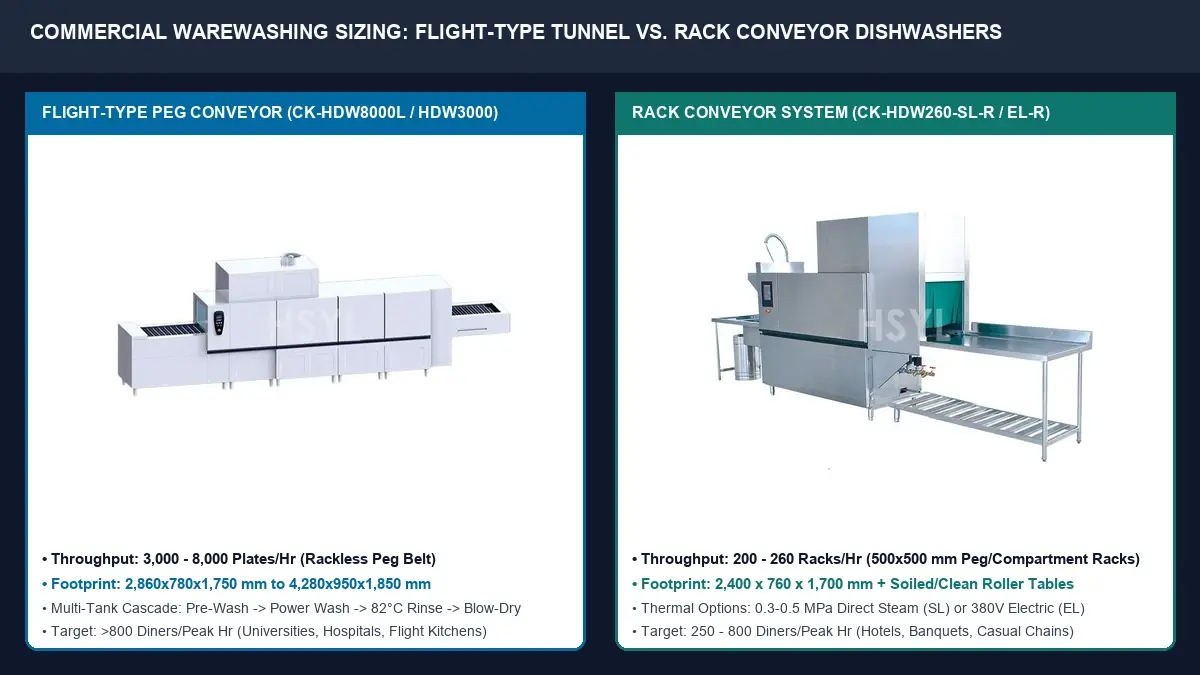
- Peak Seat-Turnover Breakpoint: Specify a Rack Conveyor Dishwasher (200–260 racks/hr, ~3,600–4,680 plates/hr theoretical, ~2,500–3,200 plates/hr at 70% loading efficiency) for banquets, hotels, and casual dining serving 250 to 800 meals per peak hour. Step up to a Flight-Type Peg-Belt Tunnel Dishwasher (3,000–8,000+ plates/hr) for hospitals, university dining halls, and inflight catering kitchens exceeding 800 meals per peak hour.
- Rack Handling Labor Elimination: Flight-type machines load soiled tableware directly onto an endless polypropylene peg conveyor belt, eliminating the manual loading, pushing, unloading, and return-storage of 500 × 500 mm (19.7" × 19.7") dish racks—cutting scullery labor by 1.5 to 2.5 FTEs per shift.
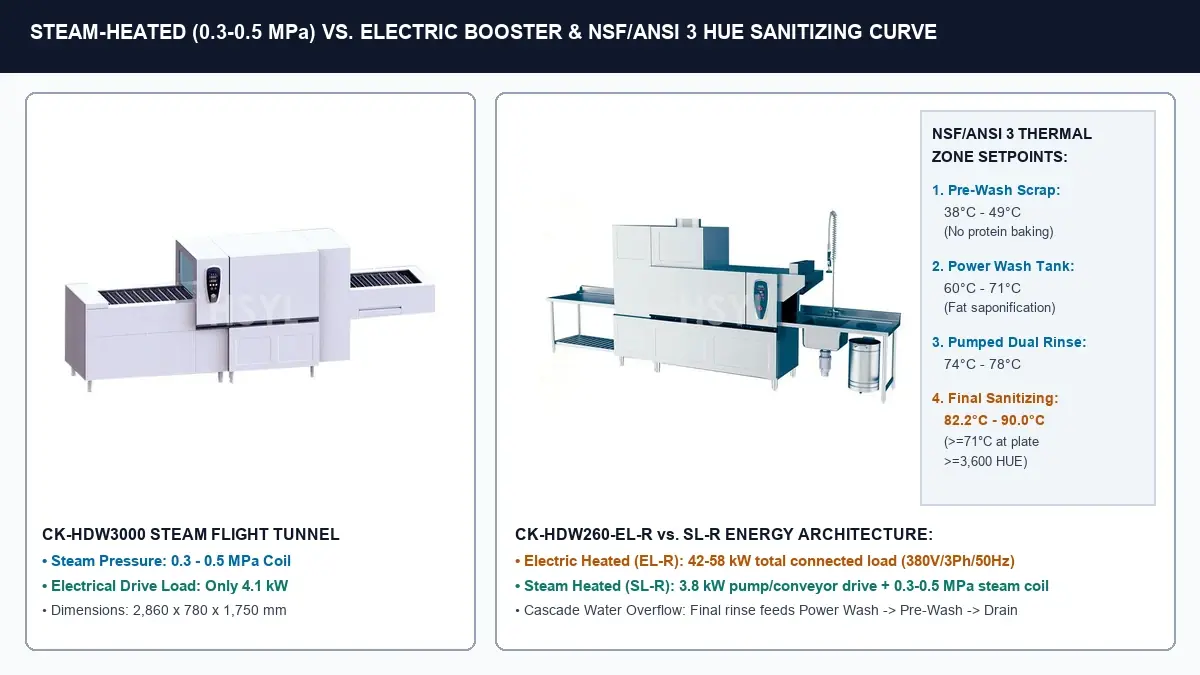
- Steam (0.3–0.5 MPa) vs. Electric Booster Connected Load: Where central boiler steam is available at 0.3–0.5 MPa (43.5–72.5 PSI), steam-heated models like the CK-HDW8000L (5.1 kW electrical drive) and CK-HDW260-SL-R (3.8 kW electrical drive) eliminate 38 kW to 75 kW of electric resistance tank/booster heating elements.
- NSF/ANSI 3 & Sinner's Circle Thermal Cascade: Multi-tank machines enforce strict thermal zoning—38°C–49°C pre-wash to strip starch/egg proteins without thermal coagulation, 60°C–71°C detergent wash for fat saponification, and 82.2°C–90.0°C (180°F–194°F) final sanitizing rinse to achieve ≥71.1°C (160°F) plate-surface temperature (≥3,600 HUE).
Key takeaway: Selecting between a rack conveyor dishwasher and a flight-type tunnel dishwasher is the single largest capital and utility decision in a commercial dish pit. If an institutional kitchen serving 1,200 covers per hour installs a single-tank rack conveyor machine, soiled trays back up into the dining room while scullery staff spend 40% of their shift lifting wet plastic peg racks. Conversely, specifying a 4.28-meter flight-type tunnel machine for a 300-seat bistro wastes floor space and idle wash-tank heating energy. Within our Commercial Kitchen Capacity & Equipment Sizing Hub, this engineering guide establishes the mathematical throughput formulas, thermal utility balances, and 5-year lifecycle economics across our commercial conveyor dishwashers lineup.
Warewashing Kinematics & Sinner's Circle Thermodynamics: Rack Pawl vs. Continuous Peg-Belt
Every commercial warewashing machine operates on Sinner's Circle, balancing four interdependent energy vectors: Mechanical Impingement (spray nozzle pressure and jet velocity), Thermal Energy (water temperature in each zone), Chemical Activity (alkaline detergent and surfactant concentration), and Contact Time (conveyor belt speed across the spray manifolds). When conveyor speed increases to handle a dining rush, contact time drops—requiring higher spray pump horsepower and multi-stage thermal cascading to maintain sanitation compliance.
Rack Conveyor Kinematics: Reciprocating Pawl Drive & 500 × 500 mm Rack Geometry
In a rack conveyor dishwasher such as the steam-heated CK-HDW260-SL-R (260 racks/hr) or electric-heated CK-HDW260-EL-R (260 racks/hr), soiled dishes, glassware, and cutlery are manually sorted into standardized 500 × 500 mm (19.75" × 19.75") polypropylene peg or compartment racks on the soiled dishtable. A stainless steel reciprocating pawl bar—driven by a geared motor with an overload slip clutch—engages the bottom ribs of each rack and indexes the rack train continuously through the chamber at 1.8 to 2.2 meters per minute.
Rack conveyor systems excel in mixed-ware flexibility: a banquet scullery can feed a 36-compartment stemware rack followed immediately by a flatware rack, an 18-plate peg rack, and a half-size sheet pan rack without adjusting machine rails. However, the workflow remains fundamentally batch-indexed: every 500 × 500 mm rack must be pre-loaded at the soiled table, slid into the entry hood, unloaded onto the clean roller table, and carried back to the soiled side via an overhead rack-return chute or utility cart.
Flight-Type Kinematics: Rackless Peg-Belt & Multi-Tank Counterflow Cascade
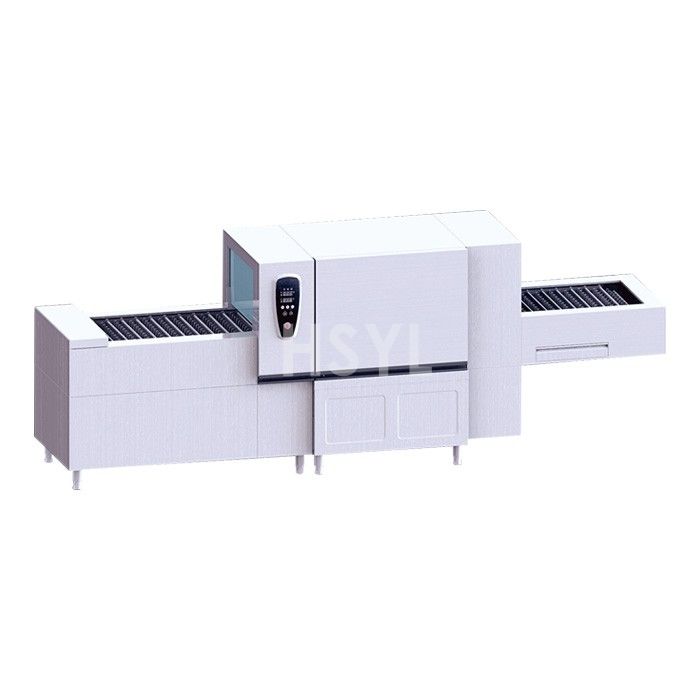
In a flight-type (tunnel) dishwasher such as the CK-HDW3000 (3,000 plates/hr) or heavy institutional CK-HDW8000L (8,000 plates/hr), individual racks are eliminated for plates and cafeteria trays. Instead, operators slot soiled plates, soup bowls, and compartmentalized mess trays directly between injection-molded heat-stabilized polypropylene fingers (pegs) mounted on a continuous stainless-steel cross-rod conveyor belt measuring 600 mm to 750 mm in active width.
Inside the 2,860 mm to 4,280 mm insulated tunnel, water flows in a counter-current cascade opposite to the direction of dish travel:
- Zone 1 — Recirculated Power Pre-Wash (38°C–49°C / 100°F–120°F): High-volume upper and lower deluge manifolds strip gross food soils, starches, and liquid egg residues. Holding pre-wash water strictly below 50°C (122°F) prevents thermal denaturation (baking) of albumin and dairy proteins onto ceramic glazes.
- Zone 2 — High-Pressure Detergent Power Wash (60°C–71°C / 140°F–160°F): Dedicated 1.5 kW to 2.2 kW stainless steel centrifugal pumps project knife-like fan jets from upper and lower hydro-dynamic wash arms at 35 to 55 kPa nozzle pressure, emulsifying animal fats and stripping dried sauces.
- Zone 3 — Pumped Dual Rinse & Fresh Sanitizing Final Rinse (82.2°C–90.0°C / 180°F–194°F): Fresh hot water from the steam heat exchanger or electric booster enters purely at the final sanitizing arch. Rather than draining directly to the sewer, this clean 82°C+ rinse water cascades backward into the pumped rinse tank, then overflows into the main detergent wash tank, and finally overflows into the pre-wash tank before skimming floating grease to the floor drain. This counterflow regeneration cuts fresh water consumption to just 42 L/h to 60 L/h on our steam-heated flight series.
- Zone 4 — High-Velocity Thermal Blow-Dryer Tunnel: Integrated centrifugal blowers project a 65°C–75°C air knife across exiting tableware, flashing off residual surface moisture so plates can be stacked immediately at the unload cradle without manual towel handling.
Engineering Specification & Peak Dish-Load Sizing Matrix
Manufacturers rate commercial dishwashers under ideal 100% continuous belt loading (theoretical mechanical capacity). In real-world scullery operations, operator gaps between racks, mixed tray sizes, and shift transitions reduce net sustainable output to an Operational Loading Efficiency Factor (Eload) of 0.70 (70%). For a foundational breakdown of seat turnover rates across smaller undercounter and hood machines, see our how to calculate commercial dishwasher capacity guide.
Peak Dish-Load & Rack-Requirement Equations
Governing Engineering Equations & Parameters:
- Required Practical Dish Throughput (Plates/Hr): Q_dishes = (N_seats × Turnover_Rate × Pieces_per_Meal) / E_load
- Required Rack Conveyor Rating (Racks/Hr, using 18 Dinner Plates per 500×500 mm Rack): Q_racks = Q_dishes / 18
- N_seats = Total dining room or cafeteria seating capacity
- Turnover_Rate = Peak hourly seat turnovers (0.8–1.2 for hotels/banquets; 2.0–3.0 for cafeterias/canteens)
- Pieces_per_Meal = Average china/tray pieces per diner (4–6 for canteens; 8–12 for full-service banquets)
- E_load = Practical human loading efficiency (0.70 standard engineering derating factor)
Worked Sizing Example A (500-Seat Hotel Banquet Hall): At 1.0 turnover/hr × 9 pieces/diner = 4,500 pieces/hr (including ~2,500 plates and ~2,000 glasses/cups). Dividing 2,500 plates by 18 plates/rack = 139 racks/hr net, plus 55 glass racks/hr = 194 racks/hr net. Applying the 0.70 efficiency factor requires 194 ÷ 0.70 = 277 racks/hr peak capacity or a 260 racks/hr CK-HDW260-SL-R paired with a dedicated bar glasswasher.
Worked Sizing Example B (1,200-Seat University Canteen): At 1.8 turnovers/hr × 3.5 plates/trays per student = 7,560 plates/hr theoretical peak load. No single-track rack conveyor can process 420 racks per hour; this facility requires the 8,000 plates/hr CK-HDW8000L Flight-Type Steam Dishwasher.
Factory Model Engineering Comparison Matrix
| Factory Model SKU | Conveyor Architecture | Dimensions (L × W × H mm) | Mechanical Capacity (100% / 70% Net) | Primary Heating Source | Electrical Drive / Total Load | Fresh Water Consumption | Target Peak Meal Volume |
|---|---|---|---|---|---|---|---|
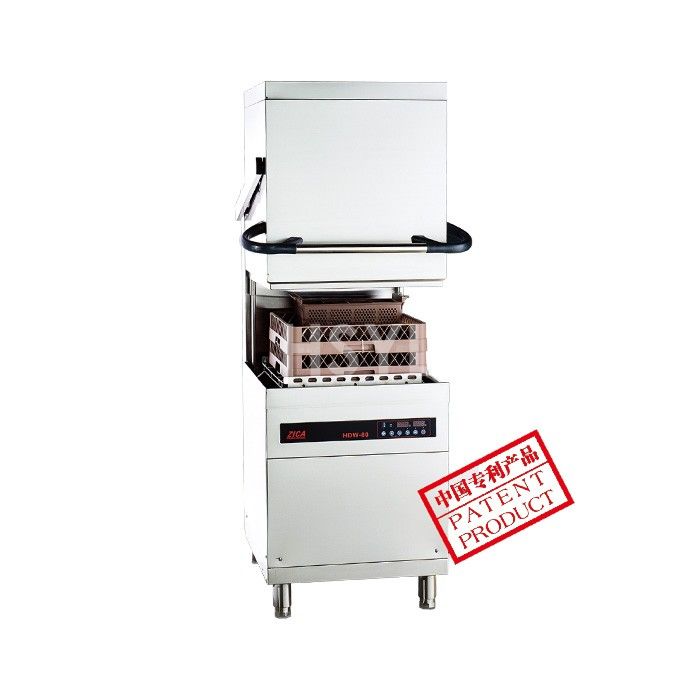
| HDW-80 | Pass-Through Door / Hood (Single Rack) | 720 × 735 × 1,445 mm | 60–80 Racks/hr (~750–1,000 plates net) | 380V Electric Tank + Rinse Booster | 14.5 – 16.5 kW (380V/3Ph) | ~160–180 L/h (2.5 L/rack) | 80 – 250 Meals/Peak Hr (Bistros, Cafes) |
| CK-HDW260-EL-R | Dual-Tank Pawl Rack Conveyor | 2,400 × 760 × 1,700 mm | 260 Racks/hr (~3,270 plates/hr net) | All-Electric (380V Immersion + Booster) | 42.0 – 54.0 kW (380V/3Ph) | 125 L/h (0.48 L/rack) | 250 – 700 Meals/Peak Hr (No Boiler Steam) |
| CK-HDW260-SL-R | Dual-Tank Pawl Rack Conveyor | 2,400 × 760 × 1,700 mm | 260 Racks/hr (~3,270 plates/hr net) | Direct Steam Coil (0.3–0.5 MPa) | 3.8 kW (Pumps & Drive Only) | 125 L/h (0.48 L/rack) | 300 – 800 Meals/Peak Hr (Hotels, Banquets) |
| CK-HDW3000 | Flight-Type Endless Peg-Belt Tunnel | 2,860 × 780 × 1,750 mm | 3,000 Plates/hr (~2,100 plates/hr net) | Direct Steam Coil (0.3–0.5 MPa) | 4.1 kW (Pumps, Belt & Dryer) | 42 L/h cascade regeneration | 600 – 1,100 Meals/Peak Hr (Compact Canteens) |
| CK-HDW8000L | Multi-Tank Flight-Type Peg-Belt Tunnel | 4,280 × 950 × 1,850 mm | 8,000 Plates/hr (~5,600 plates/hr net) | Direct Steam Coil (0.3–0.5 MPa) | 5.1 kW (Pumps, Belt & Dryer) | 60 L/h cascade regeneration | 1,200 – 3,000+ Meals/Peak Hr (Universities, Hospitals, Flight Kitchens) |
To compare budgetary capital ranges across undercounter, pass-through hood, rack conveyor, and flight-type machines before issuing tender documents, review our commercial dishwasher price and quote specification guide.
Regulatory, Sanitation & MEP Compliance: NSF/ANSI 3 HUE, ASHRAE 154 Exhaust & Drain Tempering
NSF/ANSI 3 Heat Unit Equivalents (HUE) & Thermal Disinfection
High-temperature commercial conveyor and flight dishwashers are certified under NSF/ANSI Standard 3 (Commercial Warewashing Equipment) and the FDA Food Code (§4-703.11) to achieve a 5-log (99.999%) reduction of vegetative foodborne pathogens by accumulating at least 3,600 Heat Unit Equivalents (HUE) across the wash and rinse cycles. While the fresh final sanitizing rinse manifold must operate between 82.2°C and 90.0°C (180°F and 194°F) at a dynamic flow pressure of 103 to 172 kPa (15 to 25 PSI), the actual dish surface temperature recorded by an irreversible thermal label or waterproof maximum-registering thermometer must reach at least 71.1°C (160°F). Exceeding 90.0°C (194°F) at the final rinse nozzles atomizes water into fine steam vapor that flashes off before impinging on the plate, paradoxically failing the 71.1°C surface test. Our dishwasher sanitizing rinse temperature HACCP verification guide details daily thermolabel logging protocols.
ASHRAE 154 / IMC Type II Vapor Hood Exhaust & Latent Heat Recovery
Unlike grease-laden cooking appliances that require Type I fire-rated hoods, commercial dishwashers discharge moisture-saturated vapor and sensible heat requiring a Type II condensate exhaust hood or direct pant-leg duct collars under ASHRAE Standard 154 (Ventilation for Commercial Cooking Operations) and the International Mechanical Code (IMC Section 506):
- Rack Conveyor Exhaust Collars (CK-HDW260 Series): Require 150 to 200 CFM (255 to 340 m3/h) at the soiled entry vent cowl and 300 to 400 CFM (510 to 680 m3/h) at the hot clean exit cowl (450–600 CFM total) via welded AISI 304 watertight duct work sloped back toward the machine at 2% to prevent condensate dripping onto clean china.
- Flight-Type Tunnel Exhaust (CK-HDW3000 / CK-HDW8000L): Requires 750 to 1,200 CFM (1,275 to 2,040 m3/h) total exhaust extraction across the central vapor stack and dryer discharge hood. Integrating an air-to-water exhaust heat recovery coil condenses outgoing 55°C vapor to pre-heat incoming 15°C cold city water up to 45°C, cutting booster energy load by up to 30% in line with ENERGY STAR commercial dishwasher efficiency criteria.
IPC Plumbing Drain Tempering (≤60°C / 140°F) & Indirect Air-Gap Rough-In
Under the International Plumbing Code (IPC Section 802.1.6 & 803.1), commercial dishwashers must discharge indirectly through a true air gap into a floor sink, and no wastewater exceeding 60°C (140°F) may enter PVC/ABS building sanitary drainage piping. Because wash and rinse tank dumps reach 65°C to 85°C, MEP engineers must specify either cast-iron/stainless drainage piping or an automatic thermostatic cold-water drain tempering valve set to blend cold water whenever discharge temperatures exceed 57°C (135°F). Additionally, to prevent thermal scouring of downstream grease traps, review our 3-compartment sink and grease trap flow-rate sizing guide.
Steam Supply Manifold Rough-In: 0.3–0.5 MPa Pressure Regulation & Condensate Traps
When specifying steam-heated warewashing lines such as the CK-HDW8000L, CK-HDW3000, or CK-HDW260-SL-R, the building steam header must deliver dry saturated steam regulated between 0.3 MPa and 0.5 MPa (43.5 to 72.5 PSI) via an upstream Y-strainer (100-mesh stainless screen), pilot-operated pressure-reducing valve (PRV), and 24V PID-controlled solenoid steam admission valve. Each tank heating coil and shell-and-tube final-rinse heat exchanger must discharge through a dedicated float-and-thermostatic (F&T) steam trap with a check valve into the boiler condensate return line, recovering sensible heat in the 90°C condensate while preventing water-hammer vibration inside the wash tank coils.
Metallurgy, Scale Control & Scullery Ergonomics Engineering
Deep-Drawn AISI 304/316L Wash Tanks & Hydro-Dynamic Spray Manifolds
Across our entire commercial dishwashing equipment line, wash tanks, upper/lower spray arms, and double-skinned insulated tunnel doors are fabricated from 1.5 mm to 2.0 mm AISI 304 austenitic stainless steel (with AISI 316L specified for high-chloride water districts and steam heat-exchanger coils). Deep-drawn coved tank bottoms eliminate weld-seam crevices where alkaline detergent sludge and lime scale accumulate. All vertical inspection doors integrate counter-balanced torsion springs and magnetic reed safety interlock switches meeting UL 921 / IEC 60335-2-58 commercial electric dishwasher safety standards, instantly cutting pump and belt power if a door is lifted mid-cycle.
Langelier Saturation Index (LSI) Lime Scale Prevention at 82°C+
In the final sanitizing rinse booster and steam heat exchanger, water heated above 82.2°C (180°F) experiences rapid precipitation of calcium carbonate (CaCO3) whenever feedwater hardness exceeds 3.0 grains per gallon (51 ppm as CaCO3). A 1.5 mm (1/16 inch) carbonate crust on electric booster elements or steam coils increases thermal resistance by 12% to 18% and clogs precision final-rinse fan nozzles, starving plates of sanitizing Heat Unit Equivalents. Facilities must install an upstream duplex ion-exchange water softener alongside a scheduled acid descaling regimen as detailed in our commercial dishwasher delimer and acid descaling SOP.
Scullery Layout Ergonomics: L-Shaped vs. Linear Flow
A rack conveyor system (CK-HDW260-SL-R) can be configured with 90-degree motorized or gravity roller curve tables at both the soiled entry and clean exit, allowing an L-shaped or U-shaped dish pit to fit inside a compact 4.5 m × 3.5 m room. By contrast, a flight-type tunnel machine (CK-HDW8000L) requires a straight-line footprint of 4,280 mm plus at least 1,500 mm of soiled scraping access at the load cradle and 1,500 mm of stacking clearance at the unload optical photo-eye stop switch—demanding a minimum 7.5-meter to 8.5-meter linear scullery bay.
Conductivity-Controlled Chemical Dosing & Optical Idle Energy Saver
To prevent detergent overdosing and surfactant foaming inside high-pressure wash pumps, conveyor dishwashers integrate a tank bulkhead port for a temperature-compensated inductive conductivity probe paired with peristaltic detergent and rinse-aid dosing pumps. Maintaining wash-tank alkalinity between 1,500 and 2,500 μS/cm (0.15%–0.25% concentration) ensures rapid saponification of food lipids, while injecting non-ionic surfactant rinse aid at 50 to 100 ppm into the 82.2°C final rinse header breaks water surface tension so droplets sheet off plates before entering the blow-dryer section. Both rack and flight models incorporate entry/exit micro-switches or infrared photo-eyes that automatically shut off the final-rinse solenoid valve and drop blower motors to standby whenever no racks or dishes are advancing on the conveyor.
5-Year TCO, Steam vs. Electric Energy Math & Labor Payback Analysis
5-Year Lifecycle Cost Comparison (1,000-Cover Institutional Commissary, 6 Peak Hrs/Day, 365 Days/Yr)
In high-volume facilities serving 1,000+ diners per peak period, operating two parallel electric rack conveyor lines or an undersized single rack conveyor inflates both electrical demand charges and scullery payroll compared to a single steam-heated flight-type tunnel dishwasher:
| 5-Year Cost Component (10,950 Operating Hours) | Flight-Type Steam Tunnel: CK-HDW8000L (8,000 Plates/Hr, 0.3–0.5 MPa Steam) | Rack Conveyor Electric Setup: CK-HDW260-EL-R (260 Racks/Hr + Overtime Shift) | Engineering Variance & Financial Driver |
|---|---|---|---|
| Capital Equipment & Dishtable Package | $24,500 | $15,800 (Includes 60 peg/cup racks & return chute) | +$8,700 higher initial capex for 4.28m multi-tank flight tunnel |
| 5-Year Scullery Labor (Loading, Rack Handling, Stacking) | $197,100 (2.0 FTEs × 6 hrs/day @ $18/hr) | $344,925 (3.5 FTEs × 6 hrs/day @ $18/hr for rack racking/unracking) | Direct peg-belt loading eliminates manual 500×500 mm rack loading & return handling (-1.5 FTE) |
| 5-Year Thermal & Electrical Utility Cost | $26,820 (5.1 kW elec drive + central boiler steam @ $0.055/kWh-eq) | $63,072 (48 kW average electric draw @ $0.12/kWh) | Central gas boiler steam (0.3–0.5 MPa) costs ~50% less per kWh-thermal than electric resistance |
| 5-Year Water, Sewer & Chemical Sanitizer/Detergent | $14,200 (60 L/h cascade regeneration) | $23,650 (125 L/h water + higher detergent carryover) | Multi-zone counterflow cascade cuts fresh rinse water & chemical dosing per 1,000 plates |
| 5-Year Dish Breakage & Plastic Rack Replacement | $3,200 (Resilient PP belt fingers) | $8,900 (Double-handling china chipping + replacement peg racks) | Eliminating rack-to-stack double handling reduces ceramic edge chipping by ~60% |
| Total 5-Year Lifecycle Cost (TCO) | $265,820 | $456,347 | Net 5-Year Savings: $190,527 (Capex Payback in 2.6 Months) |
Decision Summary: When to Specify Each Architecture
- Specify the CK-HDW260-SL-R or CK-HDW260-EL-R Rack Conveyor (260 Racks/Hr): When peak dining volume sits between 250 and 800 meals/hr, when scullery room length is constrained below 5.5 meters (requiring L-shaped corner dishtables), or when a high ratio of delicate banquet stemware and mixed kitchen utensils must be washed in compartmentalized 500 × 500 mm racks.
- Specify the CK-HDW3000 (3,000 Plates/Hr) or CK-HDW8000L (8,000 Plates/Hr) Flight-Type Tunnel: When peak meal volume exceeds 800 covers/hr, when uniform cafeteria trays and ceramic plates dominate the ware mix, and when eliminating 1.5+ FTEs of manual rack-handling labor and reducing water consumption to 42–60 L/h are primary operational targets.
Discuss Your Dishroom Layout & Conveyor Dishwasher Sizing with HSYL Engineers
Send HSYL your dining seat count, peak turnover rate, tray/plate dimensions, and available steam or 3-phase electriContact HSYL for Dishroom Engineering & Quotations.