Direct Answer / Key Takeaway: Complete engineering guide to commercial meat grinder hub standards, orifice plate hole size chart (3mm–35mm), and 5-year TCO.
Selecting a commercial meat grinder requires matching two distinct mechanical standards to your raw material thermal state and hourly throughput: the cutting head hub diameter (countertop #12, #22, and #32 Enterprise hubs vs. floor-standing Ø 100 mm to Ø 200 mm industrial Unger heads) and the orifice plate hole diameter (Ø 3 mm / 1/8 in. fine emulsion up to Ø 35 mm / 1.38 in. kidney-plate pre-grind). Attempting to grind unthawed frozen meat blocks (-18°C / 0°F) or force a coarse trim directly through a fine Ø 3 mm plate in a single pass on an under-torqued Enterprise grinder causes severe auger back-extrusion, friction heating above +4°C, and irreversible fat smearing.
- Hub Number Physical Dimensions: Hub designations (#12, #22, #32) are not arbitrary model names—they define the standardized outer diameter of the perforated plate: #12 = Ø 69.9 mm (2.75 in.), #22 = Ø 82.5 mm (3.25 in.), and #32 = Ø 98.4 to 100 mm (3.94 in.).
- Enterprise (Single-Cut) vs. Unger (Multi-Cut) Systems: Standard Enterprise heads pair one 4-wing rotary knife with one orifice plate (1 cutting plane per revolution); industrial Unger heads (
H82,D98,E130,U200) stack a kidney pre-cutter plate, dual-sided rotary knives, and two orifice plates in series (4 cutting planes per revolution), enabling single-pass reduction without thermal protein denaturation. - Direct -18°C Frozen Block Grinding: Processing unthawed frozen meat blocks requires floor-standing dual-auger or high-torque worm reducers (
YL-MG-100toYL-MG-200, 5.5 kW to 37 kW), eliminating 18-hour thawing rooms and preventing 3.5% to 5.2% purge drip loss. - Matched Knife-and-Plate Metallurgy: Always specify hardened 9Cr18Mo / AISI 440C martensitic stainless tool steel (56–58 HRC) knives and plates lapped together as a matched pair to maintain zero-gap shearing under NSF/ANSI Standard 8 sanitation criteria.
Key takeaway: Selecting a commercial meat grinder requires matching two distinct mechanical standards to your raw material thermal state and hourly throughput: the cutting head hub diameter (countertop #12, #22, and #32 Enterprise hubs vs. floor-standing Ø 100 mm to Ø 200 mm industrial Unger heads) and the orifice plate hole diameter (Ø 3 mm / 1/8 in. fine emulsion up to Ø 35 mm / 1.38 in. kidney-plate pre-grind). Attempting to grind unthawed frozen meat blocks (-18°C / 0°F) or force a coarse trim directly through a fine Ø 3 mm plate in a single pass on an under-torqued Enterprise grinder causes severe auger back-extrusion, friction heating above +4°C, and irreversible fat smearing.
Mechanical Shear Kinematics: Variable-Pitch Auger Extrusion & Enterprise vs. Unger Cutting Heads
A commercial meat grinder is not a crushing device—it is a positive-displacement helical extruder coupled to a rotaryscissor shear plane. When chilled boneless meat (0°C to +4°C) or tempered/frozen meat blocks (-18°C to -4°C) drop from the hopper into the grinding barrel (cylinder), a rotating variable-pitch feed worm (auger) captures the muscle chunks. The auger flight pitch is intentionally wide at the rear throat to maximize volumetric intake and progressively narrows toward the front discharge hub, compressing air voids out of the meat matrix and building positive hydrostatic extrusion pressure (0.4 to 1.8 MPa) against the perforated orifice plate.
Inside the grinding barrel wall, spiral internal rifling flutes (ribs) run longitudinally or helically from the throat to the front ring. These flutes perform a critical mechanical function: they grip the outer perimeter of the meat plug so it cannot spin uselessly in circles with the auger, forcing the meat to translate strictly axially into the holes of the stationary orifice plate where the rotating 4-blade cross knife shears it clean.
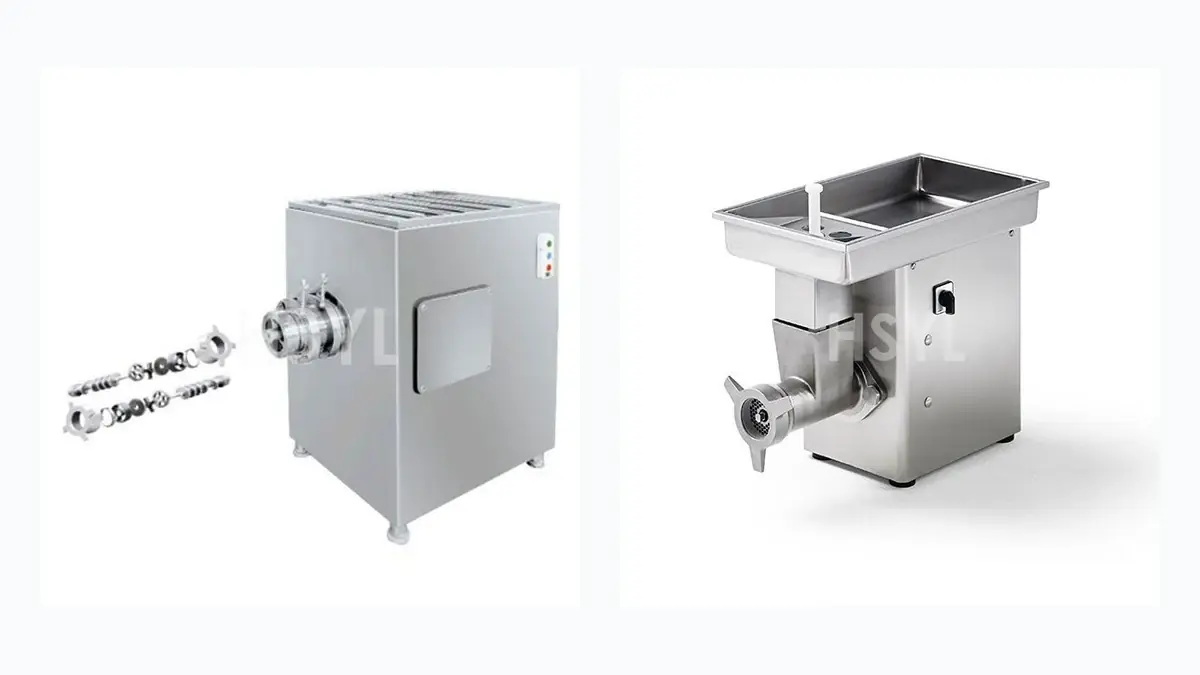
YL-MG-12 to YL-MG-32) against heavy-duty floor-standing frozen-meat grinders (YL-MG-100 to YL-MG-200) engineered with high-torque gearboxes and safety-interlocked hoppers.Enterprise System (Single-Cut) vs. Unger System (Triple/Five-Cut) Engineering
When specifying equipment across our Equipment Selection technical guides, buyers must verify whether their grinder head utilizes the North American Enterprise standard or the European industrial Unger standard—their barrels, auger square drives, knives, and plates are not mechanically interchangeable:
- Enterprise Cutting System (1 Knife + 1 Plate = 1 Shear Plane): The standard configuration on commercial countertop and butcher-shop grinders (#12, #22, #32). A single one-sided 4-wing knife rides against the inner face of a single perforated plate, secured against barrel rotation by an external side alignment pin (notch). Enterprise systems excel at grinding fresh chilled trim (0°C to +4°C) where operators perform a two-stage grind: a primary coarse pass (Ø 10 mm or Ø 12 mm) followed by a secondary fine pass (Ø 4.5 mm or Ø 6 mm).
- Unger Cutting System (3-Piece to 5-Piece Stack = 2 to 4 Shear Planes): Standard on high-throughput commissary and frozen-meat grinders (
H82,D98,E130,B160,U200). A 5-piece Full Unger set stacks, in sequence from auger to locking ring: (1) a 3-hole kidney-shaped pre-cutter plate, (2) a double-sided rotary knife, (3) a coarse intermediate plate (Ø 13 to 16 mm), (4) a second double-sided rotary knife, and (5) the final finishing orifice plate (Ø 3 to 8 mm). Because the meat is pre-sheared into three stages inside a single barrel pass, Unger grinders eliminate the labor and thermal exposure of re-feeding meat through the machine a second time.
Orifice Plate Open Area Ratio, Shear Frequency & Volumetric Extrusion Equations:
- Effective Open Perforation Area of Grinder Plate (Aopen in mm2):
Aopen = Nholes · (π · dhole2) / (4) - Blade-to-Hole Shear Frequency (fshear cuts per minute):
fshear = Nrpm · Zwings · Nholes · Kplanes - Specific Mechanical Energy & Meat Temperature Rise (Δ Tgrind in °C):
Δ Tgrind = (Pshaft · (1 - ηmech) · 3,600) / (Mmeat · cp,meat) ≤ 2.0°C - Nholes = Total count of perforated orifices on the plate; dhole = Individual orifice diameter (mm)
- Zwings = Number of cutting arms on rotary knife (4 standard; 6 on high-speed emulsifying rings)
- Kplanes = Active shear planes (1 for Enterprise; 2 for Half-Unger; 4 for 5-piece Full Unger)
- cp,meat = Specific heat of lean/fat blend (≈ 3.15 to 3.52 kJ/(kg·K) above freezing)
Commercial Meat Grinder Hub Standards (#12 to #200) & Plate Hole Size Chart (Ø 3 mm to Ø 35 mm)
To eliminate specification mismatches across our Food Preparation Equipment line, project engineers must cross-reference both the machine hub capacity table and the orifice plate aperture chart. Below is the complete engineering parameter matrix for the HSYL Commercial Meat Grinders (YL-MG Series), covering compact tabletop units (YL-MG-12, YL-MG-22, YL-MG-32) through industrial frozen-block grinders (YL-MG-100 to YL-MG-200):
| HSYL Model Code | Hub Standard & Plate Outer Dia. | Fresh Chilled Capacity (0–4°C) | Frozen Meat Capacity (-18°C) | Motor Power & Auger Speed | Auger Architecture & Hopper Volume |
|---|---|---|---|---|---|
| YL-MG-12 (Countertop) | #12 Hub (Ø 70 mm / 2.75 in.) | 120 kg/h (265 lb/h) | Not Rated (Fresh Only) | 0.75 kW (1.0 HP) / 190 rpm | Single Auger, 220V/1Ph, 27 kg Net |
| YL-MG-22 (Countertop) | #22 Hub (Ø 82 mm / 3.25 in.) | 220–250 kg/h (550 lb/h) | Not Rated (Fresh Only) | 1.10 kW (1.5 HP) / 190 rpm | Single Auger, Oiled Gear, 36 kg Net |
| YL-MG-32 (Heavy Table) | #32 Hub (Ø 100 mm / 3.94 in.) | 320–400 kg/h (880 lb/h) | Tempered -2°C Trim Only | 1.5–2.2 kW (3.0 HP) / 185 rpm | Single Auger, 380V/3Ph, 65 kg Net |
| YL-MG-100 (Floor Frozen) | Industrial Ø 100 mm Head | 600–800 kg/h (1,760 lb/h) | 300–500 kg/h (at -18°C) | 5.5 kW (7.5 HP) / 240 rpm | Variable-Pitch Auger, 35 L Hopper (260 kg) |
| YL-MG-120 (Floor Frozen) | Industrial Ø 120 mm Head | 1,000–1,500 kg/h (3,300 lb/h) | 600–1,000 kg/h (at -18°C) | 7.5 kW (10 HP) / 220–240 rpm | Heavy Single/Dual Auger, 60 L Hopper (420 kg) |
| YL-MG-130 (Dual Auger) | Unger E130 (Ø 130 mm) | 1,800–2,500 kg/h (5,500 lb/h) | 1,200–1,800 kg/h (at -18°C) | 11.0 kW (15 HP) / 180–240 rpm | Dual Auger (Feed + Cut), 100 L Hopper (680 kg) |
| YL-MG-160 (Commissary) | Unger B160 (Ø 160 mm) | 2,500–3,500 kg/h (7,700 lb/h) | 1,800–2,800 kg/h (at -18°C) | 18.5 kW (25 HP) / 160–220 rpm | Dual Auger + VFD Option, 160 L Hopper (980 kg) |
| YL-MG-200 (Block Grinder) | Unger U200 (Ø 200 mm) | 4,500–6,000 kg/h (13,200 lb/h) | 3,000–4,500 kg/h (Whole 25 kg Block) | 30–37 kW (50 HP) / 140–200 rpm | Reinforced Dual Auger + 200 L Bin Lifter (1,550 kg) |
Orifice Plate Hole Size Chart (Ø 3 mm to Ø 35 mm) & Culinary Application Mapping
Selecting the correct orifice plate aperture determines protein particle definition, moisture binding, and downstream forming performance when feeding our HLM-100 Commercial Meat Mixer (see our Commercial Meat Mixer Selection Guide) and Commercial Hamburger Press HF-100 / HF-130 (detailed in our Hamburger Patty Press Portion Control Guide):
- Ø 3.0 mm to Ø 4.0 mm (1/8 in. to 5/32 in.) Ultra-Fine Plate: Used for the second/final pass of frankfurters, hot dogs, bologna, mortadella, and fine pâté pastes, as well as finely minced beef tartar. Never feed un-ground whole muscle chunks directly into a Ø 3 mm Enterprise plate—always pre-grind through a Ø 10 mm to Ø 12 mm plate first.
- Ø 4.5 mm to Ø 5.0 mm (3/16 in.) Standard Fine Burger & Breakfast Sausage Plate: The global QSR benchmark for fast-food smash burgers, breakfast pork patties, finely textured meatballs, and dumpling fillings.
- Ø 6.0 mm to Ø 8.0 mm (1/4 in. to 5/16 in.) Medium Steakhouse Burger & Fresh Bratwurst Plate: Preserves distinct lean-to-fat particle mosaic definition for gourmet steakhouse burger patties, Italian sausages, pepperoni, salami, and shepherd's pie mince.
- Ø 10.0 mm to Ø 14.0 mm (3/8 in. to 9/16 in.) Coarse Chili & Primary Breaking Plate: Used as the first-pass breaking plate for frozen/chilled trim before mixing in the
HLM-100, or as the final cut for Texas chili con carne and coarse chorizo. - Ø 16.0 mm to Ø 35.0 mm (5/8 in. to 1-3/8 in.) Kidney / 3-Hole Pre-Cutter Plate: Installed at the rear of an Unger stack or used for primary reduction of -18°C frozen blocks prior to silent bowl cutting or stew dicing.
Regulatory, Cold-Chain Thermal Control & Operator Safety Compliance
Grinding raw skeletal muscle ruptures cellular membranes and distributes surface flora throughout the entire interior mass of the batch. Consequently, meat grinding rooms are subject to stringent microbiological, thermal, and mechanical safety mandates:
- USDA FSIS 9 CFR Part 416 & Temperature Rise Control (Δ T ≤ 2.0°C): Under USDA FSIS 9 CFR Part 416 sanitation performance standards and HACCP cold-chain rules (see our Commercial Refrigerator Temperature Zones & Storage Map), beef and pork fat begins softening and smearing across orifice plates when internal meat temperature exceeds +4.4°C (40°F). When dull blades or excessive auger back-pressure heat the meat above +7°C, melted lipid films coat the hydrophilic myosin protein strands—preventing salt-soluble protein extraction during mixing and causing burger patties to shrink, cup, and crumble on the grill. All HSYL
YL-MGgrinders are engineered with variable-pitch augers that restrict single-pass temperature rise to ≤1.5°C to 2.0°C. - NSF/ANSI Standard 8 Tool-Free Barrel Teardown: Per NSF/ANSI Standard 8, the front cast locking ring, orifice plate, cross knife, worm auger, and barrel housing must disassemble completely in under 60 seconds without specialized wrenches, exposing the rear drive shaft lip seal for 100% visual and ATP swab verification.
- OSHA 29 CFR 1910.212 Feed-Throat Guarding & Interlocked Hopper Grids: Per OSHA 29 CFR 1910.212, countertop grinders (
YL-MG-12toYL-MG-32) have an extended feed throat depth (≥120 mm) and restricted neck opening diameter accompanied by a high-density polyethylene (HDPE) stomper so operator fingers cannot reach the revolving auger flights. Floor-standing grinders (YL-MG-100toYL-MG-200) feature welded AISI 304 stainless steel safety grates over the hopper coupled with IP65 magnetic proximity interlock switches that cut motor power within 0.2 seconds if the guard grid is lifted.
Electrical Inrush Protection (D-Curve Breakers) & Cold-Room MEP Integration
When an industrial frozen-meat grinder (YL-MG-100 at 5.5 kW up to YL-MG-200 at 37 kW) bites into a solid -18°C beef or pork block, the instantaneous mechanical shear load induces locked-rotor starting currents reaching 6 × to 8 × the nominal full-load amperage (FLA). Standard commercial C-curve miniature circuit breakers (MCBs) will nuisance-trip during heavy frozen block engagement. MEP electrical engineers must specify motor-rated IEC Type D-curve circuit breakers, star-delta (Y-Δ) reduced-voltage starters, or heavy-duty variable frequency drives (VFDs) with dynamic torque-boost algorithms.
In addition, because USDA and EU hygiene regulations require central meat grinding rooms to operate at controlled ambient temperatures of +8°C to +12°C (46°F to 54°F) and undergo daily +55°C high-pressure alkaline foam washdowns, thermal shock inside the motor junction box causes moisture condensation across electrical contactors. All floor-standing YL-MG control enclosures utilize double-lip silicone door gaskets, IP65 waterproof push-button stations, and internal breather drains so washdown steam cannot short-circuit the phase-reversal relays.
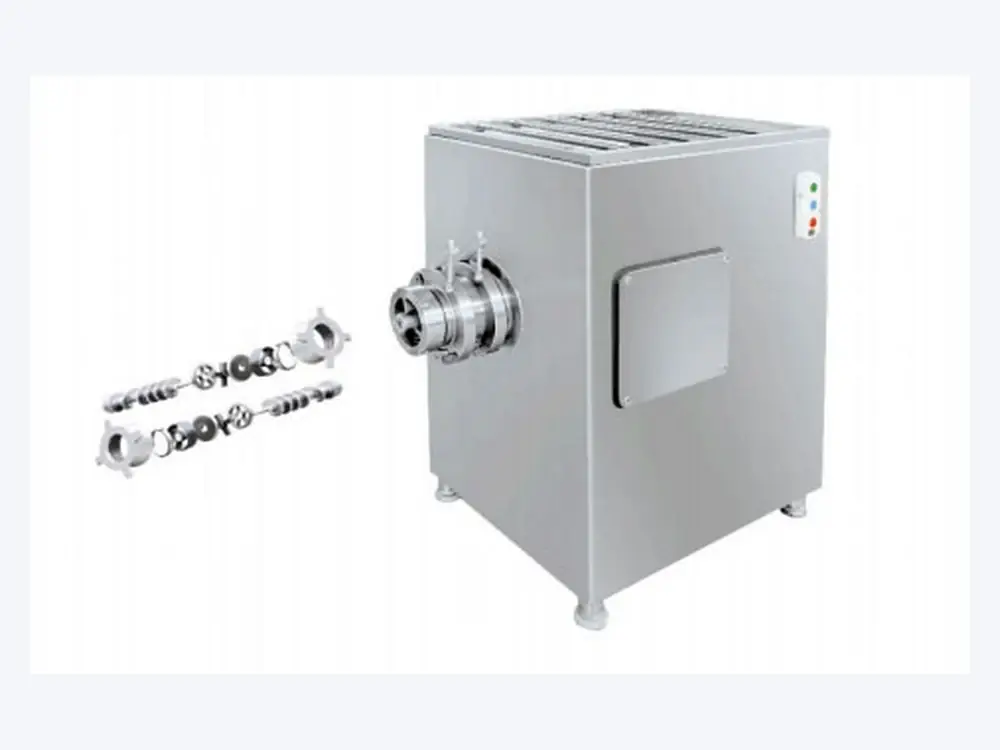
YL-MG industrial series) illustrating the external fluted locking ring, precision-ground 9Cr18Mo / 440C orifice plate hub, bi-directional reverse unjamming controls, and full AISI 304 washdown chassis.Metallurgy of Matched Knives & Plates (9Cr18Mo / 440C) & Direct -18°C Frozen Block Grinding
Why Knives and Plates Must Always Be Maintained as Matched Lapped Pairs
The single most common operational error in commercial butcheries is installing a brand-new rotary cross knife against an old, dished orifice plate—or flipping a single-sided plate backward. During hundreds of hours of operation under axial locking-ring pressure, the rotating 4-wing knife wears a microscopic mating wear track (0.02 mm to 0.08 mm deep) into the face of the perforated plate.
If an un-matched knife is tightened against a worn plate, a microscopic gap (0.05 mm+) remains between the blade edge and the inner ring of holes. Connective sinew, elastin, and collagen fibers wrap around the knife hub instead of shearing cleanly, rapidly plugging the center holes, doubling motor amperage draw, and extruding mashed, discolored paste out of the outer ring of holes. HSYL machines its rotary blades and perforated plates from vacuum-quenched 9Cr18Mo / AISI 440C martensitic stainless tool steel (56 to 58 HRC) and precision-laps them on horizontal rotary surface grinders to a flatness tolerance of ≤ 0.005 mm. Always label and rotate each knife and its corresponding plate as a permanently married set.
Dual-Auger Kinematics & Direct Grinding of -18°C Frozen Meat Blocks
In central kitchens processing 2,000 kg to 15,000 kg of boxed frozen beef, pork, or poultry daily, traditional air or water thawing rooms occupy massive refrigerated floor footprints, require 18 to 36 hours of staging lead time, and suffer 3.5% to 5.2% protein purge (drip loss)—literally washing soluble sarcoplasmic proteins and water-soluble B-vitamins down the floor drain.
Floor-standing frozen meat grinders (YL-MG-100 through YL-MG-200) eliminate thawing entirely. On dual-auger models (YL-MG-130, YL-MG-160, YL-MG-200), an upper secondary feeding auger works in synchronized counter-rotation with the lower primary cutting worm. When a solid 25 kg frozen meat block (-18°C) is dumped into the 100 L to 250 L hopper via a hydraulic 200 L Euro-bin column lifter, the heavy-tooth breaker flights on the dual augers bite into the frozen block, fracturing it into 40 mm sub-chunks and force-feeding the primary worm without bridging or cavitation. If an oversized bone fragment or dense frozen knot causes torque spikes, the operator activates the bi-directional instant reverse switch (or VFD auto-reverse torque protection) to back the block out of the shear throat in 2 seconds without opening the front locking collar.
200 L Euro-Bin Column Lifters & Continuous Patty / Sausage Line Integration
Once hourly grinding output exceeds 1,200 kg/h (YL-MG-120 and above), manual loading of 25 kg cartons into a 1,160 mm to 1,680 mm high hopper becomes the primary ergonomic bottleneck. Integrating a vertical hydraulic or chain-driven 200 L DIN 9797 Euro-bin (meat buggy) column hoist allows a single operator to roll a standard stainless steel meat cart into the lifting fork and elevate 200 kg of chilled or frozen trim into the grinder hopper in 18 seconds. At the discharge hub, the ground meat extrudes directly into a waiting 200 L Euro-bin positioned beneath the barrel lip, which is then wheeled directly to the HLM-100 twin-shaft meat mixer and HF-100 / HF-130 patty forming line—creating a closed, zero-touch sanitary production flow.
5-Year Total Cost of Ownership (TCO), Drip-Loss Yield Recovery & Labor Payback Analysis
To evaluate the financial return of upgrading from a multi-unit bank of countertop #32 fresh-meat grinders (requiring pre-thawing of frozen meat blocks) to a single floor-standing YL-MG-120 (7.5 kW) or YL-MG-130 (11 kW) direct frozen-meat grinder processing 1,200 kg/day of beef and pork (300 operating days/year = 360,000 kg/year at _ESCDOLLAR_6.80/kg raw meat cost), examine the 5-year lifecycle audit below:
| Cost Component (5-Year Cumulative) | 2x Countertop #32 Grinders (YL-MG-32 + Thawing Room) | 1x HSYL YL-MG-120 (7.5 kW Frozen/Fresh Grinder) | 1x HSYL YL-MG-130 (11 kW Dual-Auger Grinder) |
|---|---|---|---|
| Initial Equipment CAPEX | $2,400 (2x #32 Units + Thawing Racks) | $5,800 (Heavy Floor-Standing Industrial Unit) | $8,900 (Dual-Auger Heavy Commissary Unit) |
| 5-Year Thawing Purge / Drip Loss Penalty (On 1,800,000 kg Total 5-Year Meat Volume) | $428,400 (3.5% Thaw Blood/Purge Weight Loss) | $24,480 (0.2% Direct -18°C Grind; Zero Thaw) | $18,360 (0.15% Single-Pass Unger Cold Grind) |
| 5-Year Direct Grinding & Pre-Cutting Labor (Calculated at _ESCDOLLAR_18.00/hr Loaded Operator Wage) | $162,000 (6.0 man-hrs/day Hand Strip-Cutting & 2 Passes) | $40,500 (1.5 hrs/day Direct Block Chunk Grind) | $21,600 (0.8 hr/day Dual-Auger High-Speed Feed) |
| 5-Year Electrical Power & Replacement Tooling | $5,850 (Frequent Plate Resurfacing & Gear Wear) | $7,420 (7.5 kW Power + 440C Plate Sets) | $8,650 (11 kW Power + Unger Tooling Sets) |
| Total 5-Year Lifecycle Cost (TCO) | $598,650 (Massive Thaw Purge & Labor Deficit) | $78,200 (Saves $520,450 over 5 Years) | $57,510 (Saves $541,140 over 5 Years) |
Engineering ROI Conclusion: For any central kitchen, sausage plant, or burger commissary processing more than 300 kg/day of frozen meat, a direct frozen-meat grinder (YL-MG-100 to YL-MG-130) achieves 100% capital payback in under 14 operating days solely by capturing the 3.5% moisture and soluble protein weight that is otherwise lost down the drain during conventional thawing.
Discuss Your Meat Grinding & Frozen Block Processing Requirements with HSYL Engineers
Share your incoming meat block temperature (-18°C frozen or +2°C chilled), target particle size (mm), and hourly throughput requirement. HSYL engineers configure matched Enterprise or Full-Unger knife-and-plate sets for your production line. Contact HSYL for Meat Grinder Sizing & Technical Support.