Direct Answer / Key Takeaway: Engineering guide comparing commercial undercounter refrigerators, flat-top workbench chillers/freezers (ECUR/EDUR), and GN pan-rail salad prep tables (ESWR). Analyze NSF/ANSI 7 airflow, 60mm insulation, and R290 TCO.
Specifying commercial point-of-use refrigeration requires distinguishing between three structural workstation formats—Undercounter Cabinets, Flat-Top Workbench Refrigerators/Freezers (ECUR / EDUR / ECUF), and Top-Rail Salad/Sandwich Prep Tables (ECUR-2S / XSDUF-SALAD)—while matching the refrigeration evaporator method (Forced-Air Fan Cooling vs. Direct Cold-Wall Static Cooling) to ambient cookline heat loads. Installing a direct-cooled static cabinet or a rear-breathing condenser unit flush against a 40°C (104°F) commercial cooking line causes compressor high-pressure trip-outs and pushes upper Gastronorm (GN) ingredient pans above the 5°C (41°F) food-safety threshold.
- Structural Format Distinction: An Undercounter Refrigerator slides beneath an existing counter and lacks a load-bearing top; a Workbench Refrigerator (
ECUR/EDUR, 800 mm height) features a reinforced worktop deck for heavy countertop appliances or cutting boards; a Salad Prep Table (ECUR-2S, 1,050 mm overall height) integrates an insulated top cutout rail for drop-in GN 1/3 or GN 1/6 ingredient pans alongside a forward cutting board. - Forced-Air (
ECUR) vs. Direct Static Cooling (EDUR): Forced-air finned-coil evaporators deliver 2.4 × faster pull-down recovery after frequent door openings during peak restaurant service; direct-cooling copper-tube cold-wall evaporators (EDUR) provide 12% to 16% larger internal net volume (520 L vs. 445 L on a 1.8 m cabinet) and eliminate wind-chill dehydration on uncovered pastry or delicate produce. - Dimensional Footprint Matrix: Standardize workstation lengths at 1,200 mm, 1,500 mm, or 1,800 mm and depths at 600 mm (narrow bar/aisle), 700 mm (European Gastronorm line), or 800 mm (heavy central prep).
- NSF/ANSI 7 & R290 Hydrocarbon Compliance: Verify 60 mm high-density cyclopentane polyurethane insulation and natural R290 propane refrigerant (GWP = 3) tested to maintain ≤ 4.4°C (40°F) in 38°C (100°F) ambient kitchens per NSF/ANSI Standard 7.
Key takeaway: Specifying commercial point-of-use refrigeration requires distinguishing between three structural workstation formats—Undercounter Cabinets, Flat-Top Workbench Refrigerators/Freezers (
ECUR/EDUR/ECUF), and Top-Rail Salad/Sandwich Prep Tables (ECUR-2S/XSDUF-SALAD)—while matching the refrigeration evaporator method (Forced-Air Fan Cooling vs. Direct Cold-Wall Static Cooling) to ambient cookline heat loads. Installing a direct-cooled static cabinet or a rear-breathing condenser unit flush against a 40°C (104°F) commercial cooking line causes compressor high-pressure trip-outs and pushes upper Gastronorm (GN) ingredient pans above the 5°C (41°F) food-safety threshold.
Thermodynamic Architecture: Undercounter vs. Workbench vs. Salad Prep Tables & Evaporator Physics
In commercial kitchen design, every step a line cook takes between the hot cooking line and a remote walk-in cold room adds 8 to 14 seconds to ticket assembly times. Point-of-use workstation refrigeration eliminates this motion waste by embedding chilled (+2°C to +8°C) or frozen (-18°C to 0°C) storage directly underneath the culinary work surface. However, as detailed across our Equipment Selection engineering guides, conflating an undercounter cabinet, a heavy-duty worktop refrigerator, and a rail-top salad prep table leads to severe ergonomic and thermodynamic failures.
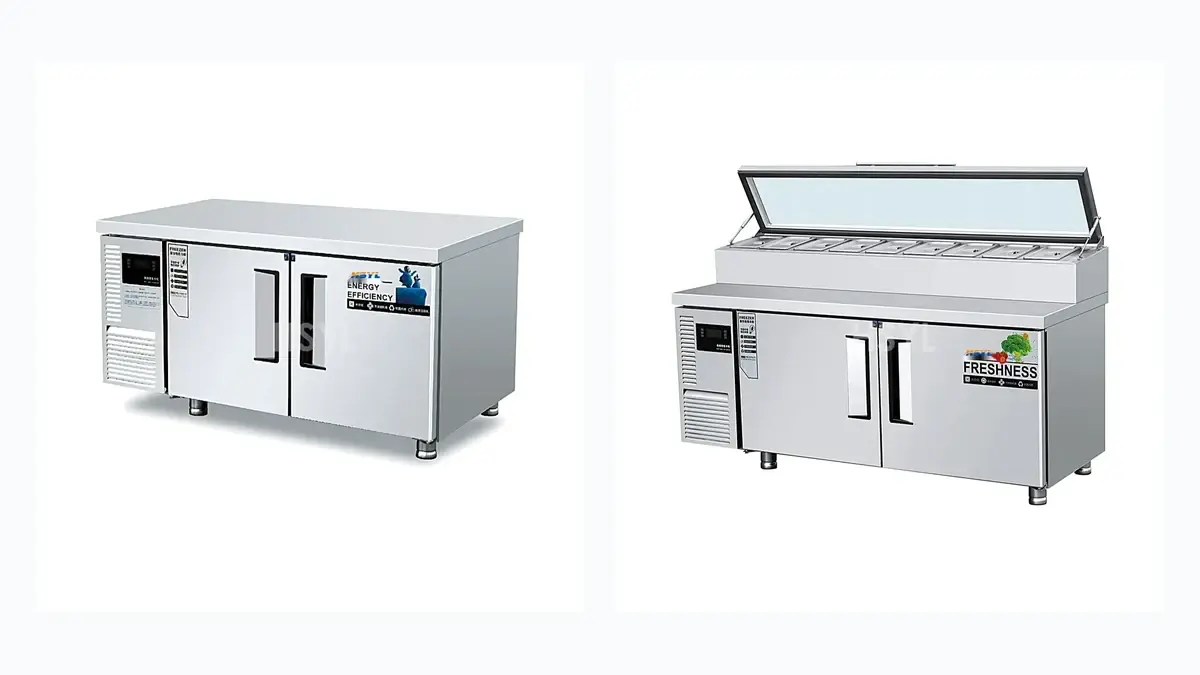
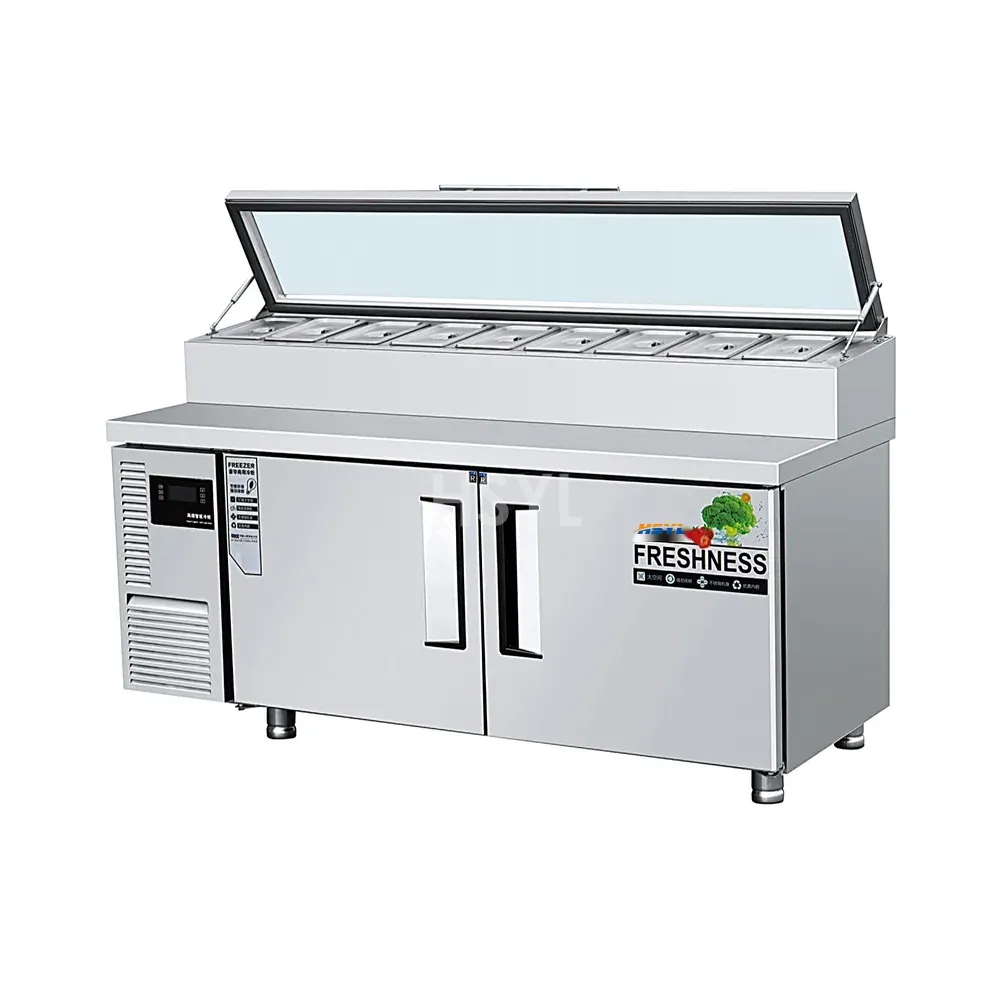
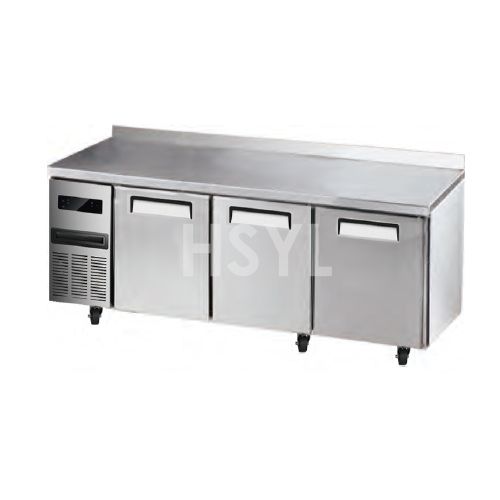
ECUR18-2, 800 mm deck height, left) engineered for closed-door backup storage and countertop equipment mounting versus the ECUR18-2S fan-cooled salad prep table (1,050 mm total height with insulated top GN pan rail, right).Structural & Thermal Load Comparison of the Three Workstation Formats
- Commercial Undercounter Refrigerators: Built with a low-profile overall height (750 mm to 810 mm) and a non-structural top skin designed strictly to slide underneath an existing stone, wood, or custom stainless counter. Because an overhead counter overhang traps warm discharge air if the condensing unit vents upward or backward, undercounter units must utilize front-breathing louver grilles.
- Commercial Worktop (Workbench) Refrigerators & Freezers (
ECUR/EDUR/ECUF/EDUF): Engineered as self-supporting structural islands or cookline stations (800 mm working deck height, with optional 100 mm rear splashback to prevent liquids from dripping behind the cabinet). The top work surface is reinforced with high-density backing board and 60 mm foamed-in-place cyclopentane polyurethane insulation, allowing it to support heavy dynamic chopping loads or commercial countertop equipment (slicers, induction ranges, vacuum sealers, panini grills) while keeping the reach-in cabinet below completely sealed against ambient kitchen heat. - Salad / Sandwich / Pizza Prep Table Refrigerators (
ECUR-2S/XSDUF-SALAD): Features a cut-out top well that suspends standard Gastronorm (GN 1/3,GN 1/6, orGN 1/9) polycarbonate or stainless steel ingredient pans directly above the reach-in storage base, covered by a hinged insulated night hood (1,050 mm overall height). Because the hinged top lid remains open for 2 to 4 hours continuously during lunch and dinner rushes, a prep table experiences 2.8 × to 3.6 × higher latent and sensible infiltration heat loads than a closed-top workbench refrigerator.
Workstation Cabinet Conductive Heat Gain & Open-Rail Infiltration Governing Equations:
- Conductive Wall & Deck Heat Gain (Qcond in W):
Qcond = Σ ( (kfoam) / (Linsul) · Awall · (Tambient - Tcabinet) ) - Door & Open-Rail Moist Air Infiltration Load (Qinf in W per ASHRAE Refrigeration Handbook):
Qinf = mair · (hamb - hcab) · Fopen - Coefficient of Performance & Compressor Electrical Draw (Pelec):
Pelec = (Qcond + Qinf + Qproduct + Qfan) / (COPR290) - kfoam = Thermal conductivity of cyclopentane polyurethane (≈ 0.022 W/(m·K))
- Linsul = Cabinet insulation wall thickness (0.060 m / 60 mm on HSYL E Series)
- hamb - hcab = Enthalpy difference between humid kitchen air (38°C, 55% RH) and chilled interior (+4°C)
Evaporator Cooling Method: Forced-Air Fan Cooling (ECUR) vs. Direct Static Cold-Wall (EDUR)
When configuring cabinets from our Commercial Refrigeration Equipment range, buyers must choose between two fundamentally different internal heat-exchange architectures:
- Forced-Air Fan Cooling (
ECURRefrigerators,ECUFFreezers &ECUR-2SSalad Tables): An axial or tangential evaporator fan pulls cabinet air across a finned copper-aluminum evaporator coil and distributes a high-velocity cold air curtain across the shelves and underneath the top GN ingredient pans. Forced-air cooling eliminates thermal stratification (± 1.0°C cabinet uniformity), provides rapid temperature pull-down when doors are opened 40+ times per hour on an active cookline, and features automatic off-cycle or electric defrost. - Direct Static Cold-Wall Cooling (
EDURRefrigerators,EDUFFreezers &XSDUF-SALADStatic Salad Tables): Refrigerant copper tubing is serpentined and thermally bonded directly behind the inner stainless steel liner walls. Heat is absorbed via natural buoyancy convection and radiation without an internal evaporator fan coil box protruding into the storage compartment. Consequently, direct-cooled models yield 12% to 17% more usable internal liter capacity within the exact same exterior footprint (e.g., 520 L on theEDUR18-2 800vs. 445 L on theECUR18-2 800), maintain higher relative humidity (80%–85% RH) so uncovered dough balls, cake garnishes, and leafy greens do not crust or wilt, and cost less to maintain due to fewer moving fan components.
Engineering Specification & Footprint Matrix: 1.2 m vs. 1.5 m vs. 1.8 m Workstations
To match floor plans across narrow coffee bars (600 mm depth), standard European Gastronorm lines (700 mm depth), and heavy hotel commissaries (800 mm depth), HSYL manufactures 36 distinct workbench configurations and 9 fan-cooled salad prep table configurations. Compare the verified factory data from our E Series Workbench Refrigerator and Freezer Range, our ECUR-EDTR Fan-Cooling E Series Salad Table Fridge, our XSDUF-SALAD S Series Static Cooling Salad Table Fridge, and our QDUF & XSDUF Direct-Cooling Workbench Freezers:
| HSYL Model Series | Workstation Format & Cooling Method | Length × Depth × Height (mm) | Net Volume Capacity (L) | Operating Temp. Range | Refrigerant, Power & Insulation |
|---|---|---|---|---|---|
| ECUR12-2 (600 / 700 / 800) | 1.2 m Flat Workbench / Forced-Air Chiller | 1,200 × (600/700/800) × 800 | 160 L / 200 L / 240 L | +2°C to +8°C | R290 / R404A, 240 W, 60 mm Foam (58–62 kg) |
| ECUR15-2 (600 / 700 / 800) | 1.5 m Flat Workbench / Forced-Air Chiller | 1,500 × (600/700/800) × 800 | 235 L / 290 L / 345 L | +2°C to +8°C | R290 / R404A, 240 W, 60 mm Foam (62–70 kg) |
| ECUR18-2 (600 / 700 / 800) | 1.8 m Flat Workbench / Forced-Air Chiller | 1,800 × (600/700/800) × 800 | 305 L / 375 L / 445 L | +2°C to +8°C | R290 / R404A, 240 W, 60 mm Foam (65–74 kg) |
| EDUR12 / 15 / 18-2 (800 Depth) | 1.2–1.8 m Flat Workbench / Direct Cold-Wall | (1200/1500/1800) × 800 × 800 | 270 L / 360 L / 520 L | +2°C to +8°C | R290 (1.5 A), 240 W, High-Humidity Static |
| ECUF / EDUF 12 / 15 / 18-2 | 1.2–1.8 m Flat Workbench / Low-Temp Freezer | (1200/1500/1800) × 800 × 800 | 270 L / 360 L / 520 L | -18°C to 0°C | R290, 185 W, Air (ECUF) or Direct (EDUF) |
| ECUR12-2S (600 / 700 / 800) | 1.2 m Salad Prep Table / Fan-Cooled Pan Rail | 1,200 × (600/700/800) × 1,050 | 160 L / 200 L / 240 L | +2°C to +8°C | R290, 240 W (1.5 A), 10 cm Casters, 60 mm Foam |
| ECUR15-2S (600 / 700 / 800) | 1.5 m Salad Prep Table / Fan-Cooled Pan Rail | 1,500 × (600/700/800) × 1,050 | 235 L / 290 L / 345 L | +2°C to +8°C | R290, 240 W (1.5 A), Wanbao Compressor |
| ECUR18-2S (600 / 700 / 800) | 1.8 m Salad Prep Table / Fan-Cooled Pan Rail | 1,800 × (600/700/800) × 1,050 | 305 L / 375 L / 445 L | +2°C to +8°C | R290, 240 W (1.5 A), Full GN Pan Cutout Rail |
How Cabinet Depth (600 mm vs. 700 mm vs. 800 mm) Impacts Gastronorm (GN 1/1) Pan Orientation
A frequent procurement oversight when laying out a cookline—detailed in our Workbench Refrigeration Layout for the Cooking Line Guide—is selecting a 600 mm deep cabinet when the kitchen standardizes on full-size Gastronorm GN 1/1 pans (530 × 325 mm). Because the insulated front door and rear wall consume 110 mm to 120 mm of depth, a 600 mm deep cabinet has an internal clear depth of ≈ 480 mm—meaning a 530 mm GN 1/1 pan cannot slide in lengthwise on racking runners. To slide GN 1/1 pans or 600 × 400 mm bakery trays straight onto internal support ledges, always specify the 700 mm or 800 mm depth suffix (e.g., ECUR18-2 700 or ECUR18-2 800).
Regulatory, NSF/ANSI 7 Open-Rail Compliance & Cookline MEP Integration
Operating a refrigerated cabinet directly opposite commercial fryers, charbroilers, and wok ranges subjects the refrigeration circuit to severe thermal stress regulated by international sanitation and energy codes:
- NSF/ANSI Standard 7 Open-Rail Pan Performance (30°C / 86°F Open-Hood Test): Under NSF/ANSI Standard 7, closed-top storage worktables (
ECUR/EDUR) must maintain internal food temperatures at or below +4.4°C (40°F) inside a +38°C (100°F) ambient test chamber. Salad and pizza prep tables (ECUR-2S) face an even tougher certification test: with the top insulated pan hood completely open for 4 continuous hours in an 86°F (30°C) room, every single recessed ingredient pan must hold TCS toppings (sliced tomatoes, diced chicken, shredded cheese, sour cream) between +0.5°C and +5.0°C (33°F to 41°F) without freezing the bottom of the pan. Review our Commercial Refrigerator Temperature Zones & Storage Map for HACCP cold-holding logs. - ENERGY STAR & R290 Hydrocarbon Refrigerant Mandate: Per ENERGY STAR Commercial Refrigerator Specifications and EPA SNAP / EU F-Gas regulations, high-GWP hydrofluorocarbon refrigerants like R404A (GWP = 3,922) and R134a (GWP = 1,430) are being phased out in favor of natural R290 (refrigerant-grade propane, GWP = 3, ODP = 0). Because R290 possesses a 90% higher latent heat of vaporization and lower discharge gas viscosity than R404A, HSYL's R290
ECURandEDURworktables draw just 240 W (1.5 A at 220V) for chillers and 185 W for freezers—cutting daily kWh consumption by 28% to 35%.
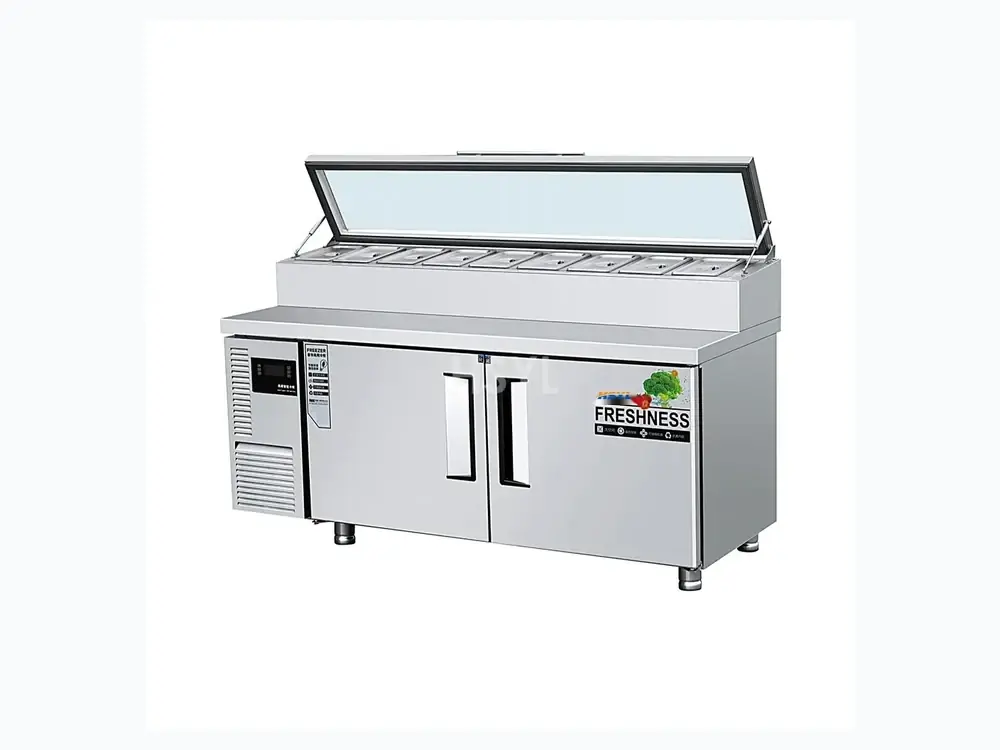
GN) top ingredient pan rail, protective stainless steel hinged cover, front digital Dixell/Carel thermostat controller, and ventilated side-mount condensing compartment.Condenser Airflow Clearance & GN Pan Flange Sealing Rules
Two installation mistakes account for over 75% of warranty service calls on commercial prep tables:
- Starving the Condenser Coil of Make-Up Air: Every watt of heat removed from the cabinet interior—plus the electrical heat of the compressor motor—must be rejected into the room by the air-cooled condenser coil. Pushing a side- or rear-breathing workbench flush against a solid wall or adjacent fryer traps a pocket of 55°C (131°F) recirculating air around the condenser. Always maintain the specified breather clearance (50 mm to 100 mm) and brush grease-laden dust off the condenser fins every 30 days.
- Missing GN Pan Divider Bars or Using Shallow Pans: In a fan-cooled salad prep table (
ECUR-2S), the cold air curtain circulates inside the pressurized plenum directly underneath the GN pans. If a line cook removes a singleGN 1/6pan and leaves a 176 × 162 mm open hole in the rail—or uses dented pans without stainless adapter bars—the dense cold air spills out of the rail and humid 35°C kitchen air rushes directly onto the evaporator coil, icing up the evaporator fins within 90 minutes. Always keep every rail slot filled with snug-fitting 100 mm or 150 mm deep GN pans and close the hinged night cover between service rushes.
Cabinet Construction & Insulation Physics: 60 mm Cyclopentane Foam & Anti-Sweat Mullions
Why 60 mm Cyclopentane Polyurethane Insulation Outperforms 40 mm Budget Cabinets
Budget commercial undercounter refrigerators frequently cut manufacturing costs by reducing cabinet wall thickness to 35 mm or 40 mm. By Fourier's law of heat conduction (q = -k · Δ T / L), increasing the high-pressure injected cyclopentane polyurethane insulation thickness (40 kg/m3 closed-cell density) to a full 60 mm (2.36 in.)—as standardized on the HSYL ECUR-2S series—increases thermal resistance (R-value) by 50%. This thicker thermal barrier prevents exterior cabinet sweating in high-humidity tropical kitchens (>75% RH) and cuts compressor duty-cycle run time from 82% down to 48% during peak summer service.
Anti-Sweat Mullion Heaters, Self-Closing Torsion Hinges & Removable Gaskets
Where the two refrigerated doors meet at the center vertical post (mullion), cold conduction from the +2°C interior would ordinarily cool the exterior stainless steel strip below the kitchen dew point, forming condensation droplets that drip onto the floor. HSYL workbenches route either a warm refrigerant discharge-gas loop (hot-gas condensate evaporation tube) or a low-wattage perimeter anti-sweat element directly behind the door frame mullion, keeping the gasket seating face dry and mold-free. Heavy-duty torsion hinges automatically pull the door shut when opened less than 90° while locking into a stay-open 90°+ loading detent when staff are restocking GN 1/1 pans with both hands. Tool-free snap-in magnetic PVC/Santoprene dart gaskets pull out of their retaining track in seconds for nightly sanitization.
Hydrophobic Epoxy-Coated Evaporator Coils & Off-Cycle vs. Electric Defrost Logic
In salad and pizza prep tables (ECUR-2S), the copper-tube aluminum-fin evaporator coil is continuously exposed to volatile organic acids (acetic acid from vinaigrettes and pickled jalapeños, citric acid from sliced tomatoes, and lactic acid from fermented cheeses and sauerkraut). Uncoated bare copper and aluminum coils suffer rapid formicary (ant-nest) micro-pitting corrosion in acidic salad-bar atmospheres, leaking refrigerant within 18 to 30 months. Specifying an electrodeposition hydrophobic epoxy-coated evaporator coil isolates the copper-aluminum fins from airborne food acids while accelerating condensate water droplet shedding during defrost cycles.
For medium-temperature chillers operating at +2°C to +8°C (ECUR and EDUR series), microprocessor controllers execute an energy-free off-cycle fan defrost every 4 to 6 hours—temporarily halting the compressor while keeping the internal circulation fan running so +4°C cabinet air melts surface frost off the -6°C coil without electric resistance heating. Conversely, for low-temperature workbench freezers operating at -18°C (ECUF and EDUF series), an automated electric resistance defrost element or hot-gas bypass valve is triggered by a coil-mounted NTC thermistor probe, terminating defrost based on actual coil temperature (+8°C) rather than a blind timer to prevent cabinet temperature spikes.
5-Year Total Cost of Ownership (TCO), R290 Energy Savings & Cookline Labor ROI
To evaluate the 5-year lifecycle return of selecting an R290-powered HSYL ECUR18-2 800 (240 W, 60 mm insulation) or ECUR18-2S 800 Salad Prep Table over a legacy R404A thin-wall (40 mm) commercial prep refrigerator operating 24 hrs/day, 365 days/year in a 32°C kitchen, review the TCO ledger below:
| Cost Component (5-Year Cumulative) | Legacy R404A 1.8m Prep Fridge (40 mm Wall, 480 W) | HSYL ECUR18-2 800 Workbench (R290, 240 W, 60 mm) | HSYL ECUR18-2S 800 Salad Prep Table (R290, 240 W) |
|---|---|---|---|
| Initial Equipment Acquisition CAPEX | $1,150 (Thin-Wall 40 mm Import Unit) | $1,320 (Heavy 60 mm R290 Flat Worktop) | $1,490 (Heavy 60 mm R290 Top-Rail Prep) |
| 5-Year Electrical Power Consumption (Calculated at _ESCDOLLAR_0.15/kWh × 43,800 Operating Hours) | $2,365 (480 W at 75% Duty Cycle = 15,768 kWh) | $756 (240 W at 48% Duty Cycle = 5,045 kWh) | $914 (240 W at 58% Duty Cycle = 6,097 kWh) |
| 5-Year Spoilage & Top-Pan Thermal Loss (Dairy, Dressings & Cut Produce Discard) | $4,380 (≈ _ESCDOLLAR_2.40/day Warm Rail / Coil Freeze Loss) | $420 (Sealed Cabinet ± 1.0°C Hold) | $680 (Ducted Under-Pan Forced Air Curtain) |
| 5-Year Compressor, Fan & Gasket Service | $1,240 (1 Compressor Replacement + R404A Recharge) | $260 (2 Snap-In Gaskets + Condenser Cleaning) | $310 (2 Snap-In Gaskets + Night Cover Hinges) |
| Total 5-Year Lifecycle Cost (TCO) | $9,135 (High Energy & Spoilage Penalty) | $2,756 (Saves $6,379 over 5 Years) | $3,394 (Saves $5,741 + Eliminates Walk-In Trips) |
Engineering ROI Conclusion: Specifying an R290-charged HSYL ECUR or EDUR workbench with 60 mm cyclopentane insulation saves _ESCDOLLAR_1,609 in electricity alone over 5 years—more than paying for the entire refrigerator out of utility bill reductions while eliminating ingredient spoilage during peak cookline service.
Discuss Your Cookline Workstation Refrigeration Layout with HSYL Engineers
Send HSYL your cookline aisle width, ambient kitchen temperature profile, GN pan count, and required voltage/frequency. Our refrigeration team specifies forced-air or static R290 workbenches and prep tables tailored to your line. Contact HSYL for Commercial Refrigeration Specification Support.