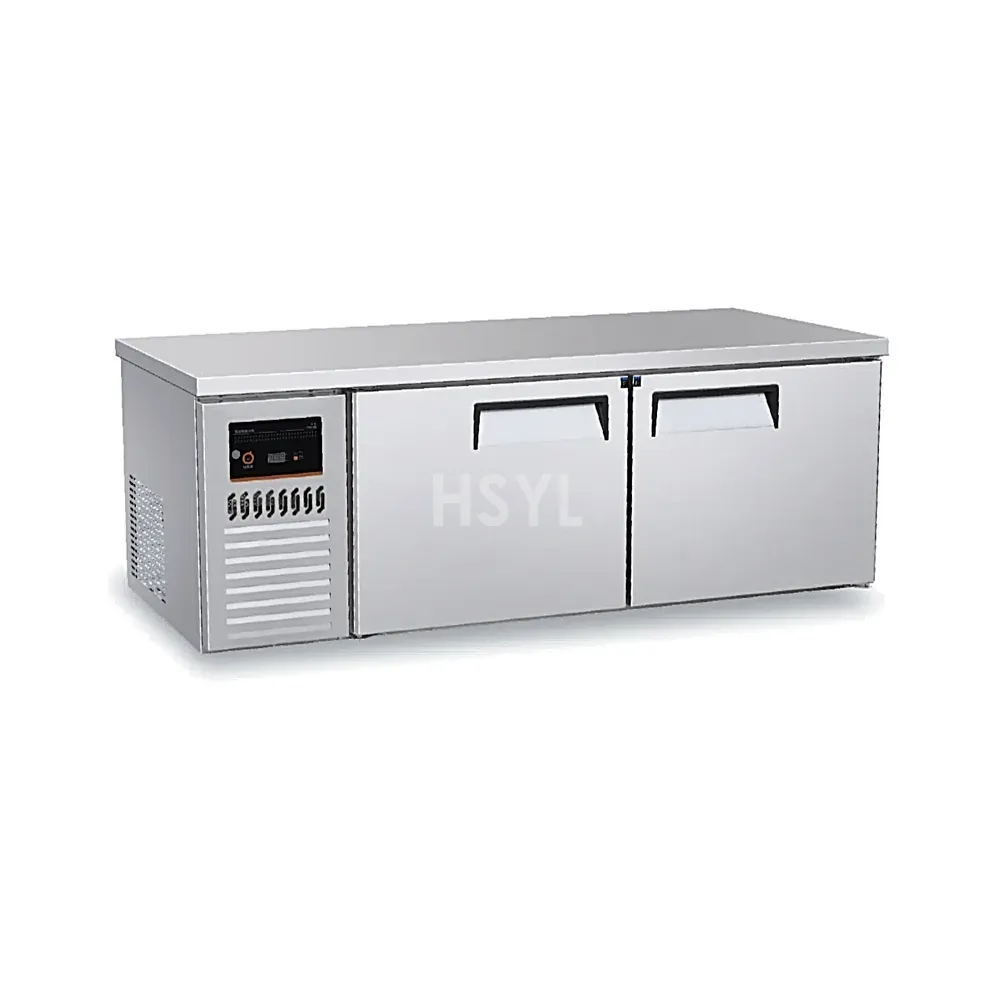
A workbench refrigerator cools one of two ways, and the choice shows up in three places: how much usable space you get, how evenly the air inside holds temperature, and how much frost you manage. Direct cooling puts the evaporator against the cabinet wall, so the cold comes from a surface and settles by natural circulation. Fan cooling runs a fan that pushes chilled air through the cabinet. On HSYL's own line the two methods sit side by side on the same frames — the direct-cooling QDUR and XSDUR workbench refrigerators against the fan-cooling E-series — which makes the comparison measurable instead of theoretical.
How the Two Methods Actually Differ
Direct cooling is simple: the evaporator cools the cabinet wall, the wall cools the air against it, and the air circulates on its own. It is the cheaper system, it draws less power, and its main cost is frost — because the evaporator surface runs below freezing, moisture in the cabinet condenses onto it and builds ice, which means manual defrosting and occasional temperature unevenness between the wall and the far side of the cabinet.
Fan cooling adds a fan that pushes chilled air through the cabinet and across an evaporator coil, so the whole cabinet holds a more uniform temperature and frost forms on the coil instead of on the food. The cost is a higher continuous power draw and, if the fan runs hard against uncovered food, faster surface drying. The trade is evenness and low-frost against energy and a slightly drier cabinet.
The Capacity Difference Most Buyers Miss
The surprising part is what each method does to usable volume on the same footprint. The direct-cooling EDUR18-2 800 documents 520 litres on a 1800 × 800 × 800 mm frame, where the fan-cooling ECUR18-2 800 documents 445 litres on the identical frame. The gap exists because the fan and evaporator coil occupy space inside a fan-cooled cabinet, while a direct-cooling cabinet packs its evaporator into the wall and leaves the interior open. A 75-litre difference on the same bench footprint is real — it is roughly the difference between fitting the full prep load or spilling over onto a second unit.
The pattern repeats across the range: the direct-cooling models consistently document more litres per linear metre than their fan-cooled equivalents, because the cooling hardware is in the wall, not in the box. If the workbench is where the cooking line stages its busiest refrigerated product, that interior space is worth more than the energy saving.
Energy and Evenness
The energy trade runs the other way in a way spec sheets make easy to misread. The direct-cooling QDUR series documents 165 W, where the fan-cooling E-series workbench documents 240 W. The fan machine draws more, but it also cycles more predictably and holds a tighter temperature band across the cabinet — so the right comparison is power draw against what the load actually needs. A workbench full of sealed, short-hold product is fine with direct cooling and its lower draw; a cabinet opened constantly through service, or holding product that must stay within a tight temperature band, is where the fan's evenness pays for the extra watts.
Both lines run R290 refrigerant — a natural hydrocarbon refrigerant with a low global-warming impact — which matters for export markets with tightening refrigerant regulations. The fan-cooled E-series workbench also lists R404A/R290 across its configurations, so confirm the refrigerant on the ordered build where a destination market specifies one over the other.
The Workbench Range at a Glance
| Series | Method | Capacity (1.8 m frame) | Power | Refrigerant |
|---|---|---|---|---|
| QDUR / XSDUR | Direct cooling | 520 L (EDUR18-2 800) | 165 W | R290 |
| E-series (ECUR) | Fan cooling | 445 L (ECUR18-2 800) | 240 W | R404A / R290 |
| E-series (EDUR) | Direct cooling | 520 L (EDUR18-2 800) | 240 W | R290 |
The full workbench and undercounter lineup sits under commercial refrigeration equipment, and the commercial refrigerator sizing guide covers the volume-versus-access question that follows once the cooling method is settled.
Related Equipment & Systems
Where the workbench sits on the cooking line is the next decision — the workbench refrigeration layout guide covers placement and workflow, and the refrigerator temperature zones guide handles the storage-map side once the cabinet is cooling correctly.