Commercial Deep Fryer for a Food Truck
Choose a food-truck fryer by peak demand, independent vats, utilities and working space. Compare HF model references and calculate the output your menu needs.
Choose a commercial deep fryer for a food truck by the food that must leave the service window during the busiest interval. Oil capacity and appliance width are useful dimensions, but neither proves the output your menu needs. Compare the complete frying cycle, independent oil vats, utilities and the space for draining and packing food.
A compact countertop fryer is not automatically a plug-in solution for a truck. A gas fryer is not automatically suitable for an onboard LPG system. The exact model and vehicle installation need to work together.
Calculate the frying duty before comparing tank sizes
Separate fries, battered items and any other products with different cooking conditions. Use the portion weight entering the fryer and the busiest order interval, not only total daily sales.
Illustrative demand calculation: 80 orders, each requiring 150 g of fries, consume 12 kg of product. If those orders arrive over 30 minutes, the average requirement during that interval is 24 kg per hour. Demand can still be more concentrated within the interval.
Now assume a trial produces an acceptable 1 kg batch every five minutes, including loading, cooking, unloading and readiness for the next batch. That sequence equals a theoretical 12 kg per hour before interruptions. It would not meet the example's 24 kg per hour requirement. A larger label on the oil tank would not resolve the mismatch without a different verified batch or cycle.
Possible responses include a faster demonstrated configuration, genuinely parallel frying, a different menu mix or another service arrangement. Two vats do not automatically double completed orders if one operator cannot load, drain, season and pack both streams.
One vat, two vats and two baskets are different choices
| Configuration | Reason to consider it | Limitation |
|---|---|---|
| One vat with a suitable basket arrangement | A focused menu sharing compatible oil and temperature conditions | Every product uses the same oil volume and temperature setting |
| Two baskets in one vat | Separate handling of batches using the same oil | Does not provide separate oil or independent cooking temperatures |
| Two independently controlled vats | Different cooking temperatures, oil-use plans or separately managed product streams | Needs more installed space, services and an operating plan for each vat |
Independent vats can support ingredient separation, but they do not alone establish an allergen-free process. Utensils, preparation, loading and cleaning must follow the operation's allergen controls. If a quote says “double basket”, establish whether it means one shared vat or two independent vats before comparing prices.
Compare actual gas and electric references
The following are catalog and website references, not approved food-truck specifications. They make the electrical and physical differences visible before a vehicle suitability review.
| Reference | Published or catalog facts | Implication for the truck |
|---|---|---|
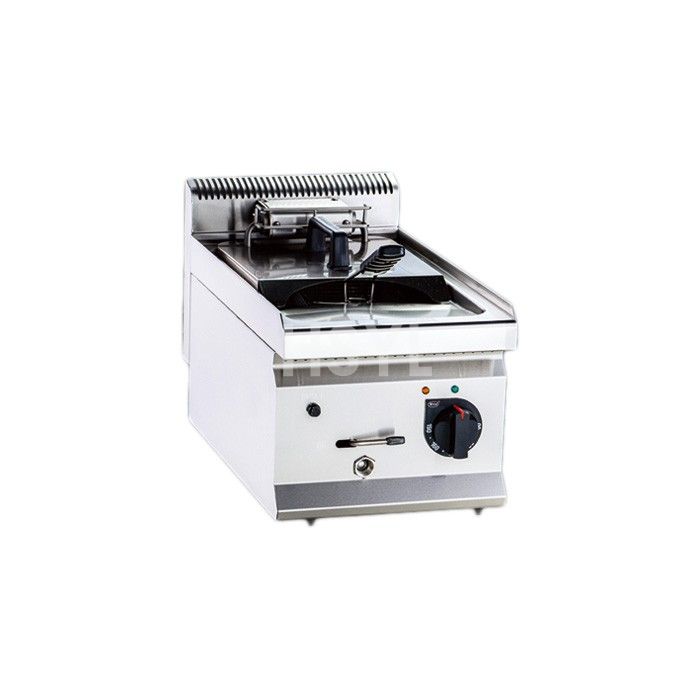
| HF6035E countertop electric fryer | 350 mm body width; Hualing catalog input 5.4 kW, 3N~380 V | A narrow appliance still needs a compatible supply, support and working area |
| HF6060E countertop electric fryer | 600 mm body width; Hualing catalog input 10.8 kW, 3N~380 V | The catalog input is twice the smaller reference; output must be checked separately |
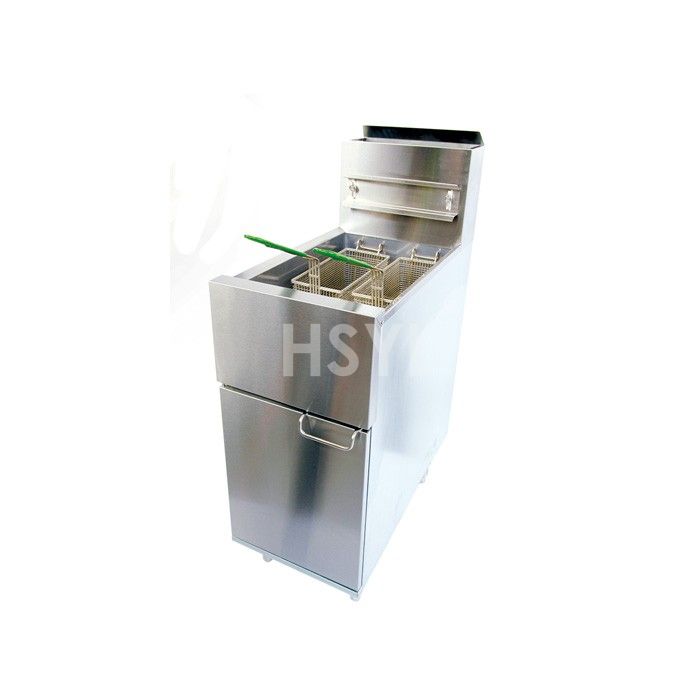
| HF7040-3G gas fryer | 25 L catalog capacity; 400 × 820 × 1163 mm body; 55.6 kg net weight | Review floor space, operating weight, gas configuration and extraction |
Compare the HF countertop electric fryer range and HF7040-3G gas fryer against the quotation for the exact unit. Catalog input is not a portions-per-hour rating. The gas fryer's 25 L entry is not a basket-load or usable oil-fill instruction.
When electric is worth comparing
Electric frying is a candidate when the site or onboard system can supply the required voltage, phase and load alongside other equipment. Compare the full operating schedule, including oven heating and compressor starts. Do not select protective devices or generator capacity from the fryer rating alone.
When gas is worth comparing
Gas frying is a candidate when the vehicle has an appropriate fuel system and the proposed installation can be approved. Include fuel storage, supply arrangement, ventilation and service access in the comparison. Electrical frying also produces grease-laden cooking emissions; changing the heat source does not remove that design issue.
Allocate space from loading to handoff
- Cold product staging: bring only the batch required by the operation's food-control procedure to the fry station.
- Frying: preserve access to baskets, controls and the approved operating area.
- Draining and finishing: provide a stable landing position where oil does not drip across the aisle.
- Seasoning and packing: keep this work from blocking the next batch.
- Collection: hand off the finished order without reaching over hot oil.
If the packing area can finish only one order at a time, adding fryer capacity may simply move the queue to that area. Run a full service trial with the intended number of staff and packaging.
Include the shutdown and transport routine
Oil handling requires space as well as a procedure. Identify how the selected appliance is shut down, cooled, drained or secured according to its instructions before the vehicle moves. Do not assume the fryer can travel with hot oil because it fits the floor plan.
Keep the manufacturer's cleaning and draining access available after installation. A tank valve hidden behind fixed furniture can make an otherwise suitable fryer impractical. Use the frying-duty selection guide to structure the product trial and output comparison.
Compare gas and electric fryer references
Compare the same frying duty, oil-management needs and installation scope across both fuel options. These product references do not establish approval for a vehicle installation.
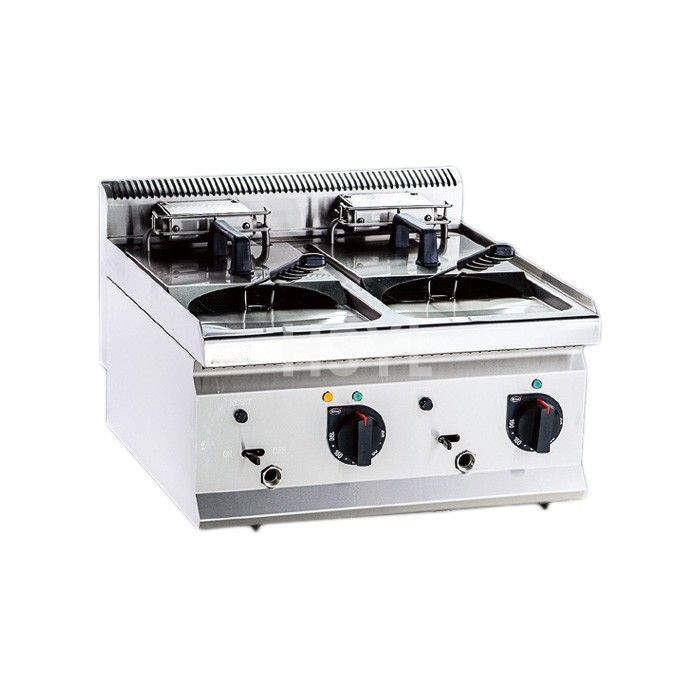
HF Electric Fryer Range
Compare independent vats and controls for the recipes you need to run together. Ask for the exact HF electric model, supply requirements and a representative loaded frying test.
View product detailsHF7040-3G Gas Fryer
Compare the HF7040-3G format where a suitable gas installation can be provided. Confirm gas configuration, working oil fill, clearances and the shutdown and transport arrangement before ordering.
View product detailsSend a requirement that can be priced accurately
Request a food-truck fryer comparison with the menu, portion weights, peak order interval, separation needs, utility details and station drawing. Ask for the exact vat arrangement, model data, installation conditions and mobile-use suitability. Compare the installed station and acceptable finished output rather than selecting the largest tank that fits.
Frequently Asked Questions
Does a fryer with two baskets have two independent oil vats?
Not necessarily. Two baskets may share one oil vat, one oil condition and one cooking temperature. If you need separate oil systems or simultaneous recipes at different settings, check the number of independent vats and controls on the exact model rather than counting baskets in a photograph.
Can I calculate hourly food output from the oil capacity?
No. A 25 L catalog capacity does not state the food output per hour or the permitted working fill. Output depends on the product, batch size, recovery and the complete loading, cooking and unloading cycle. Use a repeatable trial with your menu item, and follow the selected model's instructions for oil fill.
Is one electric fryer always easier to install in a food truck than gas?
It depends on the vehicle's available services. Electric equipment may need a supply that the truck cannot provide; gas equipment brings its own fuel, installation and ventilation requirements. The HF6035E and HF6060E catalog examples list 3N~380 V. Confirm the exact electrical or gas configuration and mobile suitability before comparing installation cost.
Will separate vats guarantee allergen-free frying?
No. Separate vats can support separation, but shared utensils, storage, preparation surfaces, handling and cleaning may still cause cross-contact. Any allergen claim needs a complete, controlled food-handling process. Do not use a twin-vat equipment description alone as the basis for a customer-facing allergen guarantee.
How much spare capacity should I allow for a peak service?
First calculate the required finished output in the busiest service window, then compare it with a demonstrated complete batch cycle. If the trial only just meets demand, investigate queues, recovery, draining and changeover before selecting the unit. Use measured operating conditions to decide the margin; this guide does not prescribe a universal percentage.
Plan the Equipment Around Your Kitchen.
Share your menu, peak service demand, available space and site utilities. Tell us which equipment you are considering so we can review the requirements with you.