Commercial Drink Fridges
Choose commercial drink fridges by bottle facings, door traffic, restocking and site fit. Compare HSYL E Series dimensions and request a model-specific quote.
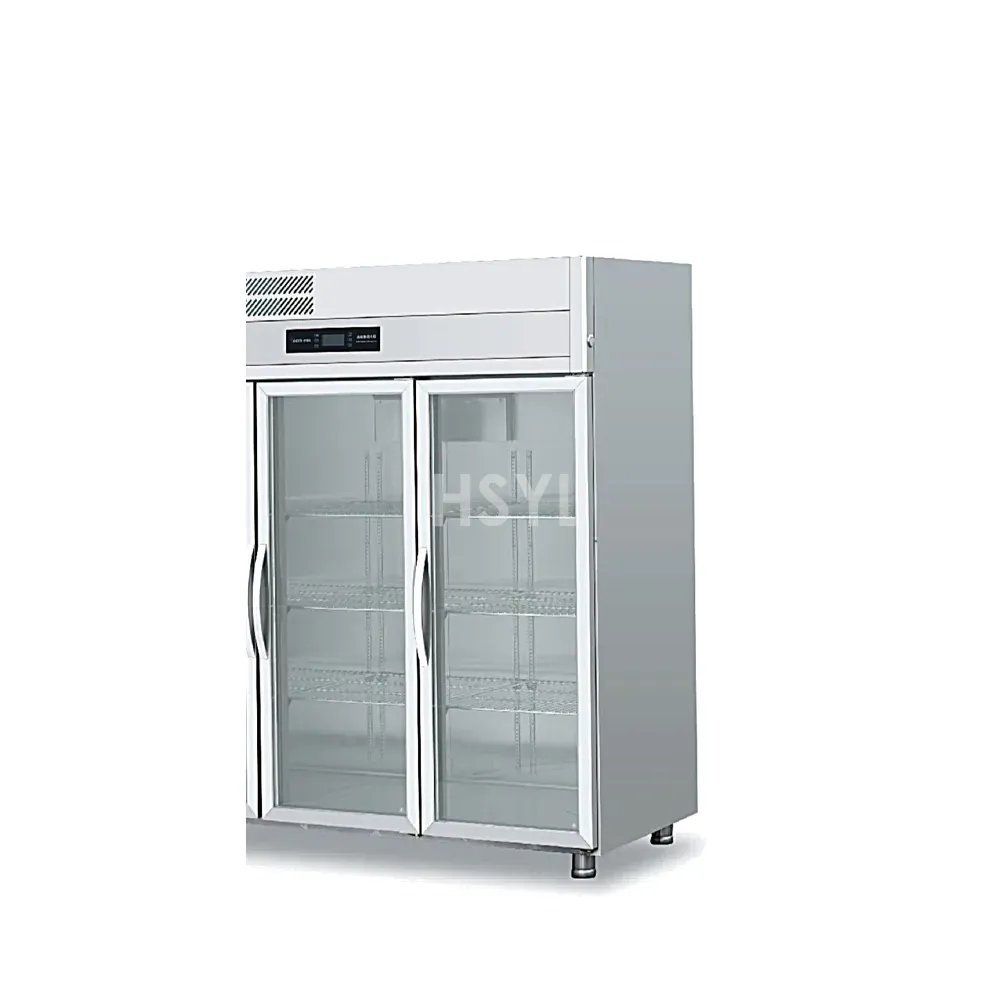
A commercial drink fridge has two jobs: keep packaged drinks within their required storage conditions and make the range easy to find, reach and replenish. A cabinet that has enough nominal litres can still fail at the counter if a door blocks the queue, tall bottles do not fit the shelves or staff must refill it during the busiest minutes. Start with the products and service pattern, then use cabinet dimensions to make a shortlist.
Work out the display before comparing litres
List every drink format you intend to show: can diameter, bottle height, pack depth and the number of varieties that need a visible front row. Measure the tallest bottle with its cap and leave enough room for handling above it. On a shelf sketch, draw the number of facings for each product. A facing is one visible position, not the total quantity stored behind it. If staff cannot reach the rear stock without moving the front row, count that as slower replenishment rather than usable display capacity.
Next, record when the cabinet is refilled. A café with staff access behind the counter can use a different arrangement from a self-service lobby where guests open the door repeatedly. Ask for a loaded-cabinet demonstration using your actual bottle sizes and door-opening pattern; an empty-cabinet temperature display does not describe recovery during service.
Use published model dimensions as a shortlist
HSYL's E Series display refrigerator page lists both direct-cooling and air-cooling glass-door variants. The table below selects three refrigerator examples from that published range. It is a space-planning reference, not a final order specification. Verify the current data sheet and quotation for the exact model before purchase.
| Published model | Door layout | Nominal capacity | External dimensions | Best question to test |
|---|---|---|---|---|
| EDTR24-1G | Single glass door | 380 L | 610 × 760 × 1950 mm | Does one door give enough visible facings without blocking the counter? |
| EDTR48-2G | Two side-by-side glass doors | 870 L | 1220 × 760 × 1950 mm | Can staff replenish one side while customers use the other? |
| EDTR72-3G | Three glass doors | 1370 L | 1830 × 760 × 1950 mm | Is there enough frontage and aisle clearance for all doors in use? |
All three rows are listed as direct-cooling refrigerators with a published 2–8 °C operating range. That range is a catalogue value, not proof that every bottled product is suitable for it or that the loaded cabinet will hold the same temperature in every room. Check the drink producer's storage instructions and the cabinet's performance under the actual site conditions. HSYL also publishes ECTR air-cooling equivalents; select between methods by the tested temperature behaviour, maintenance routine and site conditions of the chosen model rather than assuming one method always wins.
Check the installation route and everyday access
- Door swing and queue: draw each door fully open on the floor plan. Keep the serving and wheelchair-access routes workable when someone is selecting a drink.
- Delivery path: compare the cabinet's packed dimensions with lifts, doors and turns; the operating dimensions alone do not describe the crate.
- Heat rejection: obtain the selected model's installation clearances and keep condenser access open for cleaning. A flush-looking layout is of no value if the unit cannot reject heat or be serviced.
- Power and local compliance: the cited E Series direct-cooling rows list 220 V, 50 Hz and R290. Verify supply, plug, refrigerant-handling rules and destination-market requirements for the actual unit; do not infer that every market receives the same configuration.
Compare another display-cabinet footprint when aisle depth is tight
The published E Series EDTR24-1G is 610 × 760 × 1950 mm. HSYL also lists a Q Series glass-door refrigerator, QDTR24-1G, at 600 × 700 × 1950 mm on its Q and S Series display-cabinet page. These external dimensions make the Q Series worth comparing where cabinet depth constrains the aisle; they do not establish usable shelf space, required ventilation clearance or loaded temperature performance. Ask for the internal shelf drawing and installation clearances for both quoted models, then place the actual drinks and door swing on the site plan before selecting either one.
Request evidence for the cabinet that will ship
HSYL's company page describes cabinet foaming and refrigeration-circuit vacuum and leak-detection equipment. That description is not a test record for the particular fridge in your quotation. Before release, agree which checks will be witnessed or documented for the selected model and configuration.
- Match the model and unit identity on the data sheet, nameplate, inspection record and packing list.
- Ask which circuit-integrity and door-seal checks apply to this unit, and request the recorded result and test method where these are contract requirements.
- If temperature recovery matters in service, agree a representative bottle load, ambient condition, door-opening sequence, probe positions and acceptance criterion before the test. Do not accept an empty-cabinet display reading as a loaded result.
Use the factory acceptance checklist to record agreed checks, deviations and release documents.
Send a quotation request that can be checked
Supply a floor plan, the drink size list, target number of facings, expected door openings during the busiest hour, replenishment frequency, room temperature, electrical supply and destination market. Ask HSYL to return the exact model code, shelf layout, clearances, tested operating conditions, accessories, warranty scope and packing dimensions. Compare the response with the site drawing and a loaded sample arrangement before approving the order.
Review the E Series display refrigerator range for the current product table. If customers do not need to see the stock, compare a solid-door cabinet using HSYL's display-versus-storage guide before paying for glass-door frontage.
Frequently Asked Questions
Can I convert 380 L directly into a bottle count?
No. Nominal litres do not describe shelf spacing, bottle shape, air gaps or the number of visible facings. Request internal shelf dimensions and test a layout using the actual package sizes.
Should I choose air cooling for every busy drink display?
No. HSYL lists both direct- and air-cooling E Series configurations. Compare loaded temperature performance, door-opening pattern, defrost and cleaning requirements for the quoted model under your site conditions.
Plan the Equipment Around Your Kitchen.
Share your menu, peak service demand, available space and site utilities. Tell us which equipment you are considering so we can review the requirements with you.