Commercial Food Slicer
Choose a commercial food slicer by food condition, maximum loading size and finished cut. Compare meat-slicer references and plan a useful product trial.
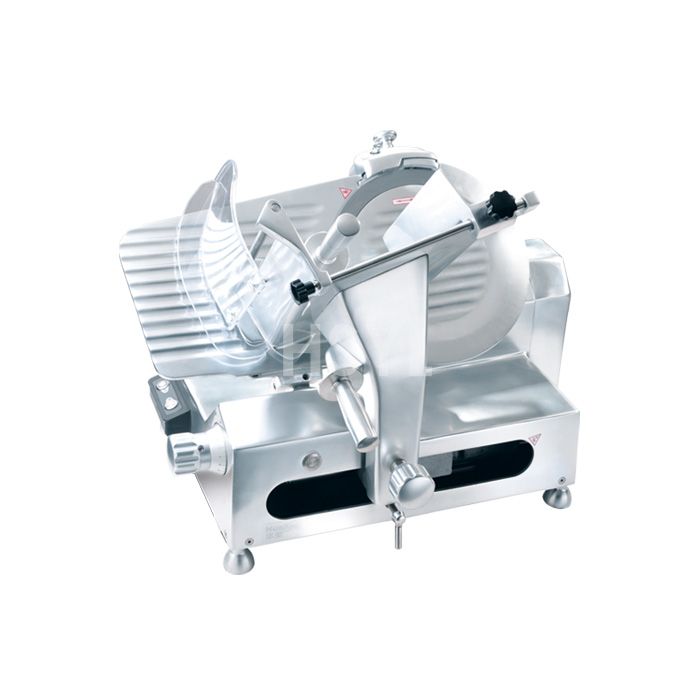
“Commercial food slicer” describes a buying task more broadly than a single machine type. Meat portions, cheese blocks, vegetables and bakery products can require different cutting mechanisms and handling methods. Identify your food and finished cut first; then shortlist machines explicitly suited to that duty.
Write the cut requirement in one sentence
Describe the food, its temperature and condition, the largest piece entering the machine, and the result leaving it. For example, a request for uniform slices from a boneless meat block is different from a request for strips, diced pieces or bread slices. Include bones, rind, crust or other difficult features rather than assuming they can pass through the same cutter.
Send photographs with a ruler and a sample of the desired result. If thickness or portion weight matters, state the acceptance range you need. Equal thickness does not guarantee equal weight when the food's cross-section changes.
Distinguish two meat-cutting references
| Reference | What the published data shows | Question it leaves to resolve |
|---|---|---|
| HB-320 | 320 mm blade diameter, 230 mm maximum cutting height and a listed 0–18 mm thickness range. | Will your largest piece fit the complete loading envelope, and will your food produce the required slice? |
| HCS500 | A separate cutting arrangement with published 3.5 mm and 5.0 mm blade-gap references. | Which assembly is offered, and what finished shape does it produce with your product? |
A blade diameter is not a substitute for maximum loading dimensions. Likewise, a blade gap does not by itself prove the final cut size, shape or quality. Ask for a demonstration of the exact configuration instead of treating these as interchangeable slicers.
Use a trial that measures usable output
Run your representative product at the intended starting temperature. Record loading, cutting, unloading and interruptions. Keep damaged slices, ends and rework separate from acceptable product.
Illustrative trial calculation: if 180 acceptable slices are collected during an 18-minute observed task, the average is 10 acceptable slices per minute for that task. That is not an all-day rating. Cleaning, product changes, replenishment and approved rest periods still belong in the shift plan.
Inspect more than a neat stack at the end. Check the beginning and end of the piece, thickness consistency, tearing or smearing, and how much handling is needed to separate or collect slices. These observations can change the choice even when two machines quote similar mechanical speeds.
Keep the acceptance record specific
- Food identity, temperature, starting dimensions and preparation.
- Machine model, blade or cutting assembly and settings.
- Observed time, acceptable output, waste and interruptions.
- Required staff actions and the supplied guarding arrangement.
- The agreed quality criteria and any limits found during the test.
Check changeovers before fixing the workstation
A machine used for several foods must have a workable cleaning and changeover procedure for those uses. Ask which parts are removable, how the blade is handled under the supplied instructions and where cleaned parts are placed. Include allergen separation in your operating plan where relevant. Do not bypass guards or improvise access to a blade to save changeover time.
Also check the bench or floor support, operator reach, finished-product collection and the exact power supply. Published voltage alternatives are not proof that one supplied machine can use every voltage without modification.
Request the right machine family
For meat slicing, use the references above to start a discussion. For cheese, vegetables, bakery products or mixed duties, ask for a machine and cutting system explicitly approved for the named food. A meat-slicer photograph is not evidence of universal food compatibility.
Related Products
These are meat-cutting references with different cutting arrangements. Use your food sample and required finished cut to decide which configuration to investigate.
HB-320 Commercial Meat Slicer
Review this adjustable meat-slicing reference when individual slice thickness and the loading envelope are central to the job. Confirm suitability for the actual meat condition.
View product details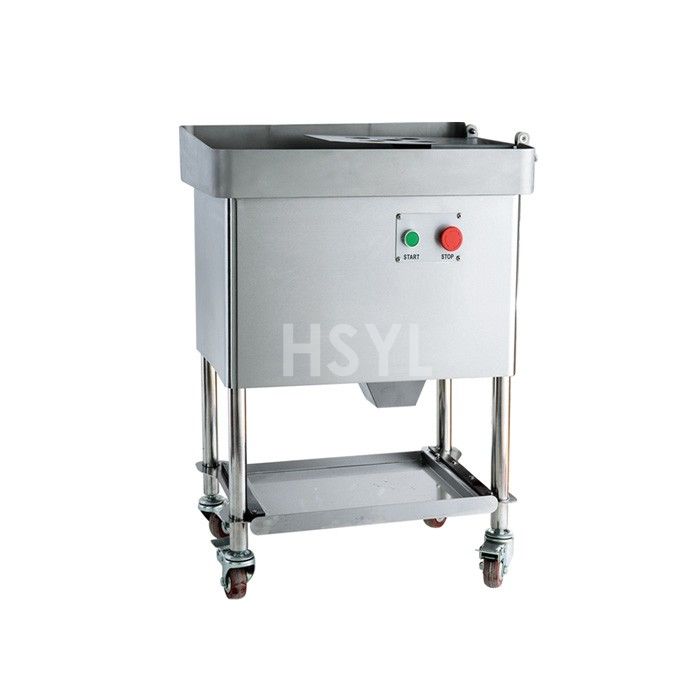
HCS500 Commercial Meat Slicer
Review the offered blade-gap assembly when a different meat-cutting setup is required. Ask for the finished shape and usable output to be demonstrated with your product.
View product detailsSend HSYL the food sample description and desired cut, along with the peak preparation window and site supply. Request a suitability response and trial scope before final model selection.
Frequently Asked Questions
Does the 0 mm end of a thickness range mean the machine makes a zero-thickness slice?
No. A published adjustment range can include the closed setting. Agree on a practical slice target and demonstrate it with the intended food.
Can I infer continuous-duty capability from motor power or machine weight?
No. Request the permitted operating duty and instructions for the exact model. Weight and motor power alone do not establish how long it can run under your load.
Plan the Equipment Around Your Kitchen.
Share your menu, peak service demand, available space and site utilities. Tell us which equipment you are considering so we can review the requirements with you.